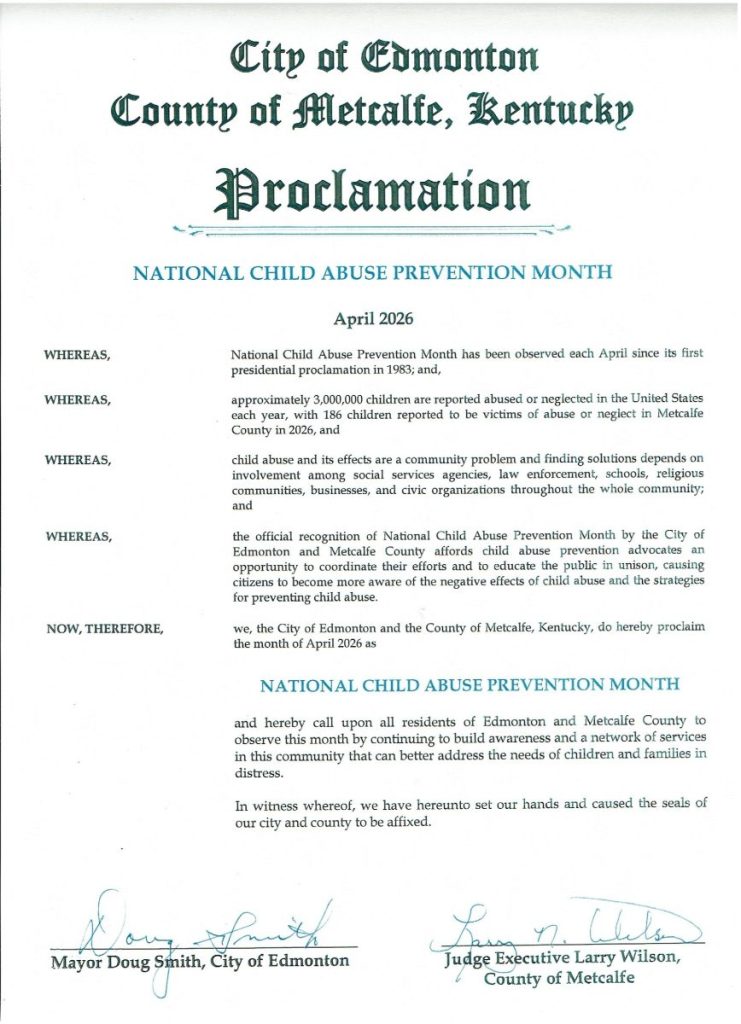
National Child Abuse Prevention Month
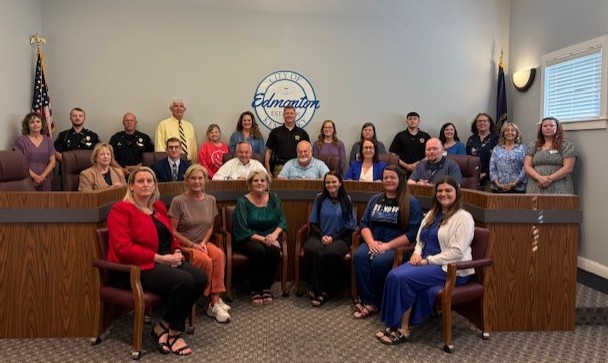
Front row (L-R): Rachel Dial, Director of Instruction, Metcalfe Co. Schools; Lori Eskridge, Metcalfe Co. Family Resource; Alisha Rowe, CHFS Admin. Spec.; Jaylan Ford, CHFS Social Service Worker; Tiffany Miller, CHFS SSW; Kelly Branham, SSW; Row 2: Sharon Howard, Attorney; Brad Wanken, DPA; Larry Wilson, J/E Metcalfe; Doug Smith, Mayor Edmonton; Mica Pence, Family Court Judge; Jonathan Daniel, CHSF FSOS; Back row: Gina Gibson, Chamber President; Edmonton Officer Chase Conrad; Edmonton Police Chief David Robertson; Tommy Garrett, Circuit Court Clerk; Teresa Hamlett, Edmonton Council Member; Leah Thompson, Executive Director BRACAC; Metcalfe Sheriff Lonnie Hodges; Megan Harper, Circuit Court Clerk, Deputy Clerk; Micah Reece, Victim Advocate, Commonwealth Attorney’s Office; Metcalfe Officer Alex Montel; Misty Morgan, CHFS SRAA; Lucena Davis, RN, Nurse Consultant; Debbie Vinnahme, Education Coordinator, BRACAS; and Rachel Leach, MDT Coordinator, BRACAC. Photo | PJ Martin
Staff Report
“Pinwheels are recognized nationally as the symbol of child abuse prevention; local displays reflect participation in this movement”, stated Alisha Rowe, Cabinet for Health and Family Services, Protection and Permanency. Rowe went on to provide some tragic statistics.
“The goal is to help all children grow up in safe, stable, and nurturing communities, emphasizing prevention before abuse occurs through broader public understanding and involvement.”
Child abuse does harm to the developing brain, which leads to long-term health, social, and emotional problems. The impact on the community includes increased healthcare, criminal justice, and education costs, and reduced worker productivity.
Healthy family relationships help to reduce the shock that the abuse has on children’s development.
The most recent numbers show that Metcalfe County had 118 reports that met the criteria for abuse, 89 unique families in reports, 186 unique children in reports, and 40 substantiated reports of abuse. Every single case is one too many!
Kentucky ranked fifth highest in the USA for child abuse. The U.S. Department of Health and Human Services, Children’s Bureau, “Child Maltreatment Report” findings show 14.1 maltreatment victims per 1,000 children (about 14 in 1,000). This rate is similar to 2023’s. Most victims in Kentucky and nationally are younger than one year old.
However, the number of victims in Kentucky decreased by 13% compared to 2020.
Norton Healthcare Resources highlighted concerns about reporting for infants with prenatal substance exposure. Only 23.7% of Kentucky’s substance-exposed infants had a plan for safe care, placing Kentucky third lowest among reporting states.
The Kentucky Child Fatality and Near Fatality Panel has long noted that many child fatalities or near-fatalities involve substance-exposed infants without a plan for safe care. The national report aligns with these panel observations.
Kentucky ranks eighth highest for caregivers with substance disorders: nearly 40% versus a national average of about 25%.
Prevention begins with helping to strengthen families. When families are overwhelmed, children are more vulnerable. Small, thoughtful gestures from friends, neighbors, and extended family can reduce parental stress and support child safety. Strong, supportive families create safer environments for children.
Rowe stated that she was thankful to have adopted three children from within the system, as reflected by these statistics.
She added, “If each family helped one child, the outcomes would improve.”
Many children need simple acts of care—hugs, kind words, and often lack consistent, loving routines such as shared family meals.
Family Court Judge Mica Pence then spoke about the importance of small, practical acts of support and especially short-term caregiving, and how it can greatly help families under stress.
“Providing a safe caregiver for a night” can give parents a needed break; small actions can make a big, big difference.”
Also, support should extend beyond the child to the entire family experiencing stress. Whether it is financial stress and/or challenging family situations that can change people’s behavior.