The Opioid Settlement: Distribution of Funds – Who Will Benefit?
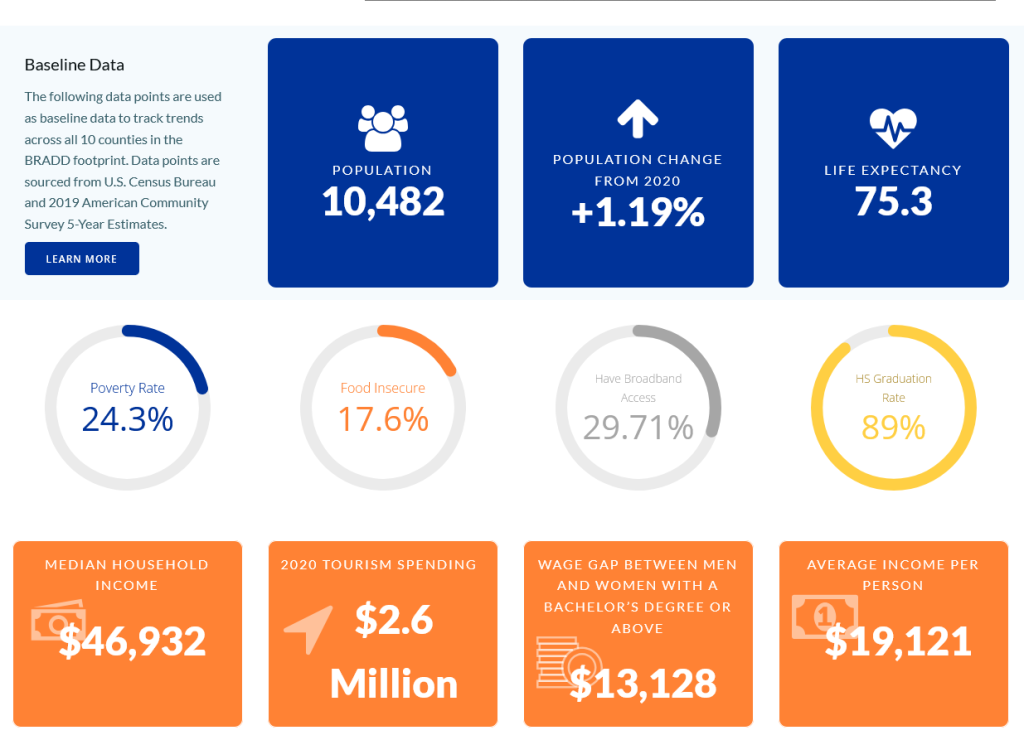
Source: BRADD.org – Metcalfe County data points are sourced from U.S. Census Bureau and 2019 American Community Survey 5-Year Estimates.
By PJ Martin
Editor
The Herald-News
The opioid crisis continues to devastate families and communities across the Barren River Area Development District (BRADD). Millions of dollars from opioid settlements are flowing into Kentucky, offering a potential lifeline. But how are these funds being used locally to combat addiction and its devastating consequences?
Half of the proceeds from the opioid settlements are being allocated to counties, cities, and local governments. In this article, we will explore how these funds are being used and the challenges in deciding the best ways to allocate them.
Various county and city treasurers have reported keeping the opioid funds received in interest-bearing bank accounts. They remain uncertain as to the best use of the fund and have been advised by the 10-county BRADD to hold off on spending the funds as a project is underway.
Metcalfe County has received $133,124.73 in opioid funds as of June. The only recorded expenditure so far is $918 for substance abuse speaker Jared Thomas, who spoke to students about his journey to overcome alcohol and drug addiction, in collaboration with the local school system.
Neighboring Monroe County has received $354,844.04 in opioid funds as of June. Their expenditures include a $1,000 contribution to BRADD and a $10,000 contribution to the Monroe County Health Department.
So, what is this BRADD project everyone is anticipating, and why hasn’t there been more public discussion about it? The community seems largely uninformed.
The Anchor Project is a collaborative effort among multiple organizations to address the opioid epidemic in the BRADD area. It is the first project of its kind in Kentucky and aims to provide integrated treatment programs that address key issues contributing to the legal system backlog and the rise in homelessness.
Opioids are a big contributor to the cause of death in the region, with mental health issues impacting 1 in 5 individuals. The project’s goal is to establish a facility that can address both medical and mental health needs in a single location.
In 2023, a group, consisting of county judge executives, medical center administrators, and state senate representatives, traveled to the Life Learning Center in Northern Kentucky to view its 12-week transformation program and view the results.
Later in 2023, a larger group with much the same composition visited the Nashville Mental Health Cooperative – Crisis Treatment Center. The center consists of a crisis unit, detox unit, call center, and a mobile operation unit. The 24/7 triage helps law enforcement provide prisoners/patients with the appropriate care in minutes.
These visits resulted in the formation of a committee and the regional opioid symposium idea was born. The symposium brought together representatives of many sectors of law enforcement, judicial, social work, community medical, practitioners, corrections, and legislators on September 18, 2023. Approximately 200 people attended and brainstormed ways of using the funds to combat the drug crisis.
From that point forward, four key partners, Med Center Health, LifeSkills, BRADD, and the Barren River Health Department District continued to meet and major projects resulted.
BRADD created the Barren River Office of Drug Control Policy (OCDP) and the advisory committee to serve as the decision makers and oversee the best use of federal, state, and local funds, including the opioid abatement fund.
In April of 2024, the Kentucky General Assembly allocated $20 million for the regional pilot of the project for Fiscal Years 2025/2026.
In December 2024, BRADD announced that Stengel Hill Design and Construction Firm had been selected to begin design of the Crisis Intake Center.
Then, in March of 2025, BRADD convened the third regional opioid advisory meeting, and during that same month, announced the appointment of Kelly Construction, Inc. as the Construction Manager for the project.
Phase I – Mental Health Crisis Intake Center (MHCIC)
Construction is set to begin in 2025. Investment $20 million.
The preliminary schedule indicates that groundbreaking for the MHCIC took place in May. This center will be modeled after a similar facility in Nashville, TN, and will be situated on a 6-acre site owned by LifeSkills on Suwanee Trail Road, in Bowling Green. In proximity to Fairview Medical Center and the emergency room at Greenview Hospital.
The center will offer round-the-clock mental health support, providing professional assessments and treatment. It will include mental healthcare, rehabilitation, and pharmacy services in one location.
The project is partnering with law enforcement to streamline transfer and referral processes to the center for treatment. In certain cases, individuals may be directed straight to treatment, bypassing the court system.
Phase II – The Life Learning Center
Construction to begin late 2025 to early 2026 with an investment of $1.3 million in appropriations of funding from federal and state.
The facility has a possible location in Horse Cave, located in Hart County. The center will provide long-term programs to help patients build their lives anew and be independent. It will provide the programs to move from recovery to work by means of training, education, and job readiness. The operations are scheduled to begin in late 2025 to early 2026.
The estimated two-year start-up cost is $1.3 million. That funds five full-time employees and a small operating budget per BRADD documentation.
Phase III – The Office of Drug Control Policy (ODCP)
Opened in December 2024. Investment $1.5 million funded by appropriation from federal, state, and local governments.
Created in December 2024, the Office of Drug Control Policy (ODCP) oversees the Anchor Project’s various phases. The members are from the various work groups that deal with opioid use, such as multiple law enforcement personnel, various types of health care personnel, social services, local government leaders, and faith-based representatives.
The ODCP is tasked with assisting local governments in the development of policies concerning drug and mental health issues. The office is also the link to assisting the city and county governments with the best uses for the Opioid Abatement Funds for prevention, treatment, and recovery.
Keep reading The Herald-News as we keep you updated as the project information is provided.
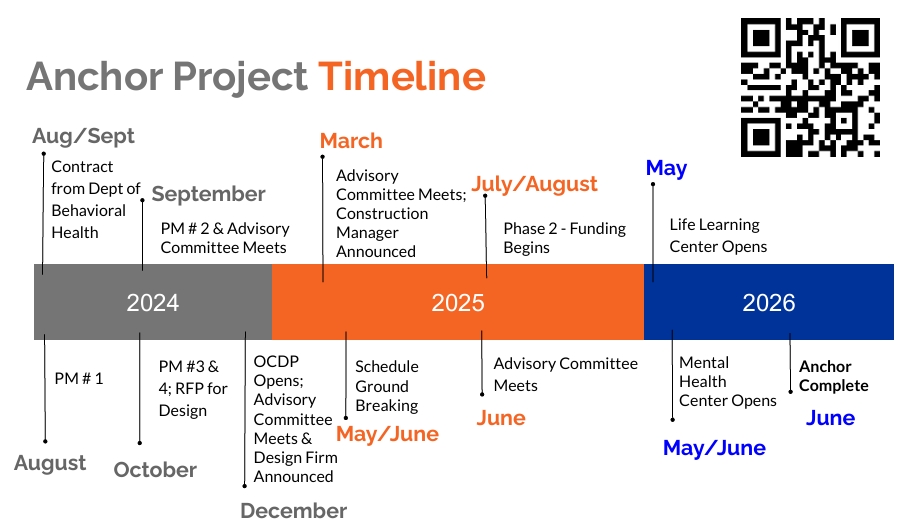
Remaining section of timeline for The Anchor Project Source: BRADD.org