Leaving a Legacy
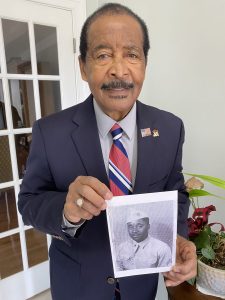
1.Jerry Bransford holds a photo of his father, David C. Bransford. Jerry recently shared his father’s story. Photo submitted.
Mary Beth Sallee
Editor
Hart Co. News-Herald
The legacy of a man is defined by the actions he takes in life and the impact it has on those around him. And if a man’s legacy is to be fully understood, his story must be told.
This is the story of Sergeant David C. Bransford, United States Army, as told by his son, Jerry Bransford.
David Bransford was born in 1914 on Flint Ridge in Mammoth Cave. One of 13 children, including his twin sister Doretha, David was raised among the caves, ridges, and woods of the place he called home.
Around the age of 18, David’s father, John Henry Bransford, worked as a chef at the Mammoth Cave Hotel.
For the Bransfords and many other families, Mammoth Cave was the source of their livelihood. However, by 1926, the Mammoth Cave National Park Association was formed as a way to acquire land that would be needed for Mammoth Cave to gain entry into the national park system. In 1928, legislation passed that allowed for land to be acquired through condemnation proceedings. This resulted in the displacement of over 500 families from Mammoth Cave, the only place they had ever known as home.
The Bransfords were among those families. John Henry moved his family to Cave City, and David began working for a gas station called Lone Oak Camp. In the 1930s, David met Gladys in Glasgow. The couple married on Christmas Eve in 1939. Thus continued David’s legacy with a family of his own. Along came children, including Jerry, who was the second of four sons.
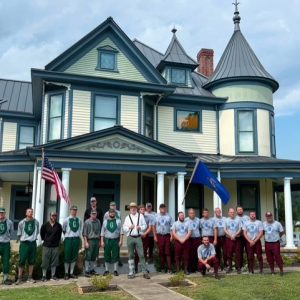
The United States Army soon came knocking on the Bransford door, as David was drafted during World War II. He received basic training at Fort Bragg, North Carolina as part of an “all-colored” troop.
“At that time, commissioned officers were typically Caucasian fellows, because there was a little bit of higher ranking,” Jerry Bransford said. “So there were very few commissioned black officers, but non-commissioned officers, there were several. But he said the com-commander would call them together each day. He’d say, ‘Men, you got to train hard. Some of you are gonna be going to war pretty soon.’”
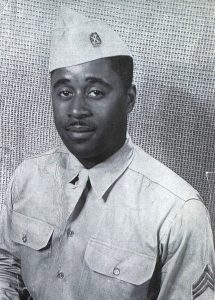
“My dad was a proud man of color,” Jerry Bransford said of his father, David C. Bransford (pictured here). “He was a good, honest, Christian man, and I miss him terribly.” Photo submitted.
Basic training for David was either eight weeks or three months, the best that Jerry could recall. But the story that David shared with his family regarding his troop’s last assembly has stayed with Jerry his entire life.
“They were aboard a train to travel to Jacksonville, Florida,” Jerry said. “At that time, the engines were steam engines, so occasionally, instead of getting diesel fuel or gas like we do, the train had to stop for water for the boiler because it was a steam engine. And he (my dad) said that whenever the train would stop along the way, the com-commander would go from car to car and told the black men to sit quietly and lower the shades because they didn’t want fellow Americans to know there was an all-black troop when they were (traveling) along the way.”
After arriving in Jacksonville for training, it was evident to David and his fellow black soldiers that, although they were serving the same country, they were still very much segregated. The line of inequality was still deeply rooted among races.
“There was a white side of the post and a black side of the post,” Jerry explained. “He said white guys could come over to your side of the post and maybe their com-commander had traded a ping pong table or something like that with the black troop. He said the white guys could come over to their side of the post and get a volleyball or a ping pong set. But he said, ‘We dare go over there.’”
Despite the inequality plaguing America at that time, Jerry described his dad as a “very proud, patriotic black man.”
“His brother Arthur was actually in World War I even before dad (was in the army). He was 17-years-old,” Jerry said. “Daddy was very proud, very proud to serve, very content in being an American fighting man.”
There was one particular story that David once shared with his family that brought him hope in what could often be a tumultuous time in the world.
“He told me at that time, if you sent correspondence back home to Kentucky, anywhere your family was, you had to go to Western Union to send a telegraph,” Jerry said. “And payday was a very busy time…A lot of soldiers were there to conduct business. So, dad came up to Western Union in Jacksonville, Florida one morning to send money back home to my mother and my oldest brother. And he said each time he would get to the front of the line, white soldiers would come into the office, and he was told to get to the rear…He said, ‘I finally went to the back of the room, and I guess I looked very dismayed and tired.’ A white captain, a man of authority, walked in. Dad said, ‘I didn’t know who he was or where he was from. He came right over to me and asked me what my business was there.’”
Jerry continued, “Dad said, ‘Sir, I’ve tried unsuccessfully to send a Western Union home to Glasgow, Kentucky to my wife and baby.’ He (the white captain) said, ‘Well, why haven’t you?’ He said, ‘Sir, well, each time I get to front of the line, the operator would tell me to get back there and wait my turn. And the captain said, ‘You come and go with me.’ He took my daddy to the front of the line and had white soldiers to move to the sides. He told the operator, ‘I want you to take care of this man. You take care of him right now, and I’m gonna stand right here and see that you do.’(My dad said), ‘And when I was able to have my business done, he walked me out to the parking lot, to the all-colored bus. And I never saw that man again. See, he must have been an angel. It seems so coincidental that this man from nowhere, somebody I never saw, did that for me.’”
“That story was so impactful to me all through the years,” Jerry said. “I thought about it for years, having that told, but now’s the time. Me being 78-years-old, it’s time for me to share that with the public.”
David served in the United States Army for five years, becoming a driver for a high-ranking general while stationed in Florida. But despite having been of service to his country for half a decade, despite the uniform he wore, it made no difference when it came to the color of his skin.
Jerry recalled another story that his dad shared with him.
“He said, ‘After being in the war for five years, I finally got to Louisville, Kentucky coming back to Glasgow, and I got aboard a Greyhound bus,’” Jerry said. “‘Each time a white passenger would get aboard the bus, then the black folks were told to move to the rear. Then when there was no seat, you had to stand.’ He said, ‘I stood the last few hours on the bus wanting to get to Cave City to get to Glasgow.’”
However, David’s character was one of resilience and perseverance. Jerry said his father never told any of those stories with anger or resentment.
Jerry shared a story of his own from when he was a youngster visiting Mammoth Cave with his father.
“When I was 12-years-old, we would go to Mammoth Cave at least three times a year,” Jerry recalled. “…We’d go up to Flint Ridge where dad said, ‘I used to run down this lane when I was 10-years-old, barefooted, and the church was over here, and I was baptized in the Green River down there.’ We would go to the hotel, and of course my dad knew that we had to go to the back door, and some of the people who worked at the hotel knew my father, a couple of white folks. They said, ‘David, how you doing?’ Daddy said, ‘Well, Miss Millie, this is my wife and my four boys here, and we’d like some ice cream cones. And she’d say, ‘Well, now David, you know you gotta go to the back door.’ He never made a fuss about that. I mean, he couldn’t. So we’d go to the back door and get our refreshments and go back up to the picnic area. I remember my mama said, ‘This is a federal park. We ought to be able to go to the front door.’ My daddy said, ‘No, no. Just leave that alone. We gotta do what we gotta do.’”
Once again, no resentment. No anger. That same moral character was handed down from David Bransford to his sons, providing Jerry himself with the same type of resilience and perseverance to overcome the inequality that he would face later in life.
“I was one of 16 kids that integrated Glasgow High School in 1964,” Jerry said. “…I didn’t get to an integrated school until I was 17. So, I suppose I just accepted my place in the social system. I mean, we were never taught to consider ourselves as second-class citizens, but I think a lot of black people, like my dad and myself, I knew where my side of town was, and I accepted that…I could go to Glasgow right now and show you the invisible line of segregation.”
Jerry also recalled times when he couldn’t sit at a table to eat because of the color of his skin.
“George J. Ellis was a neighborhood pharmacy in Glasgow. I think it may be a social spot now, but when I was a kid, it was the main pharmacy,” Jerry said. “You could go in…to get a prescription or maybe camera film, but you never thought about sitting at the counter or one of the tables. So, about 25 years ago, we had a reunion, and they said, ‘Let’s have this class of 1965 reunion at George J. Ellis off the square in Glasgow.’ I went in there, and I was looking around, and someone said, ‘What are you looking at, Jerry?’ I said, ‘You know, I remember coming here when I was 12, and I was afraid to even think about sitting at that table over there, but you know what, I came here today and you welcomed me, and I’m okay to sit over there.’”
“I went over to the Plaza Theater, and at the upstairs, the balcony, there used to be a sign that had ‘colored’ written on it, and that’s where you went if you saw a movie,” Jerry added. “But, you know, I came back to Glasgow, and I sat downstairs in that theater. Were we mad to sit upstairs? No. It’s just, that’s how you were born and that’s what you did. You knew where your place was.”
Jerry was drafted into the United States Army 57 years ago in 1968 at the age of 21. He served two years during the Vietnam War.
“I just finished Western Kentucky Technical College of WKU, and I knew it was just a matter of time,” Jerry said. “…I knew that my draft notice was coming. Like they might let you know a year in advance…Somewhere around 1967, I received this letter from Lyndon Johnson telling me to go to Louisville, Kentucky to be tested. So, after passing the test, you got another letter telling you to report. It said, ‘Greetings from the President of the United States of America. Your friends and neighbors have chosen you for the selective service.’”
Like his father, Jerry was very proud to serve his country.
“My oldest brother had just returned from the military,” Jerry said of that time. “He was at Fort Lewis, Washington. My dad was a U.S military veteran. My dad’s older brother, Arthur Bransford from Park City, who was an early-day guide at Mammoth Cave, was a World War I veteran…I was probably frightened whether I told anybody or not, but I never had any second thoughts about showing up.”
Jerry was sent overseas to Yugoslavia and Germany. While stationed at Fort Knox, Kentucky, the cloud of prejudice still lingered.
“About 1968, we were in the midst of the Civil rights movement,” Jerry said. “I was at Fort Knox in about my third month of training, and Dr. King was assassinated in Memphis, Tennessee in April of 1968. And there was a young com-commander called the unit to attention. He said, ‘Gentlemen, let me have your attention.’ He said, ‘Dr. Martin Luther King has been fatally assassinated in Memphis, Tennessee.’ And of course, one of the Kennedys had already been assassinated, and I was thinking, ‘What do we do now?’ It seemed like everybody I thought was up front are all gone, but there was a Caucasian guy in my unit, I don’t remember his name, but I remember him saying in a low voice, ‘I’m glad they got him. He wasn’t nothing but an old troublemaker anyway.’ So, a lot of people didn’t really appreciate what Dr. King stood for and what he was trying to do and the divine sacrifice that he gave. So, I find myself at 78-years-old, and I wonder if I could find that guy and, if he’s still living, is his opinion about Dr. King the same? Or would he have a better understanding for what he stood for and what he tried to do?”
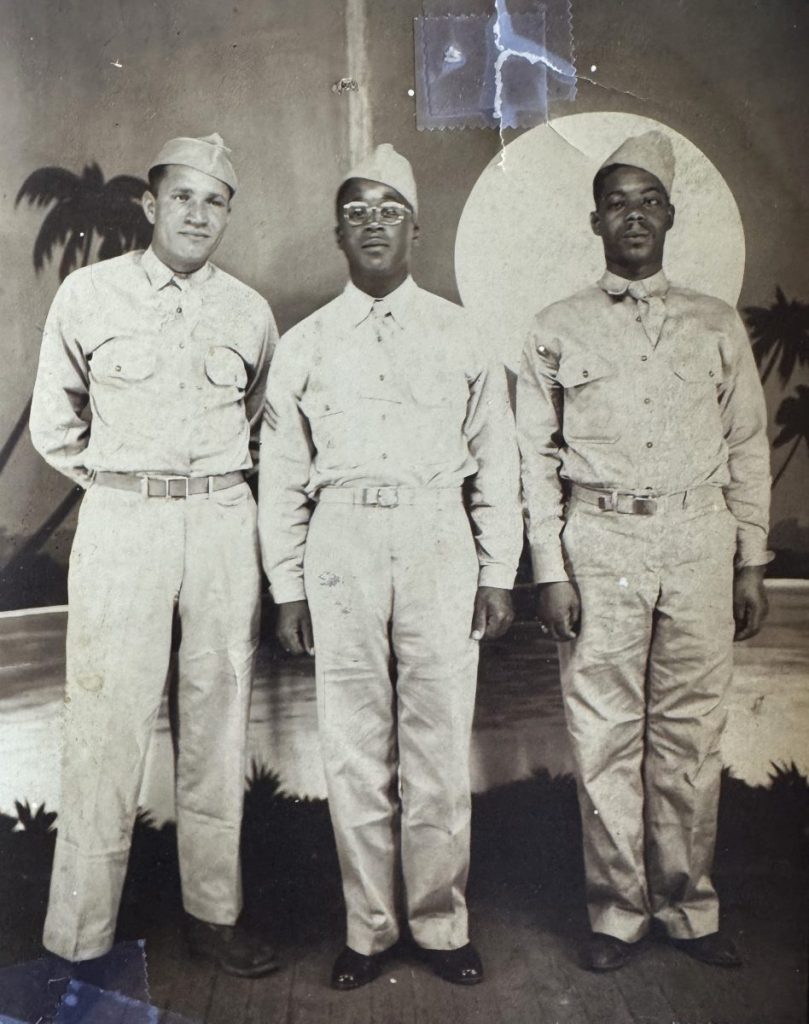
Sergeant David C. Bransford is pictured center. Photo submitted
Once David returned to Glasgow after completing his service to his country, not only did he provide for his family, but he also served as a great example of hard work, honesty, and good moral character.
“My daddy came out to Glasgow and did what a lot of guys would have to have done during that time. You know, he washed cars,” Jerry said. “He eventually left Glasgow and went to work in Louisville and was home on weekends because he probably couldn’t make enough to support his family in Glasgow. He was one of those guys who carpooled to Louisville for better employment opportunities and come home on weekends. Then finally, as years went by, there was a very nice gentleman who was a custodian at the RECC in Glasgow, and he saw that my dad became the custodian there. My daddy was there for about 30 years, and the place was kept perfectly well. There was nothing out of order. He worked hard at what he did. Had a sixth grade education, but if you hired my father, you would get the work of two men. And I assure you that everything that he knew how to do was perfectly done.”
When asked what it means to him to be a part of his family lineage with his father at the helm, Jerry smiled and said, “It means a great deal. I can’t go back and change anything that’s happened…I’m just proud to be a part of that lineage, and I felt driven to have the opportunity to tell this story.”
Leaving behind a great legacy isn’t about what you’ve amassed in physical assets or wealth. Rather, it’s how you use what you have been given to improve the world around you. It’s about choosing to not let your circumstances or anyone else’s bigotry define who you are. It’s about establishing a solid, moral foundation for those who will carry your lineage onward into the future.
Today, we honor David C. Bransford and all soldiers of color who have served our nation. As you reflect upon the stories that Jerry Bransford has shared, ask yourself this: How will the choices you make impact others? What legacy will you leave behind?
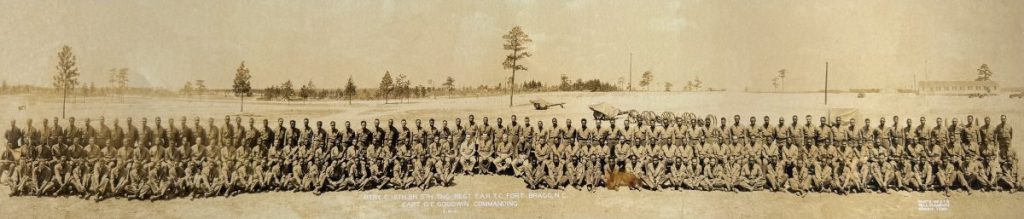
David C. Bransford (second row, fifth from left) was drafted into the United States Army and was first stationed in Fort Bragg, North Carolina in 1941 in an all-black troop. Photo submitted.