
An Underground Odyssey
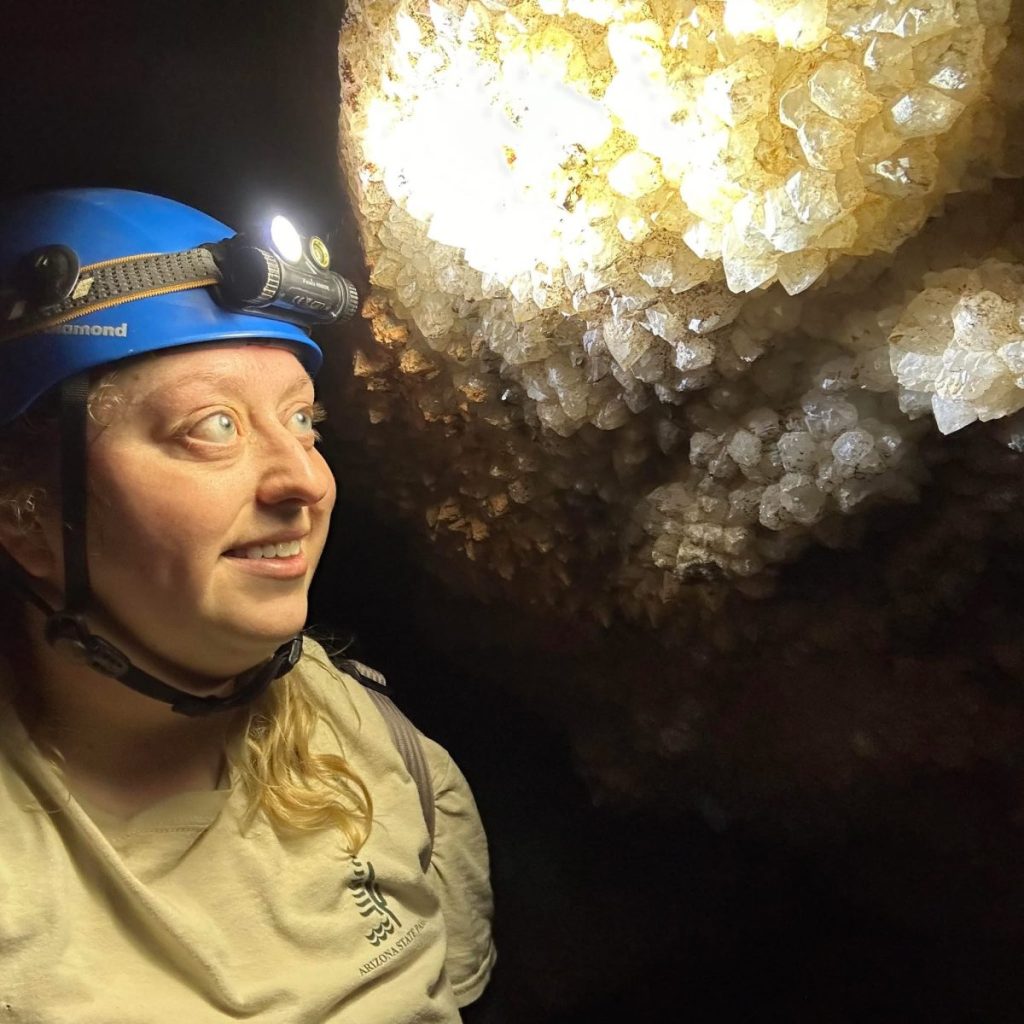
Chelsea Ballard’s fascination with caves and karst as a little girl has developed into her dream career as a cave scientist. She is pictured here examining quartz crystals in a Arizona cave near the Mexico border. Photo submitted.
Mary Beth Sallee
Editor
Hart Co. News-Herald
Tucson, Arizona is over 1,700 miles away from Hart County, but tucked away in the desert heat of the southwest is a heart that beats for the underground wonders of her old Kentucky home.
A native of Horse Cave, Chelsea Ballard has a deep-rooted history in the Mammoth Cave region that dates back to the late 1700s. Chelsea’s ancestors, on both her mom and dad’s side of the family, received land grants after the Revolutionary War and traveled via the Cumberland Gap in eastern Kentucky.
“I have many family signatures inside caves all over south-central Kentucky from the 1800s,” Chelsea said. “…I come from multiple generations of family members who have been tied to caves, particularly in the Kentucky area. I have many family stories and photos that are tied to our region. Some to mention are tied to the Floyd Collins story, the stagecoach robbery at Mammoth Cave by Jesse James, the Munford Family (establishing Munfordville), relations to Daniel Boone and the Western Frontier, the discovery of parts of the Mammoth Cave system, and guiding tours among many other caves in the area. My great-grandfather, Cleo Neville, among other family members, lived in Mammoth Cave National Park.”
Whether it be reasoned as a generational inheritance or a pure coincidence, Chelsea developed a fascination with caves at a young age. While her mom worked at the Horse Cave Library, Chelsea could often be found hanging out at Hidden River Cave.
“I borrowed caving gear and an American Cave Conservation Association t-shirt to wear on career day at school,” Chelsea said. “While students dressed up as doctors or firefighters, I dressed as a caver. Eventually, for my eighth and ninth birthdays, I convinced my parents to let me have my birthday parties there. I wanted to show all my friends about caves. I would collect American Cave Conservation publications and books on caves. My first official cave book was from my middle school science teacher, and I still have that. ”
Chelsea’s interest in caves was sparked by visits not only to Hidden River Cave but also Mammoth Cave. However, in 2005 when Chelsea was 11-years-old, that spark became a flame in what could be considered a most unfortunate way: Hurricane Katrina made landfall in Louisiana, pushing significant amounts of rain into Kentucky.
“We received a lot of rain overnight from those storms,” Chelsea said. “The following day, I walked out to find my ducks had been swimming in the pond, but a sinkhole collapsed underneath, swallowing them up. Luckily, it collapsed into an underground river, exposing a cave we didn’t know existed. After throwing down corn for three days, all 19 ducks and one goose survived. Thankfully, our good neighbor Roger Goodman helped us dig out the sinkhole, and we safely retrieved them.”
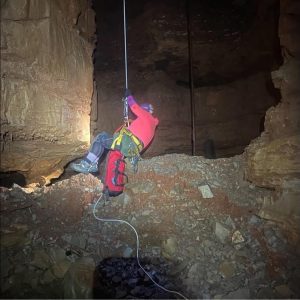
A passion for caves and karst research has led Chelsea Ballard along a path of adventure, including rappelling down into caves. Photo submitted.
From that day forward, Chelsea knew she wanted to understand more about how and why this happened. That’s when her journey into caves and karst landscapes continued onward. According to Chelsea, karst is defined as a landscape with soluble bedrock, such as limestone, that creates features over time, including sinkholes, caves, springs, underground rivers/aquifers, and disappearing surface streams.
“I was first involved professionally with caves and karst in middle school,” Chelsea shared. “I signed up as a volunteer at Hidden River Cave, learning cave tours and working at the front desk and gift shop. As I transitioned into high school, I was able to work under Peggy Nims (former Environmental Education Coordinator) and help teach classes.”
After high school, Chelsea attended Western Kentucky University (WKU) to study caves and karst landscapes.
“Once I got into college, Diamond Caverns hired me as a guide,” Chelsea said. “I worked there for a year before returning to Hidden River Cave as a cave guide and environmental education tech. I did that for several years before transitioning to Mammoth Cave National Park as a seasonal park guide.”
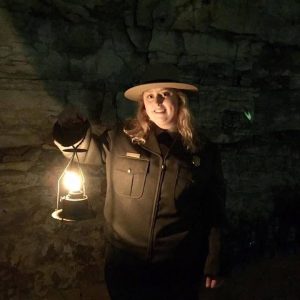
In 2016, Chelsea Ballard served as a Park Ranger at Mammoth Cave National Park. Photo submitted.
During that time, Chelsea was also hired as a research assistant by the WKU Cave and Karst program. As a research assistant, she helped conduct research on water quality in caves and springs. She also assisted with the Karst Field Studies program through WKU as an assistant to many world-renowned cave and karst professors who would teach classes locally and to students worldwide.
In 2016, Chelsea was offered an internship with Mammoth Cave National Park as a Physical Science Technician assisting with cave research, water quality, and resource management, creating maps for the park, and shadowing many other scientists employed by the National Park Service.
“At this point, I worked three jobs and went to school full-time,” Chelsea said. “From 2015 to 2023, I worked with many government agencies that assist with cave resource management, completed various research projects with published papers or abstracts, and presented at conferences or symposiums around the country. I even taught a cave class in Texas. I have worked at nonprofit, state, and federal levels surrounding cave research, and I am grateful since 2012 that all my jobs have been cave-related.”
In 2023 at the age of 29, Chelsea opted for a change of scenery as she accepted the Cave Resource Manager/Cave Scientist position at Kartchner Caverns State Park in southern Arizona. Since then, she has collaborated with many of her colleagues from Kentucky and other places across the United States with whom she had previously worked. This like-minded group of individuals are currently developing the future of a cave science and research center.
“We plan to host summer science camps, STEM and citizen science activities, and host scientists who study caves or the Sonoran Desert,” Chelsea explained. “Recently, we hosted a cave scientist, Ana, from the Yucatan in Mexico to learn and collaborate on cave and karst management and studies to better understand these fragile environments. Ana will spend two months at Mammoth Cave National Park this spring to learn more about our area in Kentucky.”
From a fascination with sinkholes in her own backyard, to exploring the longest cave system in the world and fulfilling her dreams in Arizona, Chelsea said she knew from a very young age that she would be a cave scientist.
“I didn’t think I would land my dream job at age 29.” Chelsea said. “I remember the moment I landed my dream job and I thought, ‘What now?’ It was the first time in my life that I wasn’t striving for that goal I had set for myself in second grade. This new job has opened many opportunities for me by making more connections with other cave scientists.”
Later this year in July, Chelsea will present in Brazil at an international cave conference. In November, she will present at a national cave conference to many other cave scientists about her most recent cave and karst research.
“I never knew a farm girl from the small town of Horse Cave, Kentucky would be traveling the world, telling folks about how amazing our Kentucky caves are and would now lead me to work at one of the world’s geologically diverse and protected caves,” Chelsea shared. “I am so proud of where I am from, and when I introduce myself to anyone, I always let them know I’m from Horse Cave, Kentucky.”
Through living her dream, Chelsea is also ensuring others understand that all actions have consequences.
“One thing I would like people to know about Kentucky’s caves, sinkholes, and springs is that what happens on the surface directly affects the underground, which leads to your drinking water source,” Chelsea explained. “So, you don’t fix that oil leak or dump trash into the sinkhole in your backyard. Where does that end up? It eventually makes its way underground and directly to Green or Nolin Rivers. At times, pollution in our area from the surface can make its way to the groundwater within minutes. Caves are nonrenewable resources, meaning that once the damage is done, it can’t necessarily recover to how it was before. Sometimes, those damages are forever.”
Chelsea also shared how important it is for cave exploration and karst research to continue.
“Caves and the bottom of the oceans are among the last few places we have left to explore on Earth,” she said. “It’s incredible that in 2025, we are still finding places on planet Earth that have never been seen by a person before. When climbing a mountain, you can see your ending point. But in caves, you never know what’s around the next corner and what else to discover. Caves are still considered a new science, not accepted until the last 50-70 years. Caves are believed to hold the answers to many microbiology studies searching for new medications, such as antibiotics, cancer research, and other medical-related topics. Caves are like time capsules preserving things of the past such as climate records, historic or cultural items, and many undisturbed resources. The thing about caves is that there is very little understanding about them. Something new is a
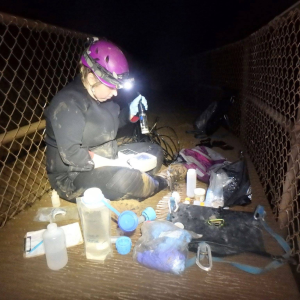
“One thing I would like people to know about Kentucky’s caves, sinkholes, and springs is that what happens on the surface directly affects the underground,” said Chelsea Ballard. She is pictured here collecting water samples in Mammoth Cave for her undergraduate thesis study at Wester Kentucky University. Photo submitted.
dded to science each year, generally from cave research.”
For anyone interested in pursuing caves as a career path, Chelsea said it will likely be one of the most rewarding and exciting fields.
“You won’t be wealthy, but you will be one of the leads in the frontier of Cave Science,” Chelsea said. “You could pursue many directions, such as geology, hydrology, archaeology, biology, ecology, and endless ideas. There are internship opportunities, seasonal cave jobs, and long-term positions, and Western Kentucky University has a great cave and karst program for undergraduate and graduate students.”
“If you don’t want to pursue a career in cave science but like the idea of exploring caves, find your local caving grotto by visiting caves.org and searching for which grotto is closest to you,” she continued. “This ensures safe caving practices and access to some of the world’s most impressive caves. The American Cave Conservation Association has plenty of cave restoration and conservation opportunities in our local area that you could join, from sinkhole clean-ups to cave formation repair, among other opportunities.”
If you are interested in more information about getting involved with caving, cave science, or cave-related jobs or have concerns about sinkholes, springs, or caves on your property, you may contact Chelsea at chelsea@caveconservation.com.
“I may live 1,700 miles away from the place I call home, but Horse Cave and Mammoth Cave will always be home to me,” Chelsea said. “I can’t wait for the day I return to serve my community by protecting and understanding our fragile karst landscape. Take care of it for me until I return.”
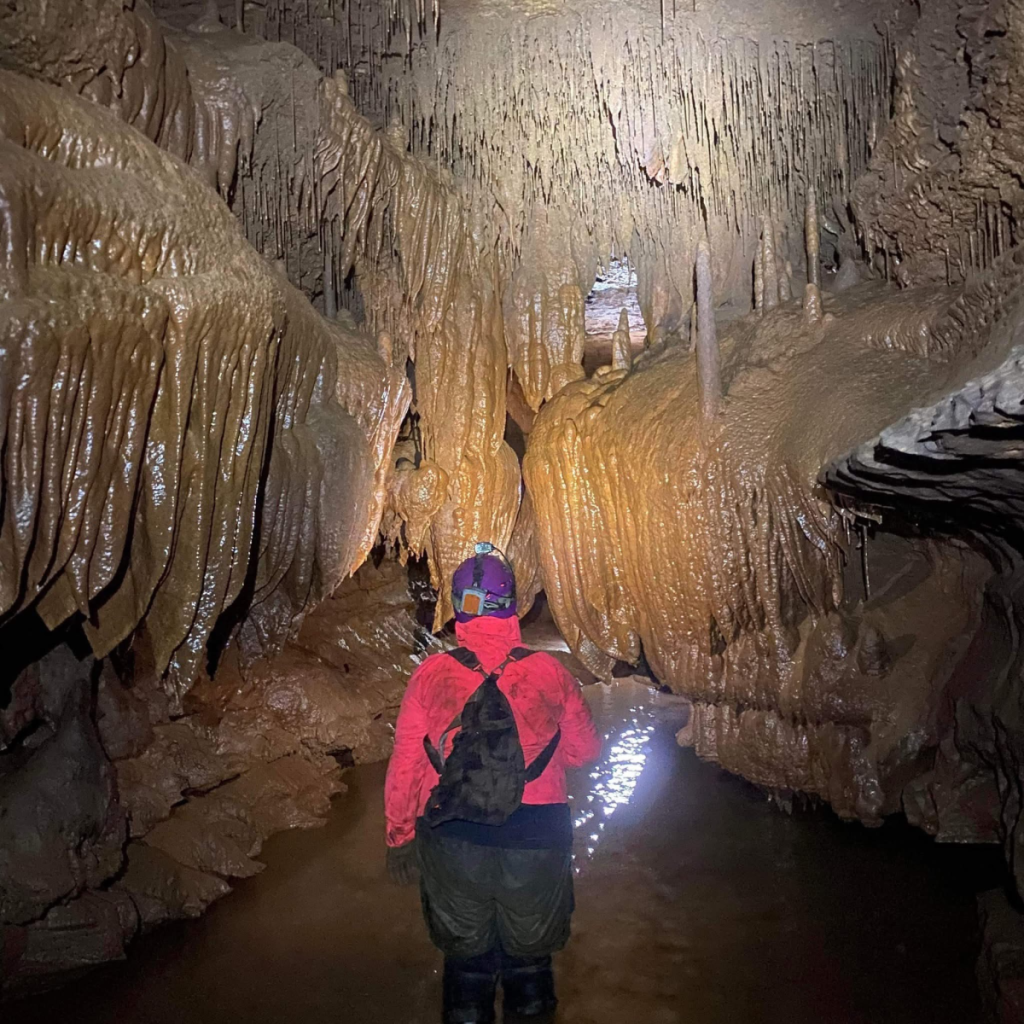
Chelsea Ballard once spent over 20 hours underground in water while working on a cave survey in Hicks Cave in Hart County. Photo submitted.
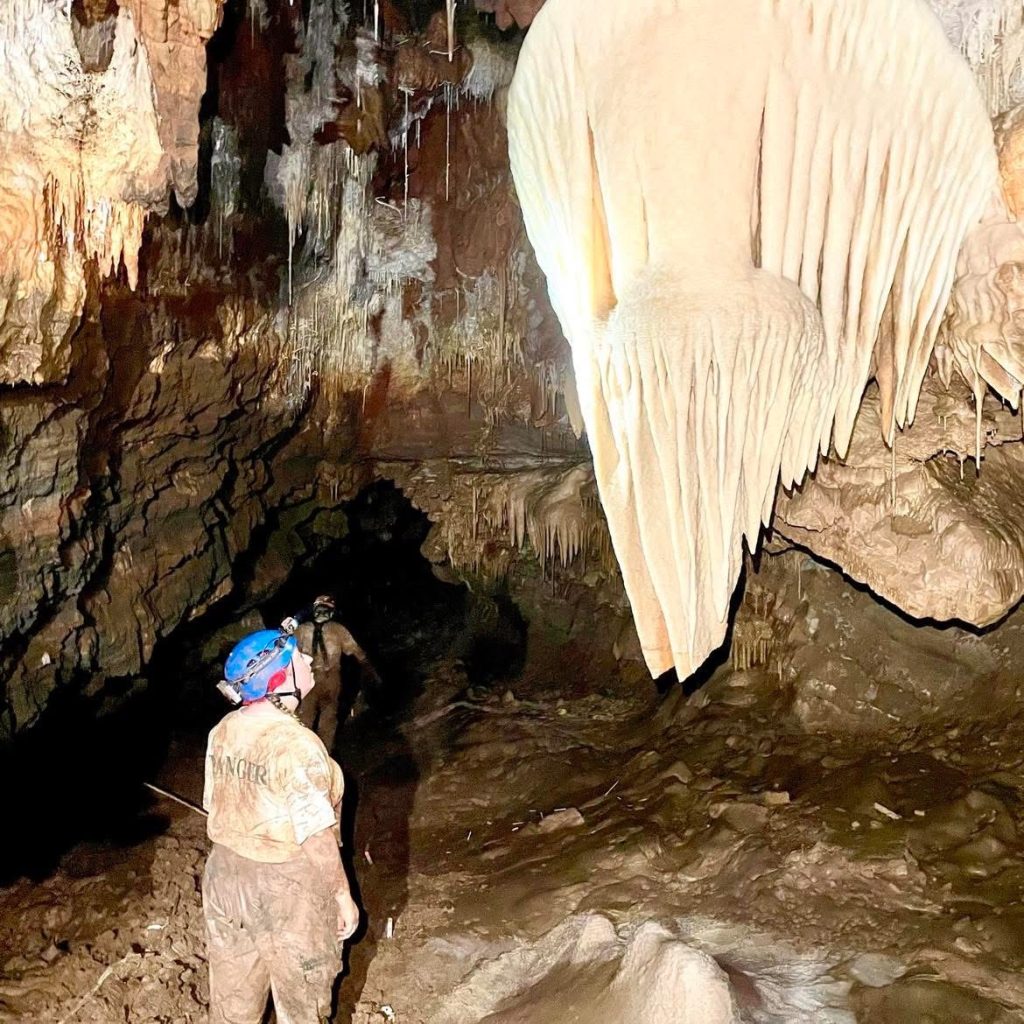
Chelsea Ballard looks up at the Angel Wing formation inside Kartchner Caverns State Park in southern Arizona.Photo submitted.
gooooooooooooooood