T.J. Samson Brings Nation’s First BrainWatch EEG Technology to Emergency Care
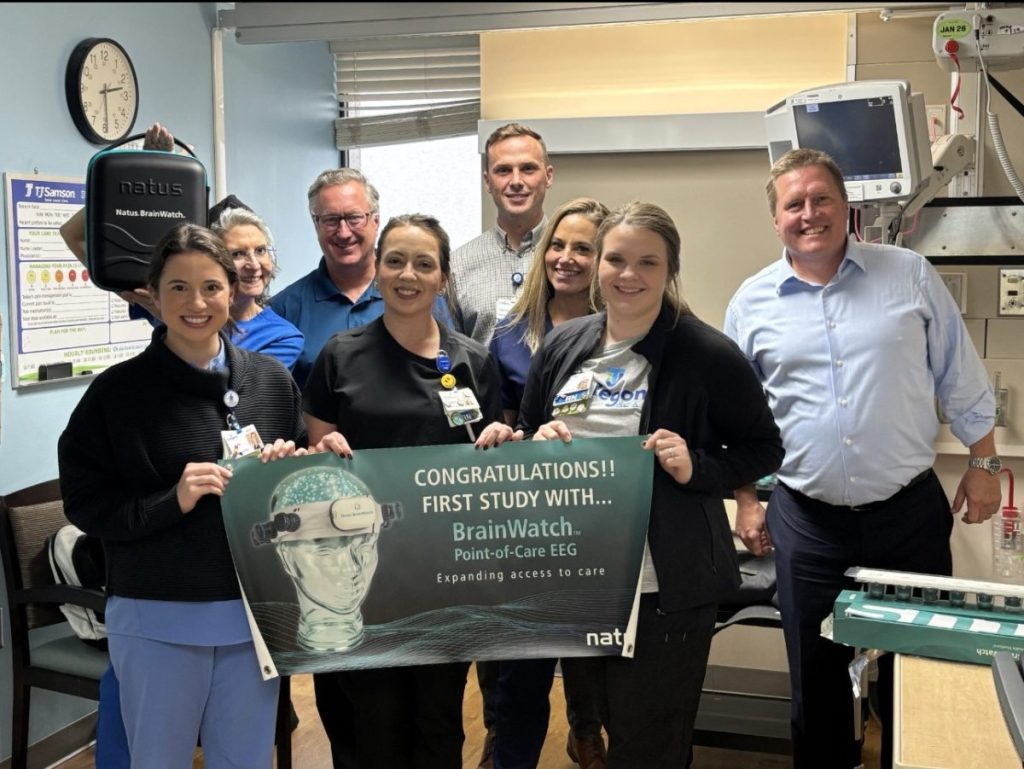
Macy Wilkerson (TJ), Minna Masor (Natus), Aaron Stifel (Natus), Ashley Dubree (TJ), Ryan Skinner (TJ), Kyna Seale (Natus), Lexi Stone (TJ), Shane Middlebrooks (Natus)
By Staff Report
T.J. Samson Community Hospital is redefining how neurological emergencies are handled by becoming the first hospital in the United States to implement BrainWatch, a rapid EEG technology that provides near-immediate insight into brain activity when time is critical.
BrainWatch, developed by Natus, allows emergency physicians and neurologists to quickly evaluate patients who arrive with confusion, loss of consciousness, or seizure-like symptoms — situations where delays in diagnosis can significantly impact outcomes.
Unlike traditional EEG testing, which can take hours to initiate, BrainWatch uses a lightweight, wireless headband that can be applied within minutes. Once in place, the system begins recording brain activity almost immediately, giving physicians early data to guide treatment decisions.
Dr. Kyra Schmidt, a board-certified neurologist at T.J. Samson Community Hospital, said the technology fills a critical gap in emergency neurological care.
“There are cases where waiting several hours for a standard EEG simply isn’t an option,” Schmidt said. “BrainWatch allows us to see what the brain is doing right away, which can make a meaningful difference in how quickly a patient receives appropriate treatment.”
While BrainWatch does not replace comprehensive EEG testing, it provides an important first look during emergencies. Physicians can often review brainwave data within 10 to 15 minutes, allowing for faster clinical decisions while additional testing or monitoring is arranged.
Hospital officials report that the technology has already improved patient care. In one recent case, BrainWatch detected seizure activity in a patient whose previous 24-hour EEG at another hospital had shown normal results. Because the activity was identified immediately, treatment was started without delay.
The system has also helped reduce the need to transfer patients to larger medical centers for neurological evaluation — a common challenge for rural hospitals. Faster access to EEG data allows physicians to determine whether a patient can safely remain at T.J. Samson or requires specialized care elsewhere.
“Speed is often what patients need most in neurological emergencies,” said Ryan Skinner, Director of Clinical Improvement at T.J. Regional Health. “BrainWatch gives our team the ability to make informed decisions quickly, right here in our community.”
T.J. Samson plans to expand the use of BrainWatch beyond the emergency department into intensive care and inpatient units. Hospital leaders say the investment reflects a broader commitment to bringing advanced medical technology to south-central Kentucky.
By introducing BrainWatch, T.J. Samson Community Hospital is showing that cutting-edge neurological care is not limited to large urban medical centers — and that patients in smaller communities can receive faster answers and timely treatment close to home.