The Pieces Alzheimer’s Could Never Erase
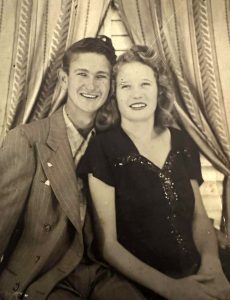
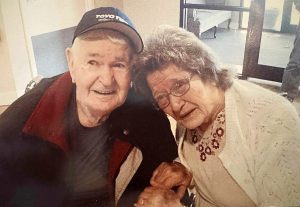
Lee and Velma Logsdon met while fishing on a riverbank. They married in 1946 when Velma was 16 and Lee was 23. They enjoyed a life together founded on faith, family, and love. Photos submitted
A Daughter’s Story of Love, Loss, and Holding On
Mary Beth Sallee
Managing Editor
Hart Co. News-Herald
When Melinda Logsdon talks about her parents, she goes back to the very beginning – before Dementia and Alzheimer’s changed everything, before hospital stays and nursing homes, before the fear, confusion, and heartbreak.
She remembers a home full of warmth and love.
“I was the menopause baby,” Melinda said with a smile. “My oldest brother was 25 when I was born, and so there’s six of us siblings.”
Melinda’s father, Caleb Lee Logsdon, was a lifelong farmer. Her mother, Velma Logsdon, poured herself into raising children and being a devoted grandmother.
“Her grandkids were all that to her,” Melinda said. “She loved to cook…She, at 70 years old, slept on the floor with my kids on pallets when they spent the night.”
Those memories have been an anchor for Melinda, especially now.
Melinda’s parents’ love story was just as memorable.
“He met her on the riverbank,” Melinda shared. “Mom loved to fish as much as he did.”
For years, Lee and Velma’s life was defined by family gatherings, attending church, fishing trips, and a shared commitment to one another. But Alzheimer’s would eventually test that commitment in ways none of them could have imagined.
Melinda’s father declined first.
“He had vascular dementia,” Melinda explained. “He loved to sleep. He was older. He was just tired.”
Lee began to withdraw, spending more and more time in bed. When he reached the point of needing full-time care, they remembered his wishes.
“He always said he didn’t want his girls to diaper him or take care of him,” Melinda said. “…He wanted to go to the VA nursing home.”
With the facility not yet ready, Lee instead moved to a nursing home in Elizabethtown, where Melinda worked. It allowed her to see him nearly every day. And through the fog of dementia, he kept his gentle contentment.
“He didn’t care if anybody came to see him or not,” Melinda said. “He was happy.”
Her mother’s decline was much different – unpredictable and emotionally devastating.
“She got to falling,” Melinda said. “She would forget to take her medicine, or she would think it was morning after she took a nap.”
A special medication dispenser was bought to help Velma stay independent, but eventually she landed in the hospital, then rehab. When it was time for discharge, her mother looked at Melinda and asked if she could stay there. Melinda agreed.
Both of Melinda’s parents were at the same nursing home in Horse Cave beginning in November of 2014.
However, the transition for Velma was difficult. She cried often, paced, and worried. Still, Melinda visited constantly – sometimes before work, sometimes after, sometimes both.
“I did not put her in the nursing home because I didn’t want to take care of her,” Melinda said. “I needed help taking care of her.”
One of the darkest moments came when Melinda’s father passed in December of 2015. Her mother was away at a psychiatric facility at the time, adjusting medications. The decision of whether to tell her – and how – was difficult. Counselors advised her to tell her once and then let it be. When Melinda delivered the news, her mother simply responded, “Okay, let’s go.” At times, she remembered. But on days she forgot, she’d look at Melinda and ask, “Where’s your daddy?” And on those days, Melinda chose patience and gentleness.
“Whatever they want to talk about, that’s what we talked about,” Melinda said. “Never argue with them…Just agree with whatever they say and go on.”
Melinda’s mother knew her until about two weeks before she passed in February of 2016. Then, something shifted.
“I became her mother,” Melinda said.
A doctor asked who Melinda was. Velma pointed and said, “That’s my mom.”
Even as her memory faded, Velma treasured the youngest generation. She carried photos of the great-grandchildren and showed them to anyone who would look.
“She would tell people, ‘These are my babies,’” Melinda recalled.
Caring for both parents while working full-time and raising children of her own took a toll on Melinda.
“It was very difficult for me to balance full-time employment as a newlywed mom of three and help my parents,” she said. “Sometimes it was very overwhelming.”
Alzheimer’s also left Melinda with a lingering fear: that one day she might face the same disease. She now does everything she can to reduce that fear – vitamins, lifestyle changes, and avoiding aluminum.
“Anything that I hear, like, if you do this, this will help you prevent Alzheimer’s,” she said.
But eventually, she found some peace.
“I decided it was best if I only worried about things that I really couldn’t change,” Melinda said. “If I can’t change it, worrying about it is not gonna change it.”
Today, Melinda keeps her parents’ memory alive through the traditions they left behind. One of her mother’s unintentional quirks became a family tradition.
“Mom always cooked on holidays…and she always left the peas in the microwave,” Melinda said. “So every holiday…we put one (bowl of peas) in the microwave, and we leave it until after the meal.”
What Melinda carries most, though, are the lessons her parents’ illness taught her, lessons she now shares with others just starting the journey.
“If it’s a good day, you take advantage of that good day,” she said. “Talk about whatever they want to talk about, even if it’s not real…Sometimes you will need breaks, and it’s okay to take a break.”
And the advice she leans on most: “It’s one day at a time…You just gotta take one day at a time. Because tomorrow may be different.”
Melinda finds comfort in knowing she loved her parents through every stage of who they became. Dementia and Alzheimer’s took much from them, but it never took the devotion that bound their family together. Melinda carries their stories onward, not just as a daughter who lived through the hardship with them, but as a woman shaped by two people who loved fiercely, worked faithfully, and faced the unthinkable. And so, every pea left in the microwave, every fishing adventure, and every shared memory becomes a small act of remembrance – a way of keeping her parents close, honoring the pieces of them that a horrid disease could never erase.