LifeSkills, Inc. and Barren River Area Development District Break Ground
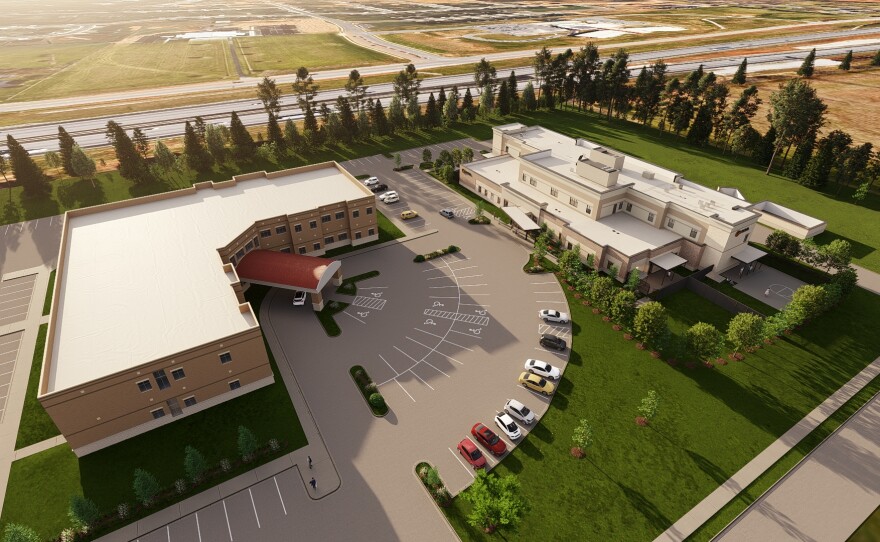
An aerial rendering of LifeSkills campus on Suwannee Trail Road in Bowling Green, including the addition of the Anchor Project. Photo courtesy of BRADD
$20 Million Anchor Project Represents Groundbreaking Approach to Crisis Care in South Central Kentucky
By Joe Dan Beavers
President/CEO, LifeSkills, Inc.
LifeSkills, Inc. and the Barren River Area Development District (BRADD) broke ground on September 22nd on a regional Mental Health Crisis Intake Center, the cornerstone facility of the transformative $20 million Anchor Project and the first of its kind in Kentucky. The ceremony marks a historic milestone in the treatment of mental health and substance abuse disorders across South Central Kentucky.
The Crisis Intake Center was designed by Stengel Hill Architecture and will be built by Kelley Construction, Inc. on a six-acre site adjacent to LifeSkills’ headquarters on Suwannee Trail Street in Bowling Green. When operational, the facility will serve as the region’s single point of entry for mental health and substance abuse crisis intervention, fundamentally changing how communities respond to individuals in crisis.
“Today we begin construction of a facility that will transform crisis care delivery not just for our region, but potentially for the entire Commonwealth,” said Joe Dan Beavers, President/CEO of LifeSkills, Inc. “This center represents our commitment to providing immediate, accessible, patient-centered care while reducing the burden on law enforcement, emergency rooms, and our judicial system.”
The Crisis Intake Center will serve the entire BRADD region, dramatically reducing response times for mental health emergencies. Currently, law enforcement officers spend an average of 3 to 4 hours per mental health crisis call. The new facility is designed to reduce that time substantially, allowing officers to return to community patrols while ensuring individuals receive appropriate clinical care.
“The Anchor Project represents the kind of innovative, regional collaboration that can serve as a model for addressing complex social challenges,” said Eric Sexton, Executive Director of BRADD. “By bringing together local governments, healthcare providers, law enforcement, and community stakeholders, we’re creating a comprehensive solution that will benefit every community in our region. BRADD is thankful for the trust the General Assembly has placed in us to help convene this regional response.”
The groundbreaking ceremony featured remarks from key project partners, including representatives from the Kentucky General Assembly who secured the $20 million in state funding through House Bill 1, local mayors and judge executives from across the BRADD region, law enforcement leadership, and healthcare professionals who helped design the facility’s operational model.
Comprehensive Regional Impact
The Crisis Intake Center is just one component of the three-part Anchor Project, which also includes:
- A Regional Office of Drug Control Policy to coordinate resources across 25 cities and 27 law enforcement agencies.
- A Life Learning Center providing evidence-based recovery programming to transition stabilized individuals into substance-free, employed lives.
In 2023, the Bowling Green Police Department alone responded to over 900 mental health crisis calls. Across the 10-county region, similar patterns strain law enforcement resources, contribute to jail overcrowding, and often result in inappropriate emergency room utilization for mental health treatment.
“We’re not just building a facility – we’re implementing a new model of care that treats mental health and substance abuse crises with the clinical expertise they require,” said Sue Parrigin, Bowling Green City Commissioner and Chair of the Anchor Project Committee. “This approach will reduce costs for our communities while providing better outcomes for individuals and families in crisis.”
Evidence-Based Design and Operations
The facility design incorporates best practices from successful crisis centers, including elements inspired by national best practices, while adding comprehensive substance abuse services under one roof. The center will feature:
- 24/7 crisis triage
- 15-person capacity voluntary observation unit
- 6-person capacity involuntary admission observation unit
- 10-person adult crisis stabilization unit
- 12-bed short-term residential substance use disorder treatment unit for men
- 12-bed short-term residential substance use disorder treatment unit for women
- Integrated mental health and substance abuse disorder treatment
- Pharmacy services for medication management
- Coordination with existing LifeSkills programming and other regional healthcare providers
LifeSkills will operate the facility as part of its comprehensive behavioral health services, leveraging almost 60 years of experience serving the region’s mental health and substance use disorder needs.
Regional Partnership and Future Vision
The Anchor Project represents an unprecedented level of regional cooperation, with local governments committing up to $13 million in additional funding through land contributions, city and county opioid abatement funds, and grants, in addition to the state’s $20 million allocation.
“This project demonstrates what’s possible when communities work together to address shared challenges,” said State Representative Kevin Jackson, R-Bowling Green. “We’ve created a model that can be replicated across Kentucky and beyond.”
Construction is expected to begin immediately on the 36,000-square-foot facility, with a targeted completion in late 2026. The crisis intake center will employ 88 people and provide services 24 hours a day, seven days a week.
For more information about the Anchor Project, please visit https://planning.bradd.org/opioid-summit/
About LifeSkills, Inc. LifeSkills supports people with mental illness, addiction, and intellectual disabilities as they build meaningful and independent lives. As South Central Kentucky’s community mental health center, LifeSkills provides the region’s most comprehensive array of behavioral health services to children and adults. For more information, visit www.lifeskills.com.
About BRADD The Barren River Area Development District serves as the regional planning and development organization for Allen, Barren, Butler, Edmonson, Hart, Logan, Metcalfe, Monroe, Simpson, and Warren counties in South Central Kentucky. BRADD works to improve the quality of life for residents through strategic planning, grant administration, and regional coordination. For more information, visit www.bradd.org.
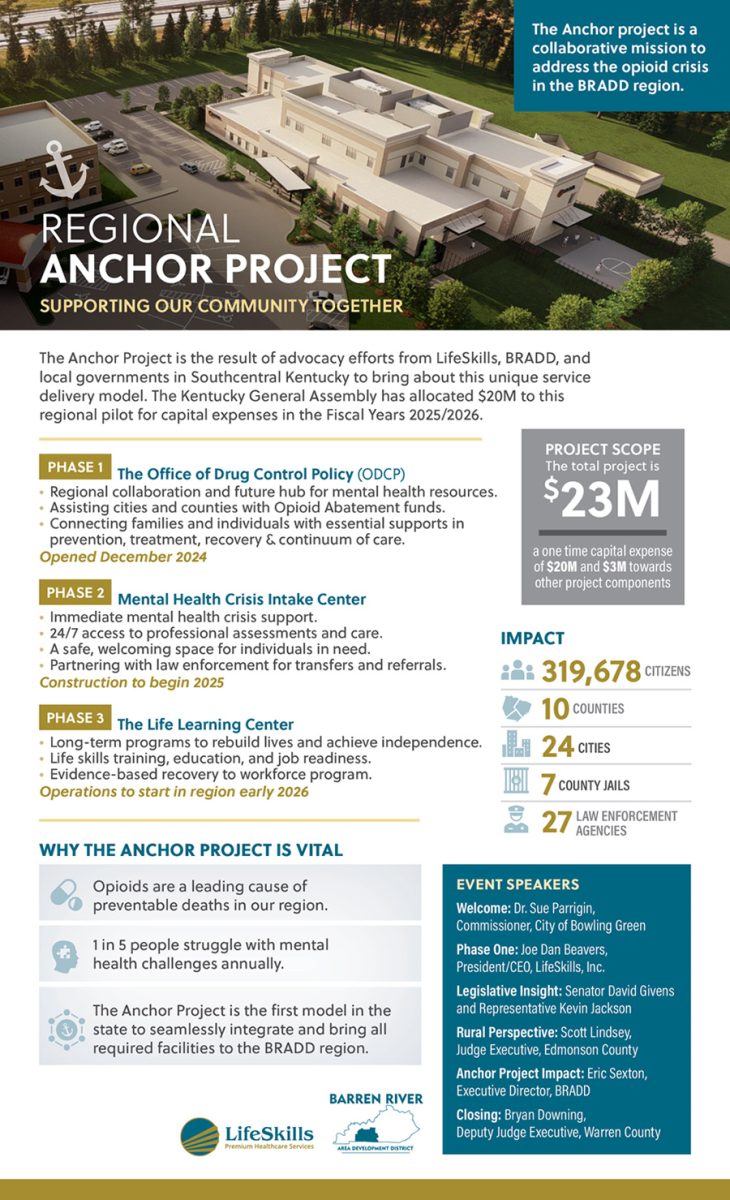
Graphic courtesy of LifefSkills