Animal Tales
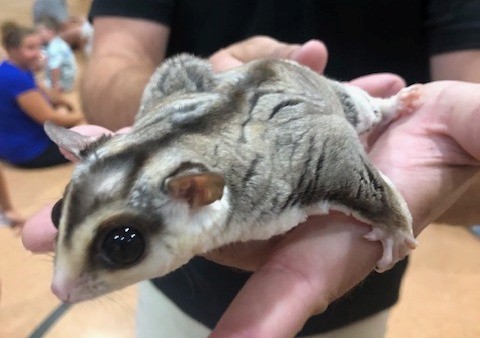
This adorable little creature is Max the Sugar Glider. Photo | PJ Martin
By PJ Martin
Editor
The Herald-News
Last Wednesday, kids and adults were treated to an unusual array of birds, reptiles, and a mammal at Animal Tales: Art of the Wild sponsored by the Metcalfe County Public Library. The large group of folks who gathered at Bowling Park gym were in for an entertaining program.
Not only did they see and touch some unusual and exotic animals, but they also learned about their diets, habitats, and in some cases, how they fool predators with their own unique camouflage and defense mechanisms.
The program was presented by Grant Allen from Owensboro, Kentucky, who has been an animal handler for around 15 years. He gave an informative talk about each creature and answered questions from the children.
The first one presented was a tarantula named Charlotte. This large spider (Theraphosidae) uses its web to capture prey similar to the spiders we see locally. Most species of tarantula live in burrows in the ground and come out mostly at night to hunt. They are commonly found in warm areas such as South America, southern North America, southern Europe, Africa, southern Asia, and Australia. The biggest concentration lives in South America, and females can live up to 30 years.
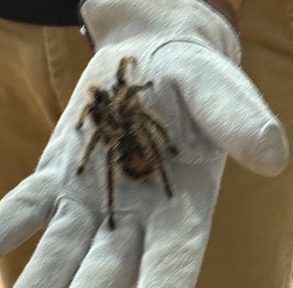
Charlotte being shown to the crowd. Photo | PJ Martin
Charlotte commonly feeds on crickets in captivity, but in the wild, tarantulas feed on small insects and larvae. The front protrusions from the head are called chelicerae, and they hold the fangs, which are used to inject venom into their prey to liquify the inside so that they can feed. The venom is not dangerous to humans, but the bite has been described as comparable to a wasp sting.
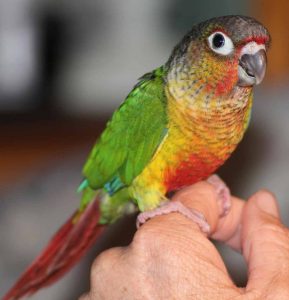
A Green-cheeked Conure (Parrot) named Elmer. Photo | Pixabay
Next was Elmer, a Green-cheeked Conure (Parrot) who is approximately 9 years old, but they can live up to 30 years in captivity. Elmer had bits of blue and red feathers along with green for camouflage, as these birds usually live in the upper tree canopy in the wild. There are many variations of conures, and their habitat is in Brazil.
They are approximately the size of a large parakeet and feed on fruits, vegetables, and seeds. They are lively, and as demonstrated, they do things their way. Elmer, instead of landing on the assisting child’s finger, kept flying to the top of Grant’s head.
Barry the Blue Tongued Skink was displayed next, and yes, they have a very blue tongue, thus the name. Barry was quite content to just lie in Grant’s hand as he was being shown around the room. This Skink is not poisonous and eats a large array of things, such as mealworms, crickets, leafy greens, or even mice.
Skinks do regulate their body temperature, so you must keep at least part of their habitat heated and overall, not below 70 degrees.
The one mammal in the program was named Max, a male Sugar Glider. Although they resemble small flying squirrels, they are not related. They have a pair of membranes on their sides called pagaia. It stretches between their front and rear legs and allows them to glide between trees safely.
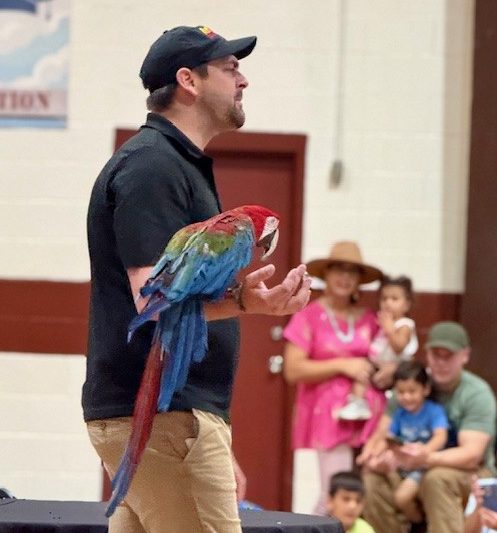
Grant is holding a Green-winged Macaw named Einstein. A very talkative bird. Photo | PJ Martin
Female Sugar Gliders have a pouch (like a kangaroo or koala) in which the babies are raised. A newborn baby sugar glider is the size of a grain of rice. They are nocturnal (night-time) creatures who eat fruits, vegetables, mealworms, and crickets. They are playful, require a lot of space, and are social animals that need to be in a group.
Animal number five was a large male Green-winged Macaw Parrot named Einstein, who is 50 years old and quite beautiful with his long colorful tail. These birds can live to age 70 or even 80 and are very intelligent. They are found in the Amazon Rainforest in South America, nesting in the top of the tree canopy. He was quite a chatty fella, making sounds as he was being shown to the audience. They eat fruits, nuts, and leafy greens, and require a very balanced diet to stay healthy in captivity. In the wild, they also ingest mineralized sand or clay, which helps to neutralize toxins in some seeds they eat.
The last was a reptile, a Spider Banana Ball Python named aptly Banana, because of his color, which is a pale yellow. The reason a snake such as this flicks its tongue is to taste the air for danger or to find food.
These snakes, as with other reptiles, require a warming light to keep them at the correct temperature and humidity to keep them healthy. Their diet consists of rats, mice, and birds, and they have approximately 100 teeth. The children happily lined up to touch Banana.
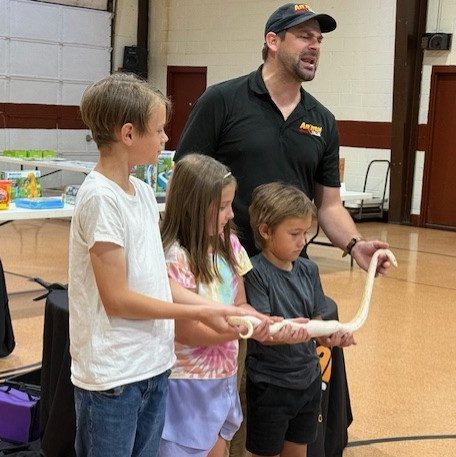
These children volunteered to help hold a Spider Banana Ball Python named Banana. Photo | PJ Martin
Animal Tales offers educational programs with a mission to educate, entertain, and inspire. Other programs offered are Zoofari Earth, Creepy Critters, Animal Science, Reptiles, Scales & Tales, and Holiday Safari.
If you would like to know more about Animal Tales or schedule them for your event, go to https://www.animaledzoocation.com/midsouth/, where you can find out more about the programs they offer.