Is Dementia on the Rise?

A helpline for caregivers available at https://alzfdn.org/caregiving-resources/.
By PJ Martin
Editor
The Herald-News
“Dementia is currently the seventh leading cause of death and one of the major causes of disability and dependency among older people globally,” according to the World Health Organization (WHO), with nearly 10 million new cases of dementia every year.
Many of us have learned to adapt in order to care for a family member or close family friend with some form of dementia. It is a symptom seen with many diseases the most notable being Alzheimer’s.
Most people think of dementia as the same thing as Alzheimer’s, but that is not true. Dementia is a term used for a specific group of symptoms. The main symptoms of dementia are difficulties with memory, language, problem-solving, and thinking skills that prevent a person from everyday activities.
Changes to the brain are the root cause of dementia, and many different reasons for brain changes can lead to dementia. There are many diseases and injuries that directly and indirectly damage the brain.
Alzheimer disease contributes to around 60–70% of cases, but dementia with Lewy bodies (abnormal deposits of protein inside nerve cells), diseases that damage the frontotemporal (degeneration of the frontal lobe of the brain), a stroke, or certain infections such as HIV, as a result of harmful use of alcohol, repetitive physical injuries to the brain (known as chronic traumatic encephalopathy), or nutritional deficiencies can all cause different forms of dementia according to The Lancet Commission.
To date, there is no cure, but many researchers are working on ways to slow or prevent the condition from progressing from its onset.
Age is still the major factor for dementia; however, researchers have found a set of 12 risk factors that with change can hopefully slow the beginning of dementia according to a 2020 report by The Lancet Commission.
- Less education
- Hypertension
- Hearing impairment
- Smoking
- Obesity
- Depression
- Physical inactivity
- Diabetes
- Low social contact
- Excessive alcohol consumption
- Traumatic brain injury
- Air pollution
“Together the 12 modifiable risk factors account for around 40% of worldwide dementias, which consequently could theoretically be prevented or delayed,” according to The Lancet.
“What we currently know is — what’s good for your heart is good for your brain, and that’s because there are a lot of vascular risk factors for dementia,” Timothy Singham, clinical psychologist and adjunct senior lecturer at the National University of Singapore.
“Your mental health suffers really quickly if you’re not physically active, you don’t get to breathe, you don’t get to see nature much, you’re cooped up in the office or at home all day,” Singham said.
So, have researchers found anything that can really help prevent the onset of dementia? Maybe not prevent it just yet, but they have found 5 factors that minimize the chances of getting dementia.
- Regular physical activity
- Eating healthy
- Building a healthy support network
- Having good sleep hygiene
- Find ways to regulate stress and emotions
Young people need to be proactive to prevent problems later, according to Ng Ai Ling, deputy director, and principal counselor at Viriya Community Services, “I think a lot of young people are [leaning on their] online social networks, but we need to not give up the face-to-face [meetups] with friends,”
“The other thing I would encourage young people to do is have a very disciplined, good sleep hygiene, because our brains really really need to rest,” Ng said. She suggests getting at least seven hours of sleep every night.
That seems like sound preventative advice since the Alzheimer’s Association claims that Alzheimer’s begins 20 years or more before memory loss or other symptoms develop.
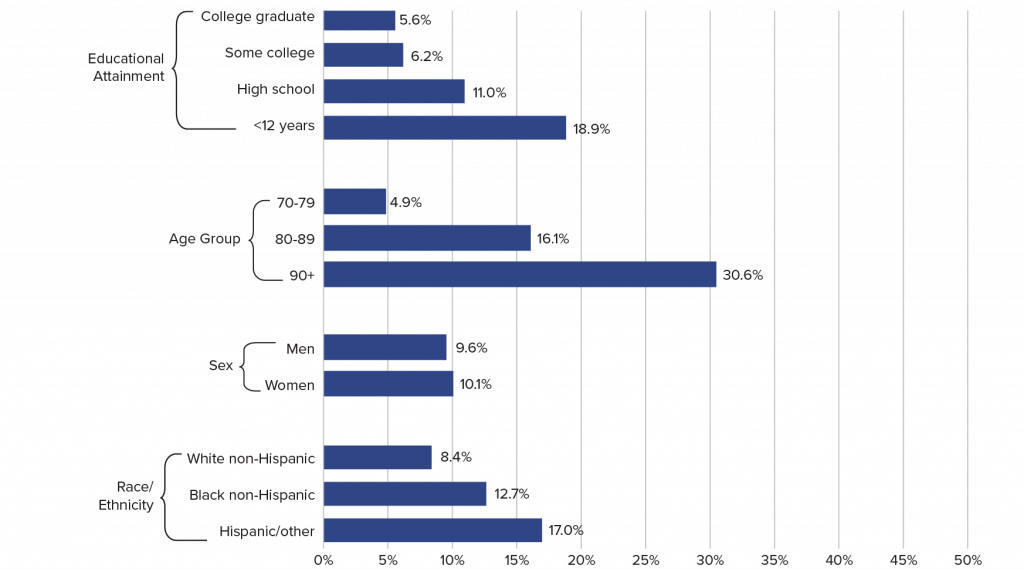
Prevalence of Probable Dementia Among the U.S. Population Ages 70 and Older, 2015 Note: Excludes persons in nursing homes. Source: Vicki A. Freedman et al., “Short-Term Changes in the Prevalence of Probable Dementia: An Analysis of the 2011–2015 National Health and Aging Trends Study,” Journals of Gerontology, Series B 73 (2018): S48-S56.
Caregivers are Struggling
“The caregivers themselves are struggling to understand the illness — you lose someone to the illness, and the person who you used to be able to relate to and communicate [with] is no longer the same,” Ng said adding that, “Caregivers and loved ones may risk developing mental health problems such as anxiety, depression, and insomnia.”
“Suddenly, someone you’re familiar with, and that person is forgetting you, and [they are] unable to perform as [they did] before the illness … There is this emotional distress that you go through,” she said.
There is help for caregivers who are dealing with the stresses of caring for a loved one with dementia. The Alzheimer’s Foundation of America (AFA) has a National Toll-Free Helpline for anyone caring for an Alzheimer’s or Dementia patient 1-866-232-8484. The helpline is open from 9 a.m. – 9 p.m. EST and there is also an option to chat live or text. All the staff are licensed social workers specifically trained in dementia care. These options are available at https://alzfdn.org/caregiving-resources/.
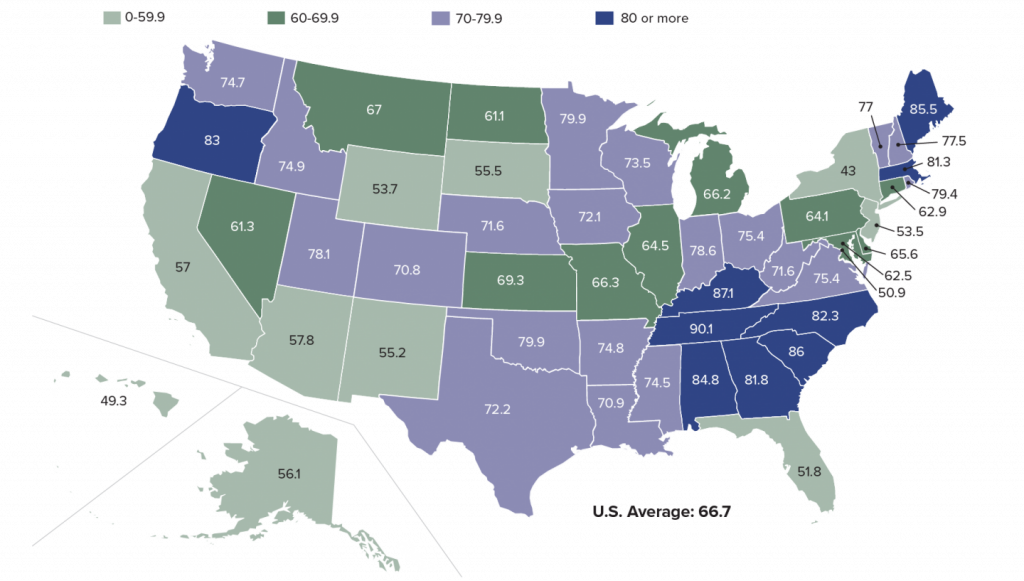
Age-Adjusted Death Rates per 100,000 by State, 2017 Source: Ellen A. Kramarow and Betzaida Tejada-Vera, “Dementia Mortality in the United States, 2000-2017,” National Vital Statistics Reports 68, no. 2 (2019).
Key Facts
- Currently more than 55 million people have dementia worldwide, over 60% of whom live in low-and middle-income countries. Every year, there are nearly 10 million new cases.
- Dementia results from a variety of diseases and injuries that affect the brain. Alzheimer disease is the most common form of dementia and may contribute to 60–70% of cases.
- Dementia is currently the seventh leading cause of death and one of the major causes of disability and dependency among older people globally.
- In 2019, dementia cost economies globally 1.3 trillion US dollars, approximately 50% of these costs are attributable to care provided by informal carers (e.g. family members and close friends), who provide on average 5 hours of care and supervision per day.
- Women are disproportionately affected by dementia, both directly and indirectly. Women experience higher disability-adjusted life years and mortality due to dementia, but also provide 70% of care hours for people living with dementia.
World Health Organization (WHO)