Finances and Grants
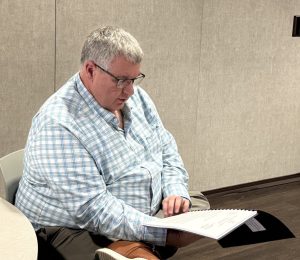
Taylor, Polson, & Company auditor Jeff Carter explaining key points to the board. Photo | PJ Martin
By PJ Martin
Editor
The Herald-News
The Ambulance Service Corporation, Inc. Board of Directors met on Wednesday, August 26, at the TJ Health Pavilion Community Center.
The meeting opened with the roll call, and the following members were present: Ervin Sorrell, Phillip Geralds, Judge/Executive Larry Wilson, Garland Gilliam, and Dr. Neil Thornbury. It was noted that Judge/Executive Jamie Byrd was at the Community pep rally, but could attend if necessary.
Also in attendance were Board Attorney Brian Pack, Executive Director Joe Middleton, Executive Secretary/Treasurer Shawn Estes, and from The Herald-News, PJ Martin.
The minutes from the April 22, 2026, meeting were reviewed and approved as written.
First on the agenda was the audit report presented by Jeff Carter of Taylor, Polson, & Company. He stated that a clean opinion or modified opinion means that nothing needs to be added or taken away. He did review a few main items with the board members for clarity.
Once complete, Middleton pointed out that the interest on the airport bond quoted by Mr. Carter was now irrelevant, since the bond had been paid off.
Finance Reports
The April finance statement was presented by Estes, who began with the adjusted receipts totaling $572,888 and the adjusted expenses totaling $590,145. That left a net loss of $17,256 for April. Estes added, ‘Through April we should be tracking 83.33% of budget, and we’re below that at 80.2%.
Estes moved on to the May financial statement, “We had a large insurance payment… and paid that bond off. That is down under the airport station road at $93,093. And even with those two expenditures, we still just showed a loss of $23,500 for May.”
The adjusted receipts for May were $619,073, and adjusted expenses were $642,611, which left a net loss of $23,538.
Next was June, the end of fiscal year 25-26. The adjusted receipts totaled $594,614, and adjusted expenses were $673,532, leaving a net loss of $78,918. Despite the net losses for April, May, and June, the year-to-date results resulted in an income of $198,623.
Middleton stated, “I would like to note that we were anticipating about a $250,000, $275,000 positive or carryover from the fiscal year… We had one ambulance that did not have a cardiac monitor in it, did not have a stair chair, and did not have a Lucas device. So, we went ahead and made that purchase. That purchase was about $70,000 to get that equipment, to get that ambulance up to ALS staff level.”
Several items needing repair at the station were also completed. Estes then added, “Should be 100% of budget, and we concluded the year at 98.7%. And that includes these additional purchases, as well as the airport bond payoff.
Finally, Estes presented July’s financial report with adjusted receipts of $619,506 and adjusted expenses of $488,897, leaving a net income of $130,609. Also finishing July under the 8.33% budget at 6.9%. The annual budget is $7,170,400.
Each monthly report was approved in turn.
Operations Report
The total runs in April were 968, in May 1,015, and in June 930. The FY 25-26 ended with a total of 11,305 runs, with 9,563 for Barren County and 1,742 for Metcalfe County.
The FY 26-27 began in July, with 936 runs for Barren County and 180 for Metcalfe County, totaling 1,116 runs.
The response report summary shows an average call time of 53 minutes and 43 seconds, with the scene time average of 15 minutes and 32 seconds, and a turnaround time at the hospital of 27 minutes and 41 seconds. The plan is to lower the patient assessment and stabilization times before transporting the patient.
Middleton revealed that, “We’re moving the response area, so that’s something that’s in the process. I met with the new director of 911 the other day, and we’re getting ready to sit down with our management team, with their management team, to actually put pencil to paper and draw out the response area for the Haywood station.”
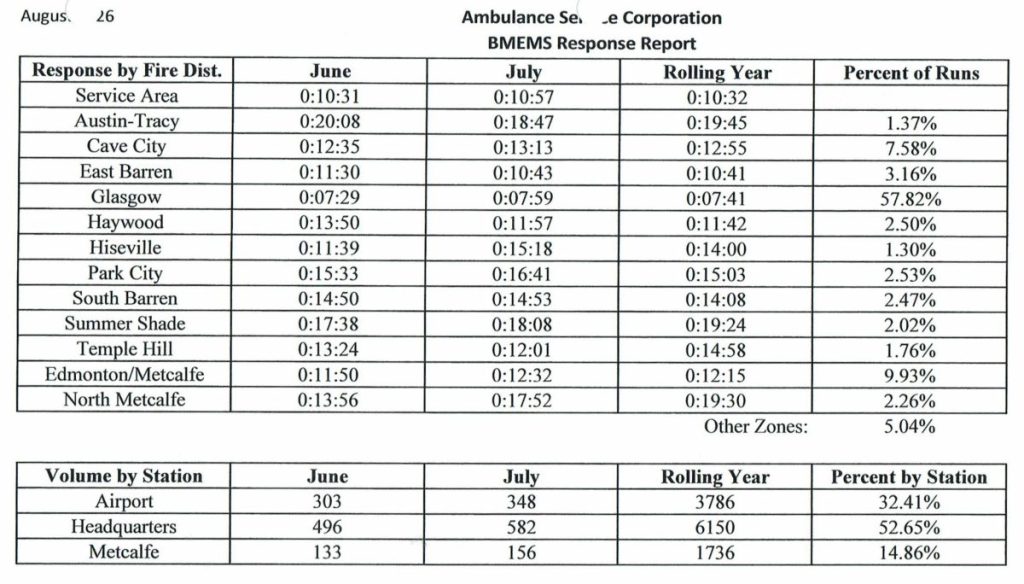
The top section shows the June and July call response times by location, and the bottom section shows calls per station for each month. Chart provided by the Ambulance Service Corporation
Clinical Report
In the clinical review report for the months of June to August, we had 700-day clinical care reports, and 35% of those were reviewed. They are going to increase the overall number of runs being reviewed as they add staff until 100% are being reviewed.
Haywood Station Update
Middleton gave an update of the Haywood Station’s construction, “The Haywood building is coming along very, very quickly. I was down there today. They were doing some excavating to prepare for the pavements. The garage doors are up. They’re painting the inside… We just talked about how we’re going to finish the floor.”
In attendance were contractors Mr. Collins, who stated, “As far as timeline to be done, we expect by the second week of October. So, we’re well ahead of schedule… We had done a few work order changes. One was concrete. We went to 4,000 BSI times. That’s right. So, it was originally spec’d 3500. 3500, so we increased that. And went thicker… We added on the generator… We tripled the size of the storage overhead, finished it, heated and cooled it.”
The theme for the construction has been what can we do so that this does not have to be repaired for the next 20 years, said Middleton, who noted the outside is all metal, no landscaping, the cement goes up to the walls, and then blacktop.
Grants
The RHT Rural Health Transformation Grant. “This is a crisis-to-care grant. $212 million was sent to the state for them to farm out. The first three things they wanted to fund were mobile training units. Treat No Transport (TNT) with Alternate Transport Destination (TAD) and a Community Paramedic Program… We applied for the mobile training unit, and we applied for the alternate transportation in Treat No Transport,” reported Middleton.
“We were awarded $825,000 for a mobile training unit… We’re expecting funds to start moving in October, and then we will immediately start putting together this training unit,” stated Middleton, who noted that there will be two adult, one child, and one infant simulation mannequin in two complete ambulance training sections.
They also applied for the TNT and TAD grants. “If we could find a way to treat people at home and not transport them, and still get our ambulance fee for that, or transport them to an alternate destination so that we’re not continually bottlenecking the hospital campus,” explained Middleton. They were awarded $129,000 to develop that program.
Middleton explained the Ambulance Supplemental Payment Program (ASPP) next. “We have been receiving the GEMT money, which is the Medicaid assessment money, to the tune of about $750,000 a year minus what we have to pay. The assessments have come back from the ASPP.”
“We get to pay them $40,162 for the first quarter. We have to pay them to participate. Once we pay them, we will get our drawdown from them in the amount of $196,394.”
The ASPP is paid by quarter, so that will be around $600,000 per year, and only government-funded services qualify for the funding.
They also applied for the AOT grant to upgrade the monitors from the LIFEPAC 15s to the LIFEPAC 35s. If received, that grant of $875,000 would replace all the monitors. A professional grant writer was used for this, and they get approximately 12%.
Middleton requested permission for an RFP for one ambulance (28-29 fiscal year) each year for Barren County instead of two every other year. The request was approved. Metcalfe would remain at one ambulance every two years.
The next meeting is scheduled for October 28, 2026, at 4 p.m. in Barren County at the new Haywood Station.
With no other business, the meeting was adjourned.