About Measles
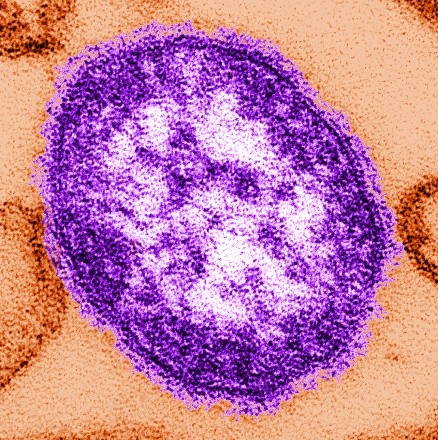
A single measles virus particle digitally colorized, thin-section electron microscopic image. Courtesy of CDC/ Cynthia S. Goldsmith; William Bellini, Ph.D.
By PJ Martin
Editor
The Herald-News
It’s a disease we haven’t heard a lot about in several years, but suddenly, Measles is in the spotlight again. Some of us older folks might remember being lined up at school and given the vaccination by a nurse from the Health Department.
Are those people immune now? If you were one of the people vaccinated for measles between 1963 and 1968, you need to check and see which vaccine you received. Vaccinations given during that period using an inactivated form of the virus that isn’t as effective as today’s vaccine. If you don’t have or can’t find your vaccination record, it is much easier to just get a new shot.
It will take approximately two weeks for your body to build up its immunity after receiving the vaccinations.
You can be exposed to Measles and not realize for 10-12 days when you start to feel the symptoms. The symptoms are a fever which can be up to 105⁰, fatigue, cough, conjunctivitis, and finally the rash, which usually begins at the hairline or on the face and travels down the body.
Today in the U.S., the first dose of the MMR (measles, mumps, and rubella) vaccine is recommended at 12–15 months of age, and the second dose is recommended at 4–6 years old, right before children enter school. The two doses are needed to fully protect from the measles virus.
However, the CDC suggests that infants ages 6 – 11 months traveling internationally should get vaccinated before traveling. Then get the regular two doses of the vaccine as scheduled.
The CDC reports that as of December 31, 2024, a total of 285 measles cases were reported by 33 jurisdictions: Arizona, California, District of Columbia, Florida, Georgia, Idaho, Illinois, Indiana, Louisiana, Maryland, Massachusetts, Michigan, Minnesota, Missouri, New Hampshire, New Jersey, New Mexico, New York City, New York State, North Carolina, Ohio, Oklahoma, Oregon, Pennsylvania, South Carolina, South Dakota, Tennessee, Texas, Vermont, Virginia, Washington, Wisconsin, and West Virginia.
About 1 in 5 unvaccinated people will require hospitalization from measles. In 2024, that rate was even higher—about 40% of people with measles were hospitalized, according to information from Johns Hopkins School of Public Health.
Scientists have found that measles wipes out the body’s memory of bacteria and viruses. This weakens your immune system, making you more likely to get sick from other diseases even after you recover from the Measles.
According to Pediatrician Liz Mumper with the Independent Medical Alliance between 2000 and early 2025, there were 4,499 cases of measles in the U.S. That averages around 180 cases per year. The disease is far more common in underdeveloped countries and in malnourished individuals.
Don’t listen to the panic tactics used by some national news outlets. Here are some facts about Measles:
- Measles is a virus, a member of the paramyxovirus family.
- Highly contagious, spread by respiratory droplets.
- The incubation period is 10 – 12 days.
- Symptoms: red rash, high fever, cough, runny nose, and red eyes,
- Can have serious complications: pneumonia or encephalitis (brain inflammation).
- The MMR vaccine is very effective at preventing measles.
- The MMR vaccine is given in two doses.
- Measles is a common global health concern.
- Humans are the only natural host for the Measles virus.
- Isolating those with Measles is necessary to prevent the spread.
- The Measles virus can survive in the air and on surfaces for up to 2 hours.
- The virus can be imported into the country by individuals.
According to the CDC, as of March 20, 2025, a total of 378 confirmed measles cases were reported by 18 jurisdictions: Alaska, California, Florida, Georgia, Kansas, Kentucky, Maryland, Michigan, New Jersey, New Mexico, New York City, New York State, Ohio, Pennsylvania, Rhode Island, Texas, Vermont, and Washington.
Per the CDC, Measles is a highly contagious virus that lives in the nose and throat mucus of an infected person. It can spread to others through coughing and sneezing. If other people breathe the contaminated air or touch the infected surface, then touch their eyes, noses, or mouths, they can become infected. The virus can live for up to two hours in the air and on surfaces.
Measles is only spread from person to person. Animals do not get nor spread measles.
An infected person can spread measles to others even before knowing they have the disease. You can spread measles to others from 4 days before through 4 days after the rash appears. Once diagnosed, the patient must be kept in isolation to prevent the spread of the virus.
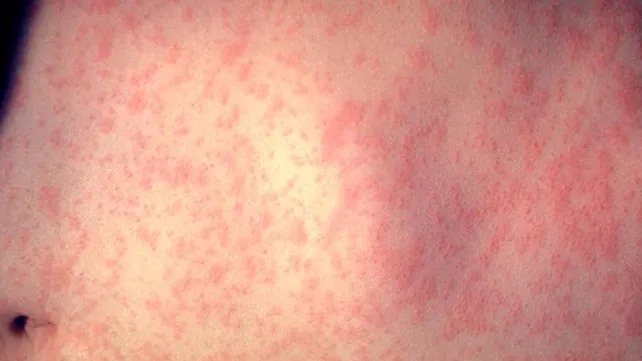
Measles produces a splotchy reddish rash that spreads from head to foot. www.healthline.com/health/rubeola-measles-pictures