Preventing heat-related deaths
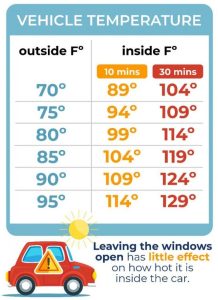
Temperatures rise very quickly inside vehicles as this chart sGraph by Car Direct USAhows.
By PJ Martin
Editor
The Herald-News
We hear it every year when the weather gets hot, a child accidentally left in a hot car with deadly consequences.
The first thing you ask yourself is, “How could you forget your child?”
It’s easier than you think, especially if you are breaking your normal routine and you aren’t the parent who usually transports your child to daycare.
Perhaps you forgot to lock your car and your small child decided to play inside and accidentally becomes locked in and trapped?
The National Safety Council states that 29 children died in hot cars in 2023 and nearly every state has had at least one child death since 1998. According to Kids and Car Safety, a nonprofit organization, seven child deaths have already occurred in 2024. On average, 37 children under the age of 15 die each year from heatstroke after being left in a vehicle.
At least 1,090 children have died in hot cars nationwide since 1990 and another 7,500 survived with varying types of injuries, according to data collected by Kids and Car Safety.
The Council for Intellectual Disability states that the statistics of elderly or disabled people left in hot cars are virtually unknown as these deaths are not widely reported.
People don’t give adults sitting in a car alone a second glance, so many cases of neglect go unnoticed. But even when they are reported, sadly they don’t receive much attention. Some disabilities are not easily recognizable, so if you see an adult alone in a hot car who looks flushed, distressed, or dehydrated, ask them if they are okay.
It isn’t just humans that die of vehicular heatstroke, your pets can too. According to data from Peta.org, in 2023 there were 47 deaths and 103 rescues of pets left in hot vehicles and that is only the ones reported. The majority are believed to be unreported leading to much higher numbers.
Heatstroke can happen in just minutes, even with the car’s windows partially rolled down. Opening a window slightly won’t help. Parking in the shade or leaving water in the vehicle won’t prevent an animal from overheating either.
How vehicles overheat
No matter how hot the temperature is outside, it is going to be much, much hotter inside a vehicle. The sun emits energy in the form of shortwave radiation and that goes right through the glass windows. The inside materials (seats, dash, etc.) soak up that energy and then radiate it back in the form of longwave (infrared) radiation. This heats the air in the vehicle to dangerously hot levels. Even if the windows are slightly open, this process still heats up the interior, because longwave radiation cannot go through the glass as easily and the open section of a window releases less than what is radiating inside. Add to this high humidity of Kentucky and it becomes deadly very quickly.
Protecting people
When it comes to safeguarding children, it is best to stick to routines, because if you are usually the one to transport the child, you will be more likely to complete the routine. Sudden changes in routines can confuse and make it easier to forget you have your child with you.
Place an object such as a purse, cell phone, or briefcase in the back seat with your child. This forces you to access the back seat when getting out of the vehicle and interacting with your child. The National Safety Council even suggests placing your left shoe in the back seat as a reminder.
Keep your car doors locked so children cannot wander inside and become trapped. Teach children that playing in cars is dangerous.
Never leave a child, a disabled person, or an incapacitated person alone in a vehicle, not even for a few minutes.
Heatstroke symptoms to look for are lethargy, confusion, slurred speech, unconsciousness, seizures, hot dry skin, a very high body temperature, and a rapid heartbeat.
If the worst happens, call 911 immediately, place ice packs on the victim’s forehead, neck, and armpits, and move them to a cooler place if possible. Stay with the person until medical help arrives.
Protecting animals
Animals are susceptible to heat strokes just like humans. The heat inside a car can be deadly. Humidity plays a crucial role in heat stroke in animals also.
Leaving the windows down slightly does nothing to help with heat build-up. Animals pant to evaporate moisture from their lungs and to take away heat from their body. If the humidity is too high, this doesn’t work well and animals of all types overheat quickly.
PETA.org receives reports about dogs, cats, and other animals who have died as a result of being left in hot cars or outside during extremely hot weather. In 2023, 163 animals endured heat-related deaths, another 855 were rescued from the heat, and those are just the ones that were reported.
A temperature of 103⁰ is considered a fever for dogs and if their temperature reaches 106⁰, it becomes a very serious situation, according to the Humane Society Veterinary Medical Association.
Animals that are at a higher rate of heatstroke are very old, very young, overweight animals, and breeds such as Boxers, Pugs, Bulldogs, Shih Tzus, and cats with shorter muzzles. Signs of heatstroke in animals are glazed-looking eyes, heavy panting, difficulty breathing, lack of coordination, salivating, vomiting, a deep red or purple tongue, seizures, or unconsciousness.
Never leave your dog, cat, or any other animal in a hot car. It’s like being baked alive! If the worst occurs, apply ice packs to the head and neck, pour cool (never cold) water over the lower portion of the animal, and do not place wet towels over the animal as they trap heat. Place wet towels under the animal, and take them to the veterinarian immediately.
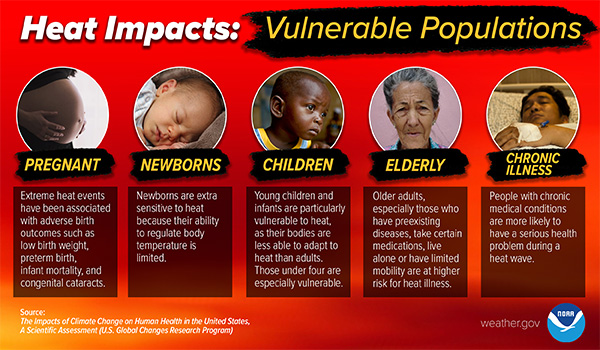
The most vulnerable people in extreme heat situations.