This little light

The Photinus pyralis firefly is one of several firefly species in Kentucky. Photo courtesy of National Geographic
By PJ Martin
Editor
The Herald-News
Have you ever sat outside on a warm (and humid) southern summer evening and watched the bright little twinkling of lightning bugs in your yard? Most of us as kids thought it was fun to run around and catch the “bugs” and put them in a jar. I’m not sure if the kids of today even think about doing that with all the game consoles and phones to keep them occupied.
We in the South refer to the little critters as lightning bugs, but they are in reality a type of beetle and if you want to get technical, they are called fireflies. Amazingly, there are more than 2,000 species of fireflies and despite their name, only some species produce the glow. For example, there are species of fireflies in the western United States that do not have the ability to produce light. Of the ones that do, their light can be yellow, green, or even orange.
How do they produce that glow? Fireflies are bioluminescent (meaning they produce their own light) by a chemical reaction within a light organ in their abdomen. Oxygen mixes with calcium and adenosine triphosphate (ATP an energy carrying molecule), and a chemical called luciferin. The beetle’s light organ has three layers, the reflector, the light cells, and the transparent exoskeleton. The chemical reaction occurs in the light cells and the reflector does as its name implies – it reflects the light produced, while the transparent part of the body allows the light to be seen.
Producing the light is a very efficient process and almost 100% of the energy is given off in the glow. Entomologists believe that the firefly can regulate the amount of oxygen allowed into its abdomen and thus control the glow pattern produced.
The lightning bugs we see are mostly male; however, most of the females can also glow. The males use their light to attract females and the various species have their own blinking patterns. Female fireflies wait on bushes or grasses lower to the ground and answer with a species-specific blink. Heavy rains or cooler temperatures can cause them to slow their flash.
According to the Brandywine Conservatory in Pennsylvania, fireflies are found in every state except Hawaii. Some firefly species have been assessed for extinction risk by the International Union for the Conservation of Nature (IUCN) Red List, but most of those species are in the mid to southwest of the United States. Entomologists are not sure why the populations are dwindling, but believe it is due to habitat loss, toxic chemicals in the water meant to kill mosquito larvae, or pollution.
As with most insects, fireflies go through metamorphosis with four distinct stages: egg, larva, pupa, and adult. Some of the larvae can glow too. It is a defense mechanism against predators and they can produce a steroid that is supposed to taste bad to predators.
The complete life cycle can take anywhere from a couple of months to two-three years, with the majority of their life as larvae. While in the larvae stage, they are predators of soft-bodied invertebrates like snails, slugs, and worms which they usually hunt for in moist soil or marshy areas. They use their mandibles to inject their prey with paralyzing neurotoxins. Once their prey is immobilized, they secrete digestive enzymes that liquefy the prey so they can consume it.
The way the larvae eat sounds extremely violent in comparison to the small glowing creatures we see flying around in the twilight.
Fireflies tend to cluster around moist areas and are usually seen on humid nights. If you want your yard to attract fireflies, you’ll need to provide them with a source of water. Calm water features like bird baths and fish ponds can be firefly attractors, but be sure to watch out for mosquitoes.
You can also use plants such as verbena, salvia, wisteria, foxgloves, and lupine, because their flowers are high in nectar. These plants also attract butterflies and bees. To help attract all these insects add in some daisies, mums, and sunflowers, because they have more pollen. Fireflies also like taller grasses, native trees, and darker areas in order to project their glow best.
Just remember their whole life span as an adult firefly is at best a couple of months and they are trying to find a mate during that short time. If you catch and put them in a jar for a couple of days that amounts to a good portion of their life span. So, it is much better to catch and keep them for a couple of hours, watch them, and release them.
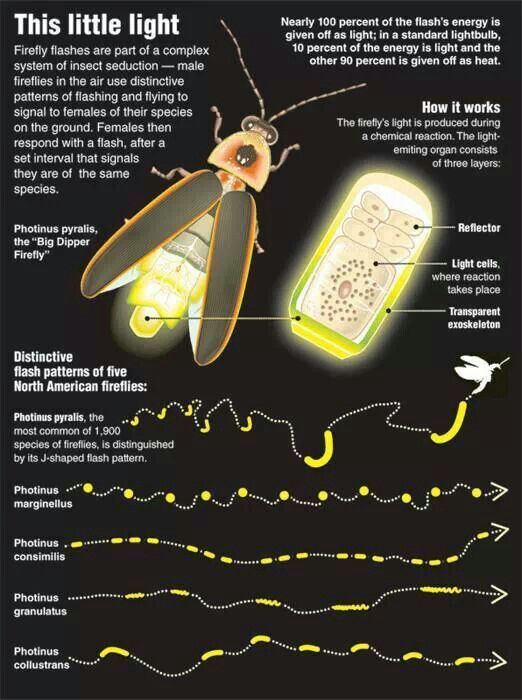
The chemical reaction process is explained along with the various flash patterns that are produced. Chart courtesy of Pinterest