The Wonders of Our World
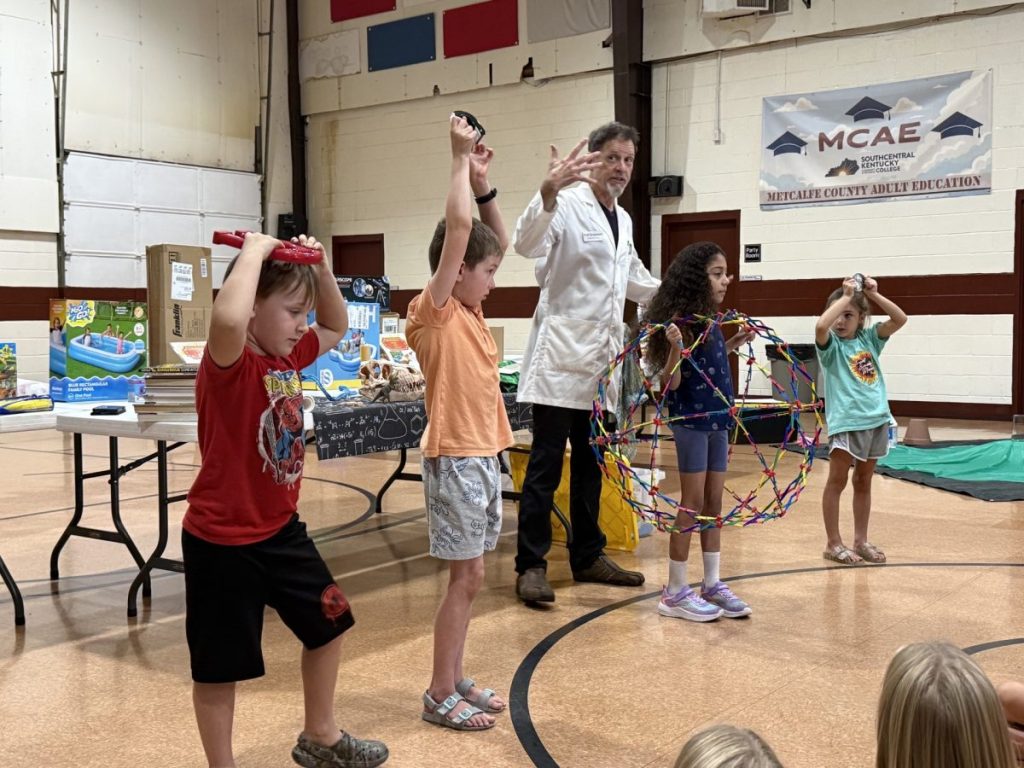
In this demonstration, the girl inside the Hoberman Sphere is Earth. The first boy is magnetic, the second boy is iron, and the last girl is nickel. The Earth spins on its axis; the Earth’s core has liquid nickel and iron and creates a magnetic force around the Earth at each pole. Photo | PJ Martin
By PJ Martin
Editor, The Heralds-News
The last in a series of special programs sponsored by the Metcalfe County Public Library was held last Wednesday at the Bowling Park gym.
There were several young children ready and waiting for Professor Graybeard to start the show at 10 a.m. He called it “Journey to the Center of the Earth”.
He began by talking about the Earth in the beginning, approximately 13.8 billion years ago, according to scientists. He had posters showing everyone beginning with a planet of a volcano-like landscape as it formed Earth. Next, the gases formed, then the water, then the Isopods, and later on the dinosaurs.
Using pieces of metal on the ends of two ropes, he showed that they do not attract and stick together at all, but when he puts the battery in one, they magnetically stick together. He asked two volunteers to represent dinosaurs and pull them apart.
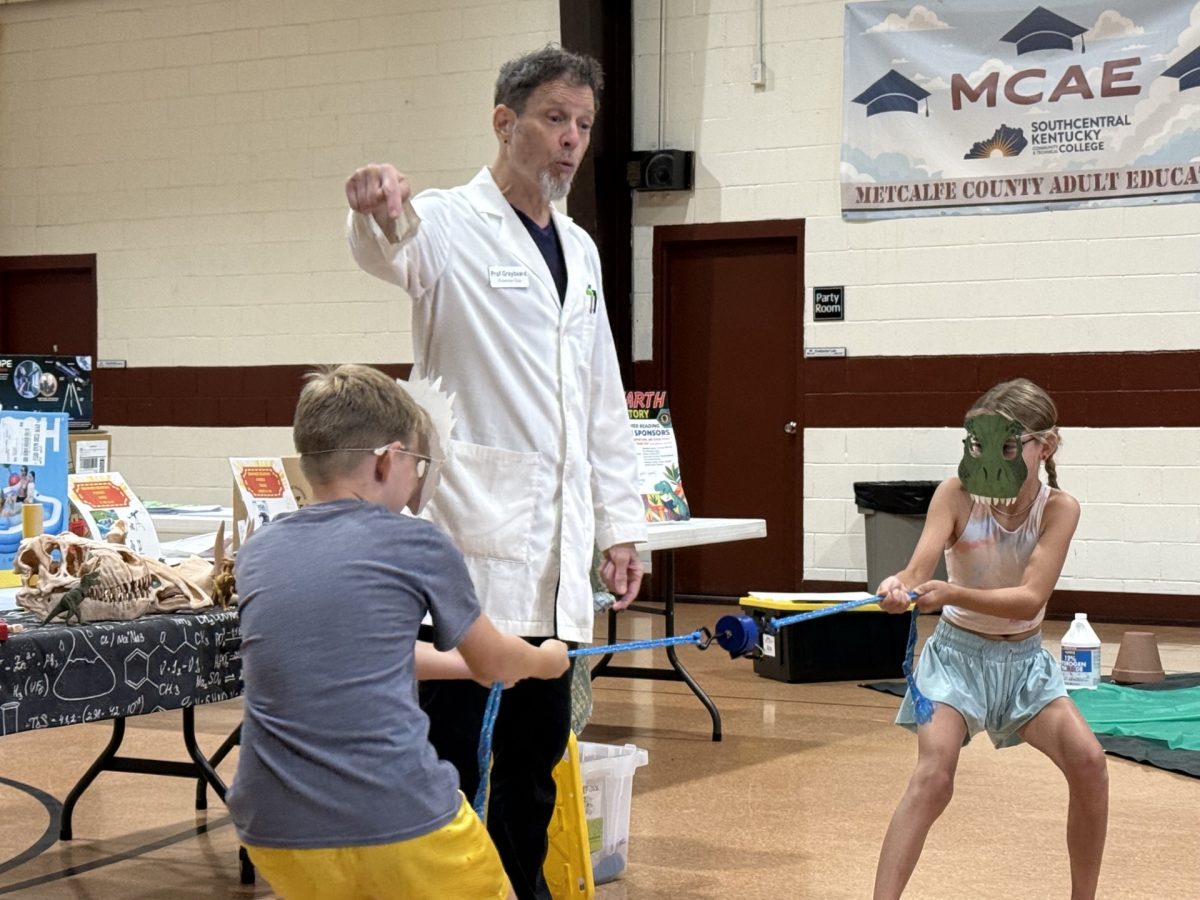
These volunteers are posing as dinosaurs trying to pull the magnet apart. They cannot until the battery is removed. Professor Graybeard is explaining electromagnetic properties. Photo | PJ Martin
He then explained that the battery moved electricity through the metal wire core and caused the cores to become electromagnetic, and the iron sticks together.
Explaining that Earth is the 3rd planet from the Sun, he then explained gravity and how it weighs objects down to the ground.
He asked volunteers to help him, and one girl was placed inside the expanded Hoberman Sphere to represent Earth. She could turn on her axis (twirl around). Then one girl held nickel, and a boy held iron, and another boy held a magnet. The Earth has a magnetic field that protects it, because the Earth’s core is made of nickel and iron and magnetizes the poles.
After explaining how things work and telling everyone what things are called, he would then ask them to repeat it back to him as he demonstrated.
He also demonstrated how fossils form. He used a plastic dinosaur lying down on the grass (a green piece of felt), then an earthquake came and a mud slide and covered the dinosaur up with layers (more felt), until a paleontologist comes along and finds the bones, but they are no longer bones. Minerals have replaced the bone, and they are now mineralized fossils. You can see them in museums.
He also demonstrated how some bones are hollow, but they are still strong, by placing a hollow tube on the floor and stacking books on top of it. It does not crush.
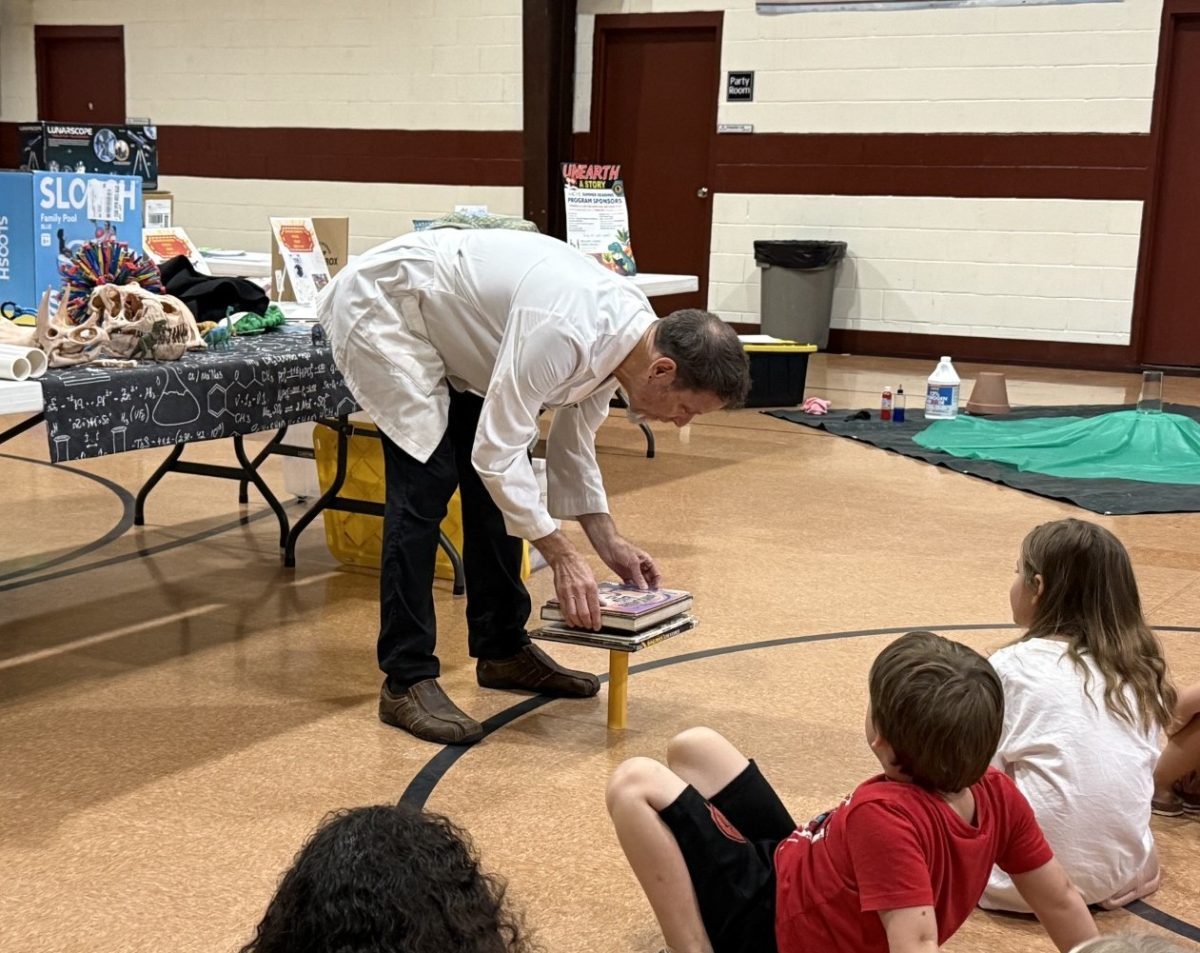
After talking about birds and some dinosaurs having hollow bones, he showed how strong a hollow tube representing a hollow bone can be. Photo | PJ Martin
He used fabric dinosaur footprints to demonstrate how far apart the tracks would be for different types of dinosaurs.
The last thing demonstrated was the volcano. He explained the difference between peroxide (H₂O₂) and water (H₂O). Then he added peroxide into the volcano’s interior glass vase, added red food coloring, then another chemical that he stated would burn your skin, and the volcano erupted.
Following the science presentation, the library held its finale for the Summer Reading Program.
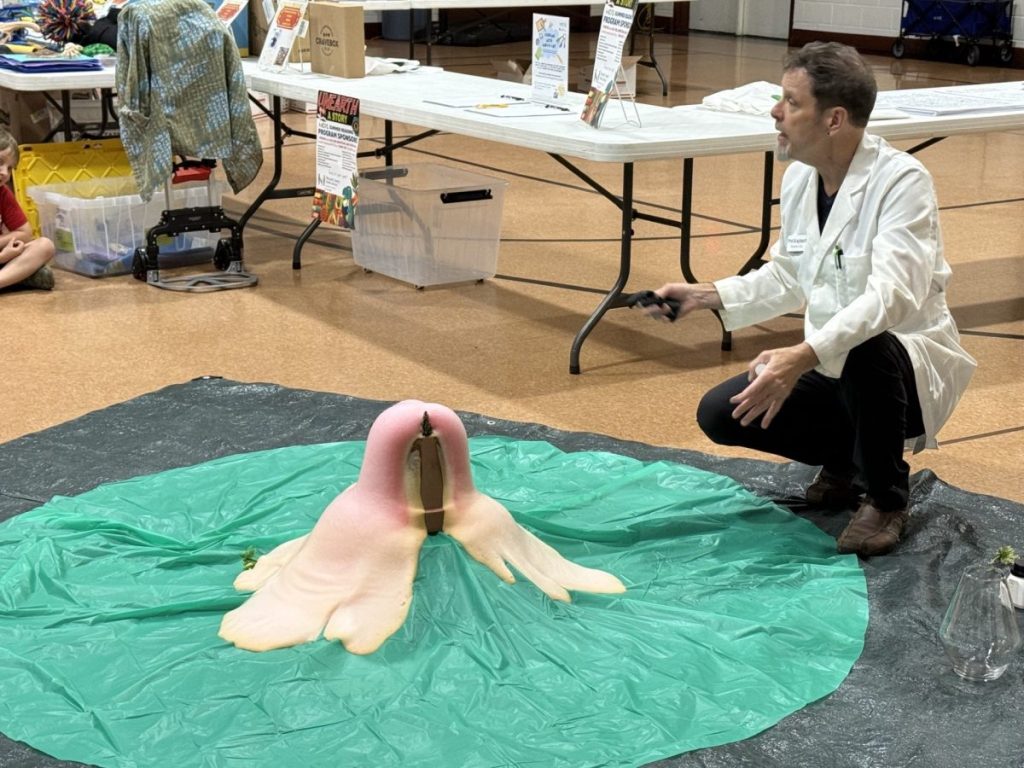
After explaining earlier about the Earth forming, he used peroxide and another ingredient to make the volcano erupt. He also explained the difference between peroxide (H₂O₂) and water (H₂O). Photo | PJ Martin