Cancer’s Tough, But My Mom’s Tougher
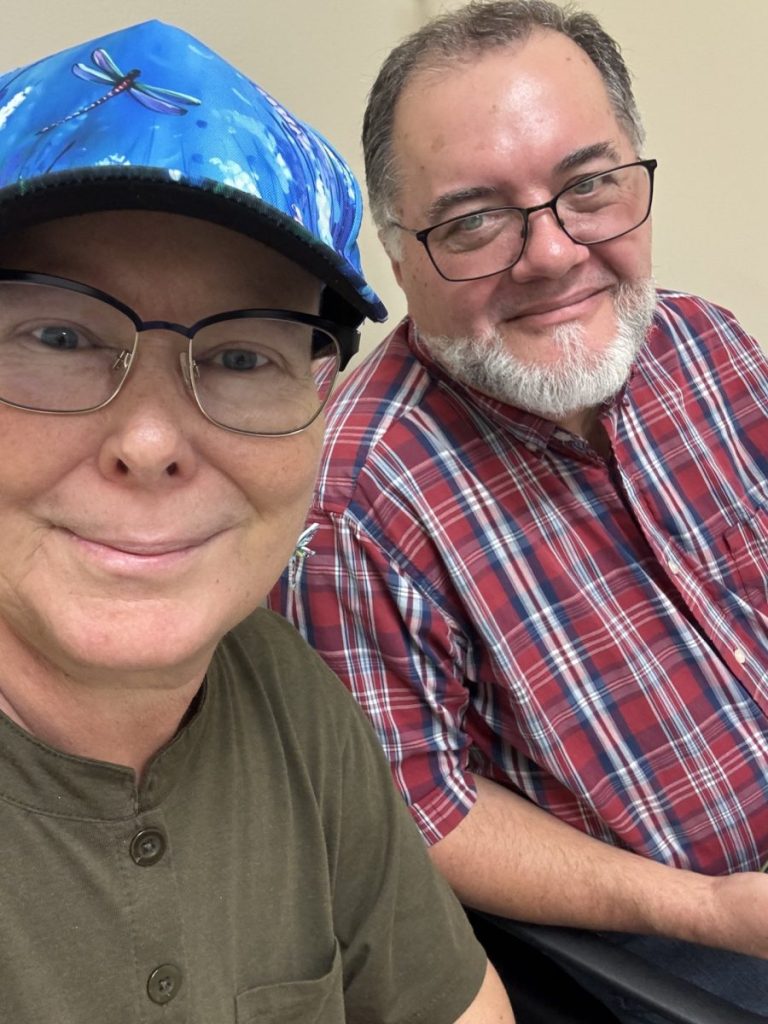
Ginger and Joey Acree. Family Photo Submitted
By PJ Martin
Editor, The Herald-News
A journey of faith, family, and fighting back.
For one local mother, wife, and longtime foster parent, the words “you have cancer” began a journey she never expected to take.
Ginger Acree’s diagnosis was aggressive — stage three triple-negative metastatic breast cancer — and the treatment that followed would stretch from early 2025 through the summer of 2026.
There were surgeries, chemotherapy, immunotherapy, and radiation. There were painful complications, exhausting side effects, and days when simply standing up was a challenge.
But through it all, she kept returning to two things that have guided her life for years: her family and her faith.
Along with her husband Joey, she has spent 22 years fostering children and has cared for 68 during that time. Together, they have nine children, eight adopted and one biological, ranging in age from 4 to 34. Six children are currently at home, with seven living there until recently, when Michael moved out. Their biological son, Colton, is 29.
Some of the children have significant special needs, including autism, NAS, and complex medical conditions. One 16-year-old has already undergone two open-heart surgeries and may eventually require a heart and liver transplant. Her youngest child was born with NAS.
Being a caregiver was nothing new to her.
Her own family history includes cancer and serious medical conditions. Her mother battled leukemia, multi-organ cancer, and underwent 48 surgeries. Another family member had leukemia, her father had melanoma, and her sister had a kidney removed.
For much of her life, she had been the person helping take care of others.
Then she became the patient.
The lump that wouldn’t go away.
The first signs came gradually. In May 2024, she had a mammogram and a skin biopsy on her right breast. The biopsy “came back okay.”
By December, however, she began not feeling well. She also noticed a lump in her right breast.
In January 2025, doctors initially believed the mass could be a cyst. She was advised to use heat and, later, was given antibiotics because she had experienced cysts in the past.
But the lump continued to grow.
By February, what had started about the size of a dime had become, in her words, the size of a “jumbo egg.”
That rapid change prompted urgent imaging, including an emergency mammogram in Glasgow at TJ, along with a PET scan, MRI, and ultrasound.
The diagnosis was stage three triple-negative metastatic breast cancer, initially described as stage 3C.
Triple-negative breast cancer does not have the hormone receptors targeted by many other breast cancer treatments and can be particularly aggressive and fast-growing. Treatment had to start immediately.
The cancer had spread to lymph nodes in the right armpit and into the subclavicular lymph nodes, which could not be reached surgically. Genetic testing showed that the cancer was not inherited.

Ginger before losing her hair to the chemotherapy treatments. Family Photo Submitted
“I never thought I would be the one,” she said of her diagnosis.
Treatment began quickly
A port was placed March 5, 2025, and her first chemotherapy infusion followed March 12. The first five months of chemotherapy consisted of three medications: Carboplatin, Paclitaxel, and Keytruda. After the five months, she received one dose of Doxorubicin, often called the “Red Devil.”
“The Keytruda caused me to have medicated hepatitis with very elevated liver levels… the Doxorubicin was the worst one,” explained Ginger.
One complication involved a partial collapse of her lung, which she attributed to the Doxorubicin. She required daily injections while recovering.
There were also dizzy spells that became so severe she sometimes experienced temporary loss of vision and hearing, and had to use a wheelchair. Her blood pressure could vary dramatically and was particularly low in the mornings.
She also experienced nausea and vomiting, headaches, neuropathy, temperature swings, dry mouth, and a metallic taste.
And then there was the fatigue… debilitating fatigue.
She describes the effects of treatment as something that can “stack up” in your body over time.
She learned that finishing treatment did not mean the side effects immediately disappear and was told Doxorubicin-related effects could continue for months, and she experienced the effects of immunotherapy for months after completing it.
Surgery brought another battle.
In August 2025, she underwent a double mastectomy and had 12 lymph nodes removed from the right axillary area. The drains remained for approximately three weeks.
The lymph-node dissection was, she said, “one of the most painful parts” of the entire experience.
Even after the surgery, she experiences nerve pain in her arm and elbow, electrical-shock sensations, numbness, and what she described as a deep “inside itch.”
The physical changes brought emotional challenges as well. She has worked through the changes to her appearance by maintaining her confidence and, when desired, using a prosthesis.
“I was told that I would lose my hair, but I never thought that I would lose my eyelashes, eyebrows, nose hairs, and toenails,” she said. “Some people lose fingernails; mine were damaged. I had to shield my eyes for safety, and my nose was always running. You don’t think of things like that really.”
Rather than wigs, she prefers breathable headscarves because wigs were too hot.
Immunotherapy, surgery, and radiation
After the mastectomy, treatment resumed in September with immunotherapy. That treatment continued for approximately seven and a half months, ending in late April.
The immunotherapy brought its own challenges, particularly severe fatigue.
Later scans revealed a benign nodule in the left adnexal area near the ovary and colon. She subsequently underwent a complete hysterectomy at the end of June.
Around the same hospitalization, she also dealt with kidney stones and passed several.
Radiation followed the hysterectomy, undergoing 25 radiation treatments beginning in early July and continuing through Aug. 22. The radiation was directed toward the breast and lymph areas that could not be reached surgically.
Radiation caused burns, redness, and mild blistering, with darkening of the treated skin that has persisted.
One product she particularly recommends to other patients is “LINDY cream,” which costs approximately $25 for a small bottle. She credits it with helping reduce the burns and blistering.

Keeping her spirits up by wearing her frog hat. Family Photo Submitted
Learning how to live through treatment
Cancer treatment became an exercise in adapting.
She learned to rearrange things around the house so frequently used items were at waist level. Bending and reaching became difficult when fatigue was severe.
For the metallic taste and dry mouth, she found plastic utensils, lemon drops, and lemonade helpful. She also used Biotene mouth rinse and spray and, at times, a prescribed “swish and swallow.”
For neuropathy and head pain, she used thermal socks and ice socks, ice gloves, and an ice cap.
During chemotherapy, she also learned about the importance of protecting her family from exposure to chemotherapy drugs by following strict toileting and cleaning practices.
She drove herself to many immunotherapy and radiation appointments, although she needed someone else to drive during chemotherapy. Her son, Colton, helped with some of the immunotherapy trips.
Her husband, Joey, works second shift. He initially did not use the Family and Medical Leave (FMLA) during chemotherapy, but eventually obtained it beginning in late July.
She strongly recommends that patients and families investigate FMLA early rather than waiting until they are already overwhelmed.
Finding strength in faith
Throughout the ordeal, her faith remained central.
She asked her church for a healing service and repeatedly emphasized the importance of prayer and accepting God’s will.
Her outlook is not that she has control over everything that happens. Instead, she believes she can control how she responds.
Her church family provided prayers and support, while fellow cancer patients became another source of encouragement. Friends have provided her with gifts of food, gas cards, and fun items.
She also used humor. At times, she wore themed outfits, including a frog hat and shirt, to bring some laughter into difficult days and to lift the spirits of those around her.
Her son, Russell, put her resilience into words, “Cancer’s tough, but my mom’s tougher.”
She has one amendment, “I’m only tougher with God.”
The importance of understanding recovery.
Recent scans following radiation have been described as “good.” Her oncologist has not formally declared her in remission, however, and surveillance will continue. One area receiving particular attention is a nodule near the lung.
She continues to see multiple specialists and has worked with three oncologists during her treatment, although she has now finished with one of them.
For her, a “good” scan is encouraging, but it does not mean everything immediately returns to normal.
One of the most important messages she wants families to understand is that remission, when it comes, does not necessarily mean instant recovery.
Fatigue, cognitive changes, nerve problems, and other physical effects can continue for months or even years.
Family members need to understand that a cancer survivor may be grateful to be finished with treatment while still being unable to do everything they once could.
“Set expectations with your family,” she advises. “They need to know that you’re going to be tired.”

Some days are worse than others. Family Photo Submitted
She also stresses that every breast cancer journey is different.
Don’t treat a prognosis as a deadline.
Ginger’s strongest message is directed toward people who receive a frightening diagnosis. “If an oncologist tells you that your prognosis and/or lifespan isn’t hopeful, don’t ever give up.”
“If you must be upset, then pick yourself back up. Every morning, find something to be grateful for and focus on it.”
She chose not to look at a prognosis as a deadline. “I looked at that, not as a deadline; but as an obstacle to overcome.” That attitude has carried her through more than a year and a half of treatment, but there are still challenges ahead.
She has additional kidney and specialist appointments, continued surveillance scans, and plans for right ankle surgery, with a possible right knee meniscus repair. She would prefer to schedule those procedures after the holidays so she can preserve family time.
After Christmas, they hope to take the children to Dauphin Island, Alabama, for a short family trip.
It is a simple plan, but after everything she and her family have endured, it represents something important, looking ahead.
For 22 years, she has opened her home to children who needed a family. During the past two years, she has had to allow others to care for her. Through cancer, surgeries, complications, and recovery, she has continued to be a mother, wife, caregiver, and woman of faith.
Her story is not simply about surviving cancer. It is about learning to accept help, finding strength when the body is exhausted, keeping faith when answers are uncertain, and continuing to make plans for tomorrow.
And, most importantly, refusing to mistake a difficult prognosis for the end of the story.

Ginger ringing the bell after her last chemotherapy treatment. Family Photo Submitted