Town Hall on Zoning, Solar Farms
By Angela Briggs, Freelance Writer
A correction to this online story has been added to correct one of the speaker’s ownership of solar panels to a single panel. Former Judge/Executive David Dickerson is the owner of a single panel that operates the opening and closing of a gate on his property. We apologize for this error and a correction for our printed publication will be issued in next week’s newspaper.
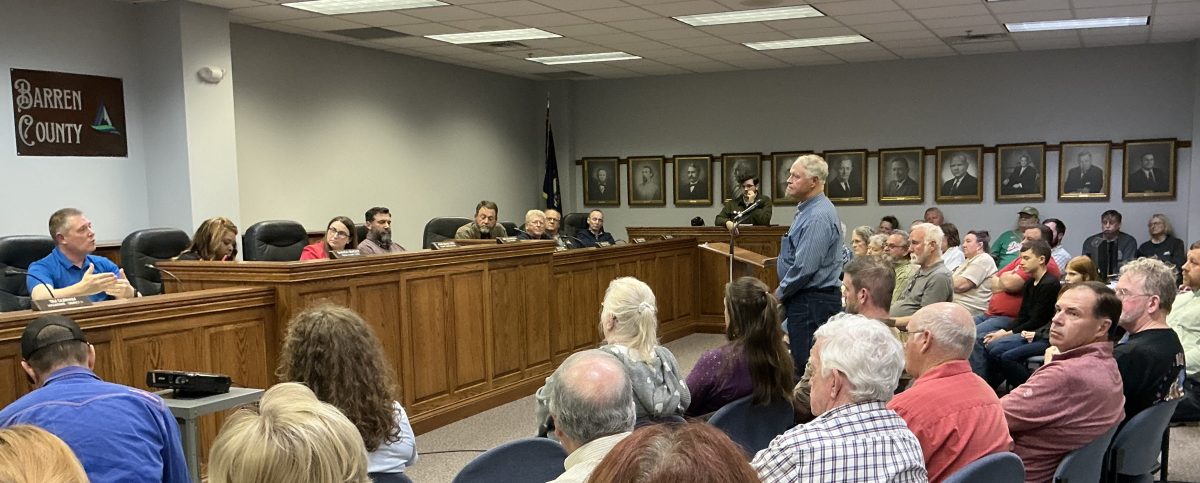
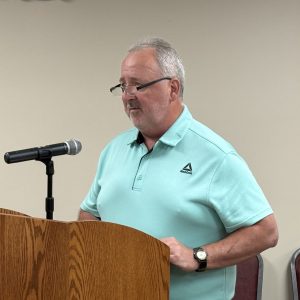
Ken Weineger owns and operates a farm in Barren County and shared his concern on how zoning would impact farms in the county at a recent town hall meeting. Joint City-County Planning Commission Director Kevin Myatt said farmers are protected by the “Right to Farm Act”, so it won’t impact them. Photo | Angela Briggs
A town hall forum was held on April 2 where citizens and elected officials discussed solar farms and county zoning. The meeting drew a standing room only crowd in the Barren County Fiscal Courtroom. Discussions on the 100-megawatt solar farm planned for southern Barren County, and zoning in general, began online in recent weeks and quickly spread into the community, leaving many people wondering what exactly was going on.
The forum was called by Barren County Judge/Executive Jamie Bewley-Byrd to “get everyone on the same page and to clear up any misunderstandings about the solar farm and zoning in general.”
KRS 278.700 defines a merchant electric generating facility (commonly referred to as a solar farm) as “an electricity generating facility or facilities that, together with all associated structures and facilities: (a) Are capable of operating at an aggregate capacity of ten megawatts (10MW) or more; and (b) Sell the electricity they produce in the wholesale market.”
In December of 2023, the Joint City-County Planning Commission (JCCPC) unanimously approved a variance for Geenex, a national developer of greenfield utility-scale solar projects, for a solar farm project in Barren County. (A variance is a request to deviate from current subdivision requirements and may only be granted on linear dimensions.)
Geenex had partnered with around a dozen property owners to install the large-scale solar farm on their land.
The variance request was submitted by an attorney on behalf of the company, which is typical for large corporations. The tracts of land that will become the solar farm are all connected, and the variance allows for continuous installation of solar panels across the different properties, without having to abide by the setback rules on the interior property lines.
The variance was in regard to the interior property lines; right-of-way setbacks on road frontage will still apply. The JCCPC has jurisdiction in variance approval only because of its oversight of subdivision guidelines. (State zoning regulations define a subdivision as a piece of property that is divided into two or more parcels.)
Based on state regulations, solar panels are considered structures, therefore they would have to abide by subdivision guidelines and setback regulations. Any changes to these setback regulations must be done at the state level and through the Public Service Commission (PSC). Variance requests are common, but must meet certain criteria in order to be approved by the JCCPC.
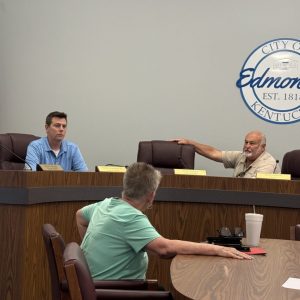
Judge Byrd allotted two minutes for each speaker, and afterward, there would be time to clear up any misunderstandings or misinformation. All magistrates were in attendance, as well as County Attorney Mike Richardson, JCCPC Director Kevin Myatt and several JCCPC members.
Tiffany Thompson was the first to take the podium, and she believes the solar farm would make surrounding property values go down. She asked if the county would adjust those affected property tax rates accordingly if the values did go down, and no definite answer was given.
State regulations were the next topic, more specifically the 1,000-foot setback that is required for solar farms and why this project did not have to abide by these rules.
Judge Byrd said this project would not be impacted because the 1,000-foot setback was a recent change made at the state level and “this project was already in motion before the change.”
When some in the crowd said “it’s just not right,” Richardson said it was in the statute, stating, “It’s not whether it’s right or wrong, but whether or not it abides by the law.”
“The process is long and detailed, and the state gives counties little authority to regulate solar panels,” Richardson added.
Adam Thompson said he did support county zoning, but he did not support the solar farm.
Judge Byrd said, “Even if zoning was put in place tonight, this project would still move forward.” She said she had met with the Public Service Commission (PSC), which has oversight of solar farms in Kentucky, the previous week, and she was told that as long as PSC requirements were being met, the project would continue to move forward.
How zoning regulations would impact farmers was a concern of several in attendance, and Myatt had a simple answer, “They won’t.”
Myatt said that agriculture and farms are protected in the Right to Farm Act that was passed in 1980. “Zoning would not dictate what barns need to look like, how many acres are tillable or anything else,” Myatt said, adding that farmers are the most protected individuals when it comes to zoning laws across the country.
David Dickerson said he felt that zoning would mean more regulation.
“We are already over regulated,” Dickerson, who has a single solar panel himself, stated.
He also said he would support implementing a tax on solar panels. Judge Byrd said that once in production, the solar farm would be taxed at the higher commercial rate, not the rate for agriculture.
Other concerns voiced by attendees included the lack of efficiency in the panels themselves, the potential for lithium to leach into the ground, the negative impact on the aesthetics of the landscape, and low community support. Richardson said that they cannot ban solar farms, adding the legislature decides the regulations, and they give the oversight powers to departments like the PSC.
When Eric Snyder spoke, he asked about revenue bonds for the project. (Revenue bonds are used to finance projects where the repayment amount is directly tied to the amount of revenue a project generates.)
Judge Byrd said the county is not part of the bonding process for the solar farm, with Richardson noting the bonds mentioned in the statute are for decommission, and they serve as proof that the company has enough money set aside to put the land back to its original state, should they decide to shut down the solar farm or if the company goes bankrupt.
Jimmy Stephens asked if the solar farm is a done deal, and Judge Byrd reiterated that the process is already in motion, and “Yes, it was a done deal.” He asked if a letter of disapproval from the court to the PSC would make a difference, to which the Judge reiterated that no, “this project was happening.”
The magistrates were given an opportunity to speak on the solar farm issue.
Magistrate Tim Coomer said he supported zoning because the county has to start somewhere in regard to land usage. When situations in other places were brought up by the crowd, Coomer said, “This is Barren County,” and the county would draw up their own rules based on local needs.
Magistrate Marty Kinslow said he believed that solar was getting a bad rap. He doesn’t see a solar farm any different than a housing development, and he is against anyone telling a landowner what they can do with their land.
Magistrate Ronnie Stinson said he was glad people got to speak their minds on this issue and let everyone know where they stand. He said he wouldn’t want solar in his front yard, but he’s not sure he could stop it either.
Magistrate Brad Groce said the court needs to hear everyone’s opinions and Barren County isn’t the only county talking about solar farms. He said while he wouldn’t want to see solar panels across from his farm, he also doesn’t really want to see subdivisions.
Billy Carver was one of the last to speak, and his summary of the discussion was “they don’t want anyone to tell them what to do with their land, but at the same time, they want to tell their neighbor what to do with theirs.”
Carver said that while he does not support zoning, there has to be some regulations, and the focus should be more about planning and development and not necessarily zoning.
Judge Byrd said that a county zoning plan does not exist as of now, and there is a lot of development going on in the county. Myatt said KRS requires the JCCPC to develop a Comprehensive Plan every five years, and this plan includes a future land use map.
“This isn’t zoning, but it is a best guess for future usage,” he added. Myatt also said if the Fiscal Court does decide to adopt zoning, it will not happen quickly, there will be numerous public hearings, and regulations could be tailored to meet local needs.
“Without zoning,” Myatt added, “the planning commission can do nothing.”