Tire and Trash Recycling
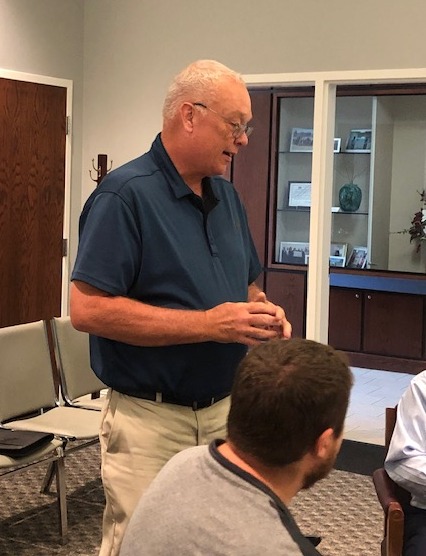
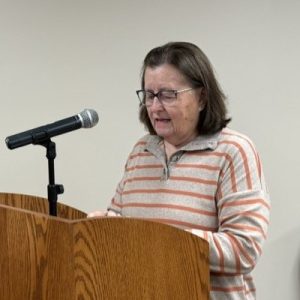
Chris Jeffries of CF Energy Solutions explains the process of tire recycling to the board as member Luke Wilson (seated) listens. Photo | PJ Martin
By PJ Martin
Editor
The Herald-News
The Edmonton/Metcalfe Industrial Development Authority (IDA) held its regular meeting on Monday, October 21st with board members Lisa Boswell, Jerry Garmon, Donna Caffee, Matt Gallagher, and Luke Wilson. Also in attendance were Mayor Doug Smith, Judge/Executive Larry Wilson, and reporter PJ Martin. The only member absent was Terry Garrett.
The minutes of the last meeting on September 16th were reviewed by those present. A motion to accept those minutes was made by Matt Gallagher and seconded by Jerry Garmon. The motion was approved.
Chairperson Lisa Boswell asked Treasurer/Secretary Alley Bragg to present the monthly financial statement.
The account balance as of October 18th was $26,420.98. Nothing different was noted, but the account drew $2.48 interest from ESB. This tiny amount caused Boswell to question whether part of the account balance would do better in a 6-month CD.
Bragg noted that the only bill expected would be for the audit and after much discussion, it was decided to leave the account as is. The financials were approved.
During other business, Chris Jeffries of CF Energy Solutions asked to address the board.
He began by saying, “I’d like to talk about some acres out there in the Industrial Park.” He later stated that he would need 10 acres in the back section and asked to see the plat.
Jeffries began, “I mentioned something to you about this tire recycling project, I believe it’s something we can do to create a few jobs right off the bat, and it can grow into a waste energy project. You know, here is some background information on the technology and so forth. But what, in short, we are wanting to do is recycle fresh tires,” Jeffries further explained, “We cook them back down, pyrolysis into their original component, crude oil, carbon black, and steel. They’re going to recycle, keep them out of landfill. They’re not just shredded for mulch or playground mulch or what have you.”
Mayor Doug Smith asked about odors from the process and Jeffries replied, “Everything goes through a wet scrubber system. The emissions are the minimal. The amount of tires we’re talking about doing initially, 5 to 700 tires a day, and it’s capable of 16 tons, or about 1,600 tires a day.”
During the discussion, Jeffries explained that other tire recycling plants charged garages 4-5 dollars a tire to dispose of them, but his business could charge half that and it would keep the money local. He added that they would generate their own electricity and once at full staff (18 months), they would produce more than needed. “I’ve already spoken to Tri-County and TVA about that meeting and putting some electricity in the grid. And it’s, it’s feasible there.”
Additionally, (proposed phase 2) Jeffries said, “We can also do scrap. I know that has been a real pain for the recycling facilities, including the county, to get rid of plastic. China doesn’t take plastic anymore and recycle bottles and whatnot…the bottles I can do it. (#1-6 plastic) I can do it. I can do waste oil as well.”
“And then a year, maybe 18 months down the road, we would like to expand and move into waste energy, municipal solid waste, garbage, and sort through it, take all the recyclables out, all the aluminum, all the glass, and the rest of it be gasified and turned into clean energy. That’s probably like I said, that’s probably a year or a little more down the road, but that’ll triple the jobs and triple the investment in the county.”
Jeffries explained further that the Barren County landfill charges the independent trash pick-up businesses by weight and his plant could do it for 20 to $25 a ton and they could process it within 24 hours.
The project will work on 400 to 600 tires a day initially and that would help out major installers in the surrounding 50-mile radius plus they would go get the tires.
When asked about the cleanliness of the facility, he replied, “It’ll go in a building 60 by 110 feet, pretty much all indoors. It’ll all be indoors. The tires will never be seen and the garbage will never be seen.”
“Well, it’ll be under two separate buildings, but same company, similar, but different processes. Yes, the tire is pyrolysis that we heated up to about 1200 degrees in a starved oxygen atmosphere. That’s the reason, though there’s no pollution, it cooks them down. The carbon black and everything else is captured in a wet scrub, and the garbage will be much the same way. It’ll be done in a two-stage process, gasified. The gasses that it gives off when it will be burned in a turbogenerator for electricity. Everything else will spend three to four seconds on a thermal oxidizer…”
The products produced would be carbon black and oil for resale and steel which is bundled and sold, and excess electricity.
He was asked how many would be employed and replied,” Initially we’re looking at six to eight, probably 10, full-time, plus the indirect jobs.”
Boswell asked, “What is that sludge tank going to be entailing?”
“That’s from the wet scrubber. That’s the particulate matter, and any solids that come out of the exhaust stream through the scrubber and electrostatic,” Jeffries answered.
When asked about financing, Jeffries explained his investors were in England and his listed initial investment would be $2,225,000.
After completing his presentation, Jerry Garmon asked him why he chose Edmonton, to which he answered, “It’s home and there is nothing like it around.”