
Questions remain unanswered in Big Spring contamination
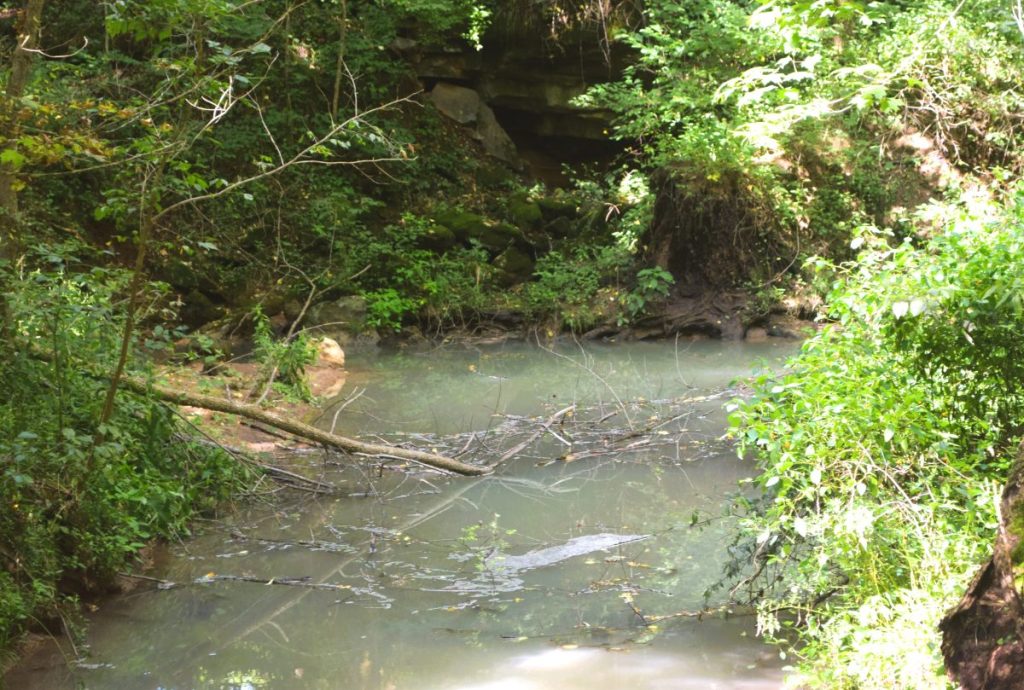
The contamination investigation of Big Spring in Upton is ongoing. Photo by Mary Beth Sallee.
Mary Beth Sallee
Managing Editor
Hart Co. News-Herald
It’s been nearly three weeks since the contamination of Big Spring in Upton was first discovered on August 16, with the once crystal clear spring transformed into cloudy, sewage-like water with a severe foul odor. By August 17, the Kentucky Division of Water and the Kentucky Emergency Response Team had visited the spring and collected water samples for testing.
However, since that time, many Upton residents are still left looking for answers, including Teresa Ash.
Although Ash is not on well water, she lives about a mile away from Big Spring and expressed that she and others in the community are simply asking for local and state officials to provide transparency with the situation at hand.
“Upton is a small community, but we matter,” Ash said. “For officials to know waters are contaminated and to continue to not notify the public is very disappointing. I’ve seen the test results myself. We just want some transparency here with what’s going on in our community.”
Those test results that Ash referenced was shared with the Hart County News-Herald. The test was taken by a private citizen of Upton, with the water source being from Big Spring as it was pumping out as not to wrongly collect anything that is already in the water. The test was performed on August 23, a week after the contamination was first discovered.
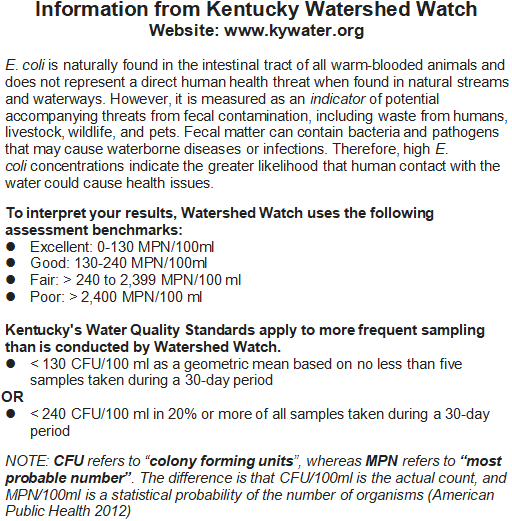
According to the Certificate of Analysis from Microbac Laboratories, Inc., of Louisville, Big Spring has tested positive for high amounts of fecal coliforms in the amount of >2419.6 MPN/100mL. To compare, acceptable levels of fecal coliform in wastewater effluent is 130.0 MPN/100mL for a 30 day geometric, and 240.0 MPN/100mL for a 7-day geometric.
The analysis states: “Results in bold have exceeded a limit defined for this project. Limits are provided for reference, but as regulatory limits change frequently, Microbac Laboratories, Inc. advises the recipient of this report to confirm such limits and units of concentration with the appropriate Federal, state, or local authorities before acting on the data.”
Fecal coliform bacteria is a specific subgroup of total coliform. The most common member of fecal coliform bacteria is Escherichia coli, most commonly known as E.coli. The presence of fecal coliform bacteria in aquatic environments indicates that the water has most likely been contaminated with the fecal material of humans or other animals. Fecal contamination can indicate the possibility for potential health risks to individuals exposed to water contaminated with fecal coliform.
The Hart County News-Herald reached out to the Louisville Regional Office of the Kentucky Division of Water on August 19 and other days thereafter to receive information about the contamination as that office covers Hardin County where Big Spring is located. Todd Giles of the regional office responded to the News-Herald on August 29.
Giles stated that the conclusion thus far is that the contamination in Big Spring is not sewage, but rather distillery waste.
“We got a call about a week ago about some discoloration,” Giles said. “…I know that ERT (the Environmental Response Team) responded initially, and we were trying to get a grasp on what it was, where it’s coming from, you know, what areas are impacted. They do some dye tracing in the streams, and some of that can tell them if it’s sewage or not, and those traces showed that it was not sewage. A lot of those areas that have been affected or impacted have farmlands that use that stillage from the distilleries to feed cattle.”
“They kind of drew conclusions that it’s probably something to that effect that got into a sinkhole or something, got into the water stream somehow, because right now they don’t know who’s responsible or exactly where it originated,” Giles added. “…But too much (stillage) can be a problem if there’s runoff. The way it’s supposed to happen is that they (farmers) contain it and maintain it on site so it can’t get in sinkholes or streams, things like that, and that’s not always the case. We’re always playing catch up, trying to figure out where it’s coming from, who’s feeding too much, who’s letting it go into a creek, that kind of thing.”
When presented with the test result numbers from the Microbac Laboratories analysis and asked if such a high amount of fecal coliform could actually come from distillery waste, Giles said it’s important to keep in mind that some level of fecal coliform can be found in all bodies of water.
“When you think about it, you’ve got birds, you’ve got deer, you’ve got all kinds of wildlife that don’t have toilets,” Giles said. “So when they do their little business, it’s usually in water or in a stream…That’s a little bit high (test results), but it’s not what I would call alarmingly high.”
When questioned with the fact that fecal coliform levels over 2,000 MPN/100mL do seem excessively high when compared to expected benchmark standards, Giles replied, “Well, it is elevated, yes, but I don’t know what kind of wildlife is there. I mean, are cattle farms nearby where, you know, where cow manure runoff is an issue? I don’t know the makeup, so I can’t really say if it’s elevated for that area or not.”
When asked if he had visited Big Spring to inspect the contamination, Giles replied that he had not.
“Actually, how it played out was that ERT was going out there, and I would just talk to my inspector who went out there and was looking around trying to find out some information,” Giles said.
Giles was also asked if his Regional Office had test results from Big Spring that he could share, or if the Bowling Green Regional Office or ERT had shared any results with him.
“I have to check on that for you,” Giles said. “…I can find out and if there is information or results that are out there, and I can make sure I get it to you.”
The BlueOval SK battery plant being constructed in Glendale is approximately 12 miles from the location of Big Spring in Upton. Giles was asked if there is any indication that the contamination could actually be from the plant’s construction.
“From what I’m hearing, no,” Giles said. “They don’t seem to think that’s being impacted by that BlueOval area, and that’s just what I’m being told.”
Giles stated that the contamination investigation of Big Spring is a collaborative effort among regional water offices and that a joint meeting would be held on August 30.
According to Giles, the Division of Water does not necessarily regulate private wells. Therefore, it is suggested that those on well water who may have concerns get their water tested.
Editor’s Note: As of press time, the source of contamination for Big Spring had not been determined. Additionally, the Hart County News-Herald is researching Kentucky Administrative Regulations (KAR) in regards to Kentucky’s water sources and is also planning to return to Big Spring for further coverage of the ongoing contamination investigation.
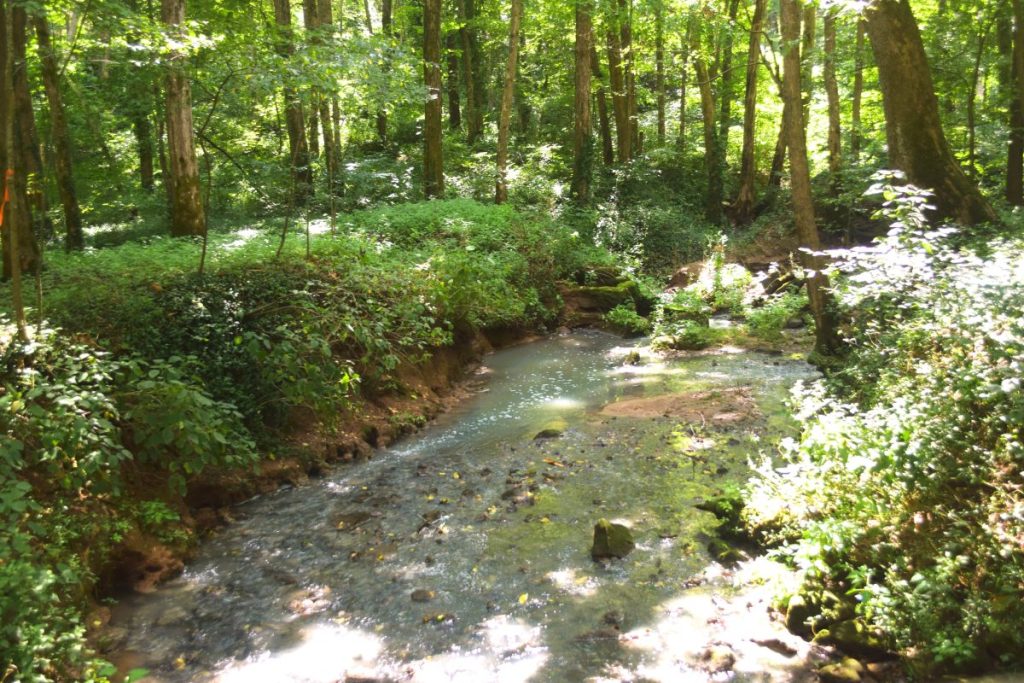
According to Todd Giles with the Louisville Regional Office of the Kentucky Division of Water, it is believed that the contamination at Big Spring has been caused by distillery waste. However, this has not been proven as the investigation is still ongoing. Photo by Mary Beth Sallee.



Great article Mary Beth! Thanks. I talked with Fish and Wildlife today.There is a scheduled release of trout into Roundstone Creek Sept.5, I was told by Eric Cummings it possibly will be delayed. Due to the appearance and coliform and E.coli count in Roundstone Creek.
Doesn’t sound like to me Mr Giles knows anything, obviously not important enough for him to make the trip. But I think we all know that contamination wasn’t caused by birds or deer. That’s insulting to everyones intelligence.
Six days to inform people? Sounds like to me they’re either covering for someone or they have just no idea what they’re doing or what’s going on.
I grew up in Upton Kentucky, I’ve always heard of big Spring, but never actually knew where it was located. Do we know if the raw sewage/contaminated water is coming up out of the ground from the spring? I’m a Microbiologist here at Western Kentucky University, and one of the volunteers for the Kentucky watershed watch. I would be interested in seeing the location and collecting samples. It may be beneficial to have live culture counts ran rather than MPN and look for fecal coliform that may point to human waste that could be leaking into the water table from a nearby septic tank. Also the biological oxygen demand, BOD test, can tell us how much organic waste is in the water.