KY Medical Cannabis Program
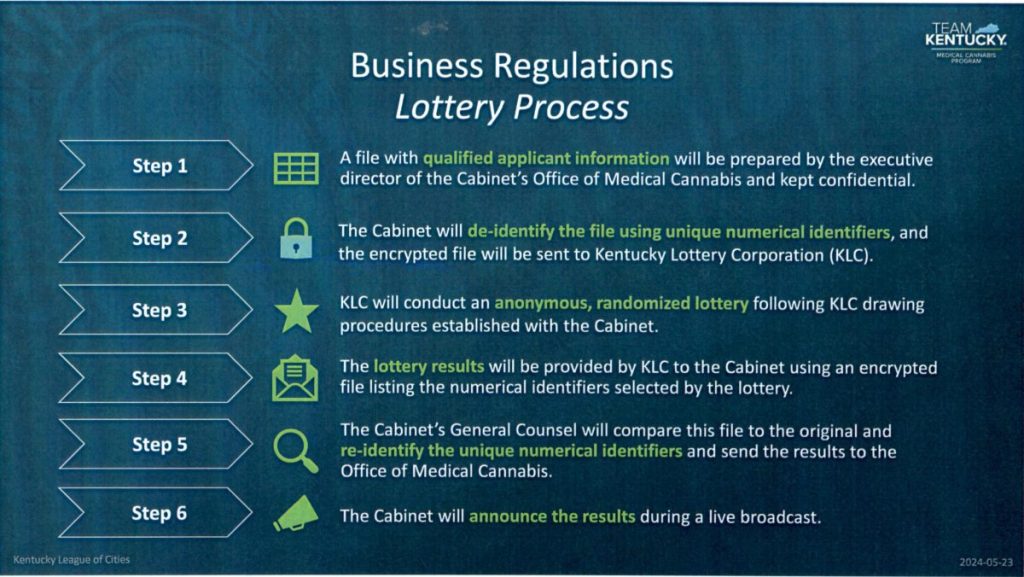
The lottery process is to be used to select the business license holders. Chart courtesy of Kentucky League of Cities
By PJ Martin
Editor
The Herald-News
Several people have asked for a summary article that explains the state’s medical cannabis program and the regulations that have been established. The sources of information contained in this article came from the Team Kentucky website, kymedcan.ky.gov, and The Kentucky League of Cities videos.
The Kentucky Medical Cannabis Program operates within the Cabinet for Health and Family Services (CHFS) and was created under KRS 218B to govern the safe use of the program. Overseeing this program will be the Office of Medical Cannabis which became effective on July 1, 2024.
The kymedcan.ky.gov mission statement: …to ensure Kentuckians suffering from serious medical conditions have safe, affordable access to medical cannabis. As medical cannabis is a healthcare necessity for Kentuckians with cancer, multiple sclerosis, epilepsy, post-traumatic stress disorder, and other serious conditions, our program will prioritize patient safety, access, and affordability.
The program has a supporting board of doctors, advisors, and a pharmacist with many years of experience in the healthcare field. From the signing of SB47 on March 31, 2024, until the Governor of Kentucky Andy Beshear signed HB829 on April 17, 2024, the entire work group and regulation were created.
The program has divided the 120 counties of Kentucky into eleven regions based on drive times. The South-Central Region includes the 9 counties of Metcalfe, Barren, Monroe, Allen, Simpson, Logan, Butler, Edmonson, and Warren,
BUSINESS
The 5 license types and the duties of each:
- Cultivator (3 levels) – responsible for planting, raising, harvesting, trimming, and curing medical cannabis.
- Processor – responsible for processing and packaging raw plant material into usable products.
- Producer – integrated license combining cultivator and processor licenses.
- Safety compliance facility – responsible for contamination and purity testing of raw plant materials and products.
- Dispensary – responsible for purchasing and selling finished products to cardholders.
The regulations have specified the initial number of license holders allowed in each category within the state of Kentucky and the costs associated with each:
| Type of license | # Allowed | License Fee | Annual Renewal Fee |
| Tier I cultivator | 10 | $12,000 | $12,000 |
| Tier II cultivators | 4 | $25,000 | $25,000 |
| Tier III cultivators | 2 | $50,000 | $50,000 |
| Tier IV cultivators | 0 | $100,000 | $100,000 |
| Processors | 10 | $25,000 | $15,000 |
| Dispensary | 48 | $30,000 | $15,000 |
| Safety Compliance | N/A | $12,000 | $12,000 |
The safety and security requirements of licensed businesses are:
- Testing – all harvest and production batches are subject to testing for THC and cannabinoid concentrations and toxins.
- Recalls – cannabis businesses can initiate voluntary or mandatory recalls based on complaints or risks to cardholder safety/health.
- Age restrictions – All patients under 18 are required to have a registered caregiver. No packaging can be targeted to minors.
- Surveillance and Alarms – All businesses must have a professionally monitored surveillance and alarm system to prevent unauthorized entry.
- Physical Security and Lighting – All entrances and exits must have proper lighting and be locked during non-working hours.
As of July 1, 2024, applications can be submitted for licensing in the 5 categories. The last day to apply is August 31, 2024.
As of September 15, the CHFS will have mailed letters to the applicants. By September 25, any application missing information will need to be completed.
By October 1st the applications are chosen according to meeting all qualifications for the lottery and finally, on an undetermined date in October the lottery will be held and license payments are due within 15 days of notification (see lottery graphic).
CARDHOLDER
How to become a registered cardholder – The patient/caregiver must visit a medical cannabis practitioner to get a written certification. Submit an application (begins January 1, 2025), the Cabinet will make a decision on the application, and if approved the patient/caregiver will download a registry ID Card.
The applications require a written certification from a medical doctor, the applicant’s information, an application fee of $25, and a notary’s signature. If approved there is a yearly fee of $25.
The qualifying criteria for the patient and caregiver are as follows they must be residents of Kentucky, have a diagnosed qualifying medical condition, and have no disqualifying felony offense convictions.
The qualifying medical conditions designated by Senate Bill 47 are:
- Any type or form of cancer;
- Post-traumatic stress disorder;
- Multiple Sclerosis, muscle spasms, or spasticity;
- Chronic or severe pain;
- Epilepsy or other intractable seizure disorder;
- Chronic nausea or cyclical vomiting syndrome.
The regulations specify the amount of cannabis allowed for 30 days by cardholders (patients and caregivers) as listed in the Qualified Patient & Designated Caregiver Guide. (see graphic) Minors are not allowed to enter the businesses.
There are four types of cardholders:
- Adults with a qualifying medical condition
- Under 18 years old with a qualifying medical condition with a custodial or legal guardian
- Caregiver who assists qualified patients with purchasing and administering
- Individuals with out-of-state registry ID cards and documentation of condition
LOCAL POLICIES
Kentucky Medical Cannabis Program provides regulations that allow local governments to enact ordinances to partially or completely prohibit cannabis businesses within their jurisdictions. A local government can also allow its citizens to vote at the next election to allow or prohibit cannabis businesses within the jurisdiction.
Local governments can create ordinances that place a fee on cannabis businesses within their jurisdiction to compensate for any additional costs caused by the businesses; however, they may not levy excessive fees, place a burden, or make operations unreasonable.
For example, if a city enacts ordinances to prohibit cannabis businesses within the city’s jurisdiction, the county government can choose to allow the businesses within the county and vice versa.
Under KRS 218B.130, if the local government city or county passes ordinances to prohibit licensed medical cannabis businesses within their jurisdiction, the public can question and petition to allow these businesses. KRS 218B.130(5) outlines the requirements of the petition process. If a petition fails, a 3-year waiting period is required before another petition or vote can take place.
School boards must establish policies to either permit or prohibit minors who are registered patients with licensed caregivers to consume medicinal cannabis at school per KRS Chapter 218B.045 If a school board allows the use of cannabis treatments, it must also create a policy as to who is allowed to administer the dosage and designate a specific location.
Kentucky law also prohibits a cannabis business from locating within 1,000 feet of an existing school or daycare facility.
If you would like to read more of the specifics you can go to https://kymedcan.ky.gov/.
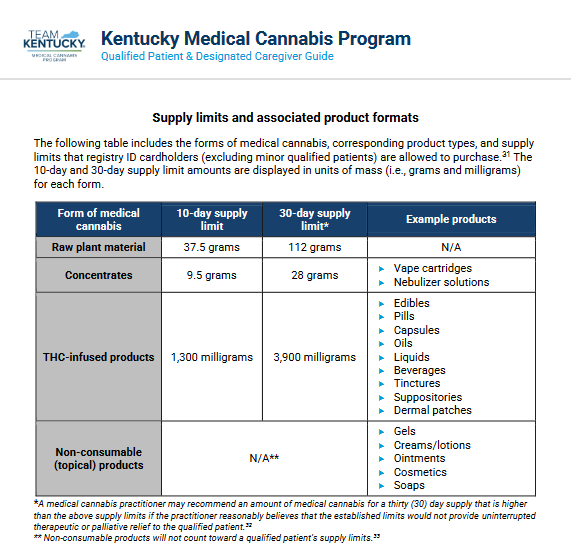
Page 14 of the Qualified Patient & Designated Caregiver Guide available at the following: https://kymedcan.ky.gov/patients-and-caregivers/Pages/default.aspx.