EMS Leaders Sound the Alarm: Are the People Worth It?
By Allyson Dix
“Are the people worth it?”
That’s the question Kentucky EMS leaders are asking as they face another budget session with an underfunded grant that has been stagnant since the 1980s. A grassroots effort to sound the alarm on the critical financial state many ambulance service agencies are currently enduring is underway.
For over four decades, Kentucky’s EMS Block Grant has remained unchanged, providing just $10,000 per county each year to support local EMS.
Established in the early 1980s under Senate Bill 66, the program was once a vital funding source for local governments. But as the costs of ambulances, equipment, and lifesaving medications have soared, the funding has failed to keep the same pace.
According to the Kentucky Board of Emergency Medical Services (KBEMS), the total grant amount has stayed flat at $1.2 million statewide, divided among 120 counties.
EMS officials warn that without an update to the decades-old funding allocation, many local agencies may be forced to reduce services or even shut down completely, posing serious risks to Kentuckians who rely on timely emergency response – especially in rural counties.
The funds, distributed at 100% through KBEMS directly to each county and passed along to local EMS agencies, remain crucial. Advocates say raising the grant amount is essential to ensure that communities can continue to provide lifesaving care to their citizens.
To address the issue, EMS officials have launched a grassroots effort to “sound the alarm” as the state soon heads into a new budget session in Frankfort. The board and EMS leaders are urging lawmakers to approve an increase in the total allocation from $1.2 million to $12 million statewide – a tenfold rise that they say reflects today’s realities.
KBEMS Chairman John Holder said EMS across the nation has faced a myriad of challenges in recent years, including workforce shortages, poor reimbursement, and increasing ambulance usage, and Kentucky is dealing with the same.
Holder said the block grant funding is a “lifeline” for county governments and their respective EMS agencies.
“This year, the Board of EMS is requesting the grant funds to be increased to an amount that satisfies the original intent of Senate Bill 66,” Holder said. “We believe this will have a significant impact on helping local governments provide reliable ambulances for their community.”
Dr. Joe Middleton, Executive Director of Hart County EMS and Barren-Metcalfe EMS, said if the appropriation request is approved, it would give local communities more say in where the money is needed most. Historically, this funding has been expected to be used similarly in both rural and urban Kentucky communities, although their needs and revenue streams can be vastly different.
“If this appropriation is approved for the block grant funding, it would be total local control of that money,” Middleton said. “It would be an absolute return on the taxpayer’s investment back to the county government, where the biggest needs can be decided in its EMS service.”
While EMS operations and funding are complex as a whole, it still deduces down to having enough money to operate its services and continuing to have the resources needed to save lives in the communities they serve.
Given that the majority of small, rural EMS agencies are struggling across the state, many find themselves forced to make difficult decisions, from delaying equipment upgrades and cutting staff hours to relying on aging ambulances that should have been retired years ago, stretching the entire system to its breaking point. Response times grow longer, and safety nets grow thinner year after year.
A comparison shows that in the 1980s, a new, fully equipped ambulance cost about $20,000; today, that same vehicle can cost at least $200,000, a ten-fold increase.
Edmonson County EMS Director Keith Sanders, who has been in his current position since 2009, described just a few of the costs, including $30,000 stretchers and $60,000 cardiac monitors required for each ambulance, and even those have a service life of seven to ten years before the need to be replaced. However, due to the financial strains, Sanders said equipment such as this sometimes has to stretch beyond the expiration dates.
“We stretch ours a little farther than that because we cannot afford to replace the equipment as often,” Sanders said.
While the block grant cannot be used for personnel, it can alleviate the funds needed to staff an ambulance agency, especially with many agencies facing personnel shortages already on top of an already crumbling financial state.
“The significance of increasing this grant would help us to replace some of the things we haven’t been able to because we don’t have the money to do it,” Sanders said. “When it comes it replacing equipment, I have very little dollars to work with and sometimes no dollars at all.”
“Are the people worth it?” Sanders asks, noting his previous efforts of testifying before legislative committees on the dwindling EMS workforce and pointing out that if something is not done to alleviate the increasing costs, then the “EMS system is going to collapse because we can’t afford to operate it.”
Back in September, Middleton spoke at a county fiscal court meeting where he laid out cost and billing details of EMS runs, specifically for the Barren-Metcalfe agency.
He said 73% of EMS runs for the entire region are billed to Medicare (61%) and Medicaid (12%), both publicly tax-funded insurances. Reimbursements from these insurances are only one-tenth of the actual cost of the EMS runs. Commercial (19%), Facility (1%), and private payments (7%) make up the other runs.
Middleton said the average EMS bill is $945.11, with an average reimbursement for a Medicaid patient being $272.13 and $434.15 for a Medicare patient.
“We always operate in disparity,” Middleton told the court.
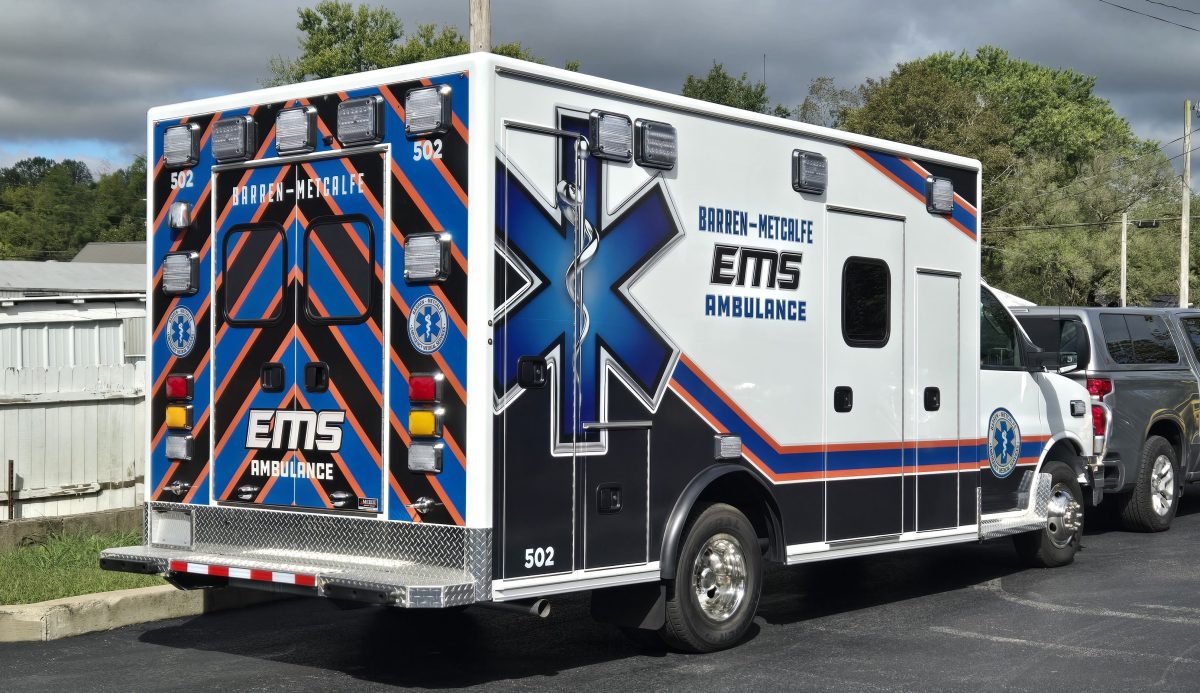
The Kentucky Board of EMS and other EMS advocates are proposing an increase in state funding that has been stagnant for forty years. Allyson Dix/JPI Photo
Smaller counties such as Metcalfe struggle to foresee a sustainable future with their ambulance services, leaving them wondering how to navigate the climbing costs.
Metcalfe County Magistrate Daniel Bragg said in that meeting that the county has already been forced to cash out CDs to help fund the service for its citizens, with the most recent being for an ambulance and monthly payments for the rest of 2025.
“At the rate that we’re going, in three or four years, we’re going to have to figure out what we are going to do, what are we going to cut, to be able to make this ambulance service payment every month?” Bragg said. “We’re good right now, but I can see in the future – three years from now – we won’t have the money.”
A couple of counties in Kentucky have already been forced to cease operations because they could no longer afford to keep their doors open, instead partnering with neighboring county EMS agencies that ultimately add longer emergency response times – at the potential cost of losing the lives of their citizens.
Jobe Publishing has asked several state representatives and senators where they stand on approving the requests posed by KBEMS.
Representative Steve Riley said he is looking forward to reviewing the proposal in its entirety and meeting with the sponsors to see how some relief can be provided.
“We really need to look at some type of investment in improving the situation with EMS, but then it also becomes a numbers game,” Riley explained. “Yes, I am in support, but I’d have to see the whole proposal in detail.” Riley said the next step would be to continue conversations in the committees to see what kind of agreement can be made.
Hart County Representative Ryan Bivens said he plans to speak with area EMS as soon as he navigates learning more about the block grant.
“While I am still learning more about this, I have always made the commitment that I will do what I can to support emergency services and first responders, especially in rural areas,” Bivens said. “I do plan to talk with some of the EMS folks in the near future. I have a great respect for the job they do, and I know they have not been exempted from the rising costs and shortage of labor in the near past.”
Senator David Givens said, “As co-chair of the 2022 EMS Task Force in Frankfort, I was most impressed by the dedication of our front-line first responders. I also learned of the many challenges our ambulance services face. Along with additional funding, we must pursue new opportunities for entry into the field and less burdensome regulations. I am hopeful that the recently implemented ambulance provider tax will result in financial resources to modernize both pay and equipment.”
Ambulance service agencies pay a tax that allows Kentucky to draw down additional federal funds, which are then returned to EMS agencies as enhanced Medicaid payments. While these funds are helpful, they’re funded by the EMS agencies themselves–not the state–and could be reduced depending on the outcome of the federal government’s recent passage of the One Big, Beautiful Bill Act.
Representative Amy Neighbors said she is also continuing to learn more about the proposal and plans to support our first responders.
“I’m aware of the proposal and continuing to learn more about it,” Neighbors said. “But without a doubt, we want to support our first responders and ensure they have the training and resources they need. As we head into a budget session with many priorities on our radar, I’m hopeful we can take meaningful steps toward helping our local EMS.”
If state legislators and the Governor work to approve the proposal, each county EMS agency would have the flexibility to direct the funds where they’re needed most, from ambulance purchases to lifesaving (and very costly) medical equipment.
KBEMS is also requesting an annual $2,110,000 in restricted funding to implement a 2024 House Bill establishing an educational fund to address the critical shortage of EMS providers, particularly in rural areas, one that they say has lacked the initial appropriations to launch since its inception.
For now, EMS providers press on, sustaining the resources they have against an all-around and growing inflation rate – a formula that many fear will eventually leave Kentucky communities without the lifesaving services they’ve long taken for granted.
Constituents can contact their representatives as they are now starting to navigate the consideration of next year’s budget session.
Letters to the Editor can be submitted to print@jpinews.com or allyson@jobeinc.com.
To find your legislators, visit https://apps.legislature.ky.gov/findyourlegislator/findyourlegislator.html