Into the Darkness: How Glasgow Fire Prepares for Mayday
By Allyson Dix, Managing Editor of the Barren County Progress
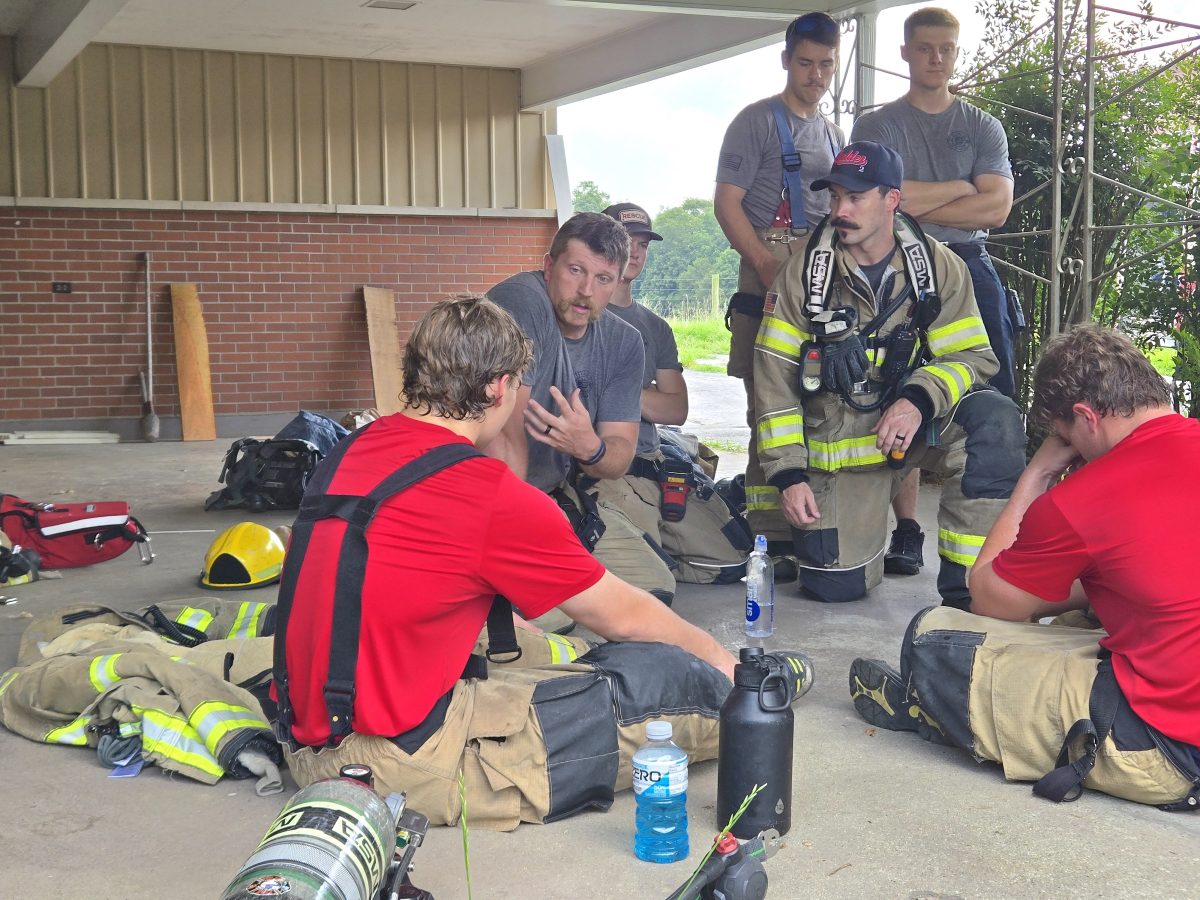
Firefighters discuss their training session outside on an extremely hot day in July. Picture includes (kneeling), from left, Jordan Keen and Lincoln Keith with Glasgow Fire Department and other firefighters. Photo by Allyson Dix
It’s hard for the average person to truly grasp what firefighters face each time they respond to a call.
Stepping into a burning building–often unfamiliar and unpredictable–is something most of us can only picture from a distance. But for the men and women behind the uniform, it’s a reality they train for constantly.
Last Friday, the Glasgow Fire Department gave the Barren County Progress an up-close look inside that reality, walking us through a live training simulation that offered a rare, eye-opening glimpse into the physical and mental demands of the job.
On this particular day, Glasgow Fire was engaged in what is called Rapid Intervention Team, or RIT. A search-and-rescue type of training for downed firefighters.
“This is what we use if we have an interior firefighter that may go down and call a mayday,” Captain Corey Buford said. “Then we send the RIT team in to rescue other firefighters.”
Captain Buford has been with Glasgow Fire for 15 years, and fortunately, he has never had to call a RIT for a downed firefighter in his career.
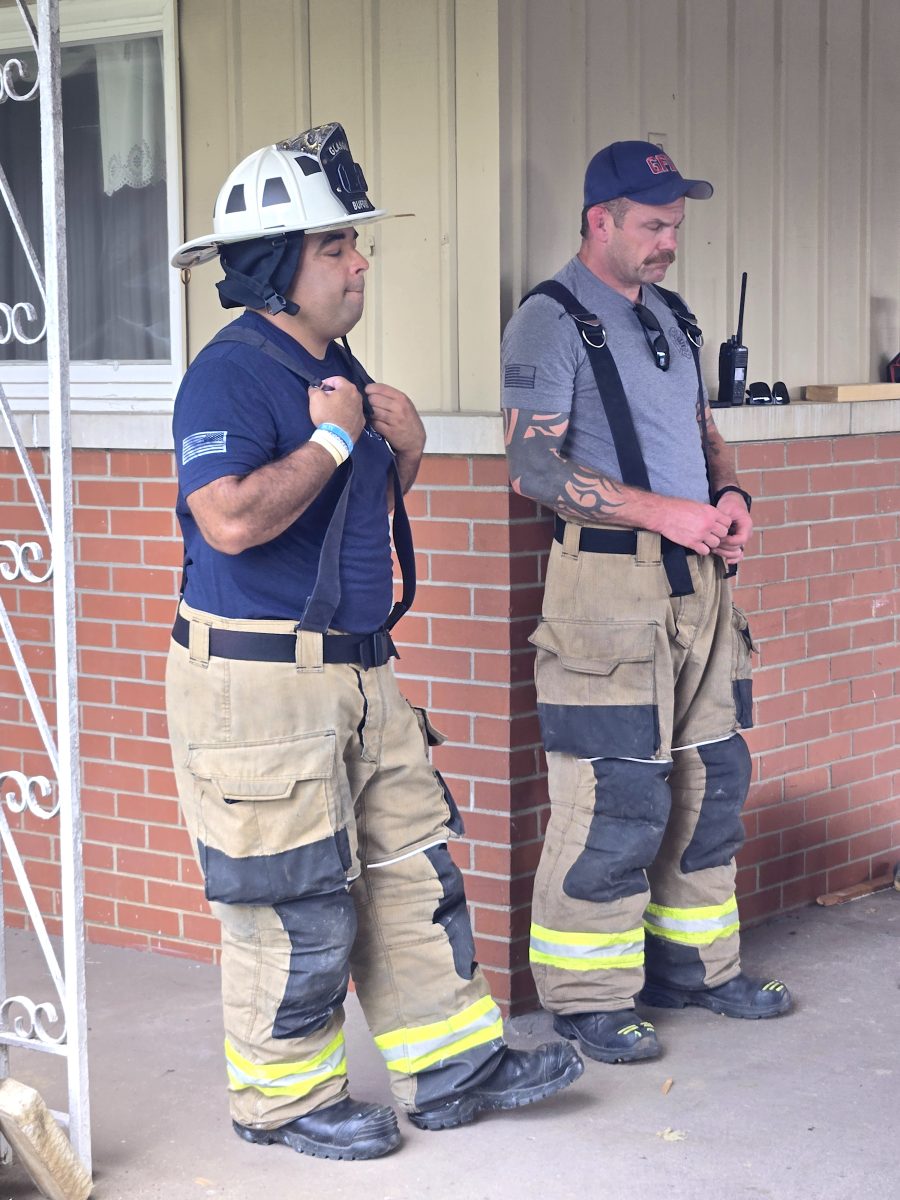
Glasgow Fire Captain Corey Buford, left, and Patches Childers await the next training session last Friday in Glasgow. Photo by Allyson Dix
“But it can get called and this is one of the ways we try to stay up on with training because if it ever does happen, we want to be ready,” Buford said.
Staged and ready inside the furnished home, we waited for the firefighters to come through, watching through a thermal imaging camera, a tool that separates objects based on temperature. One of the differences in the thermal imaging camera in training verses a real fire is that the light and dark colors will be inverted, showing potential victims in dark with a light background rather than the training simulation of light or white in appearance with a dark background, Buford explained.
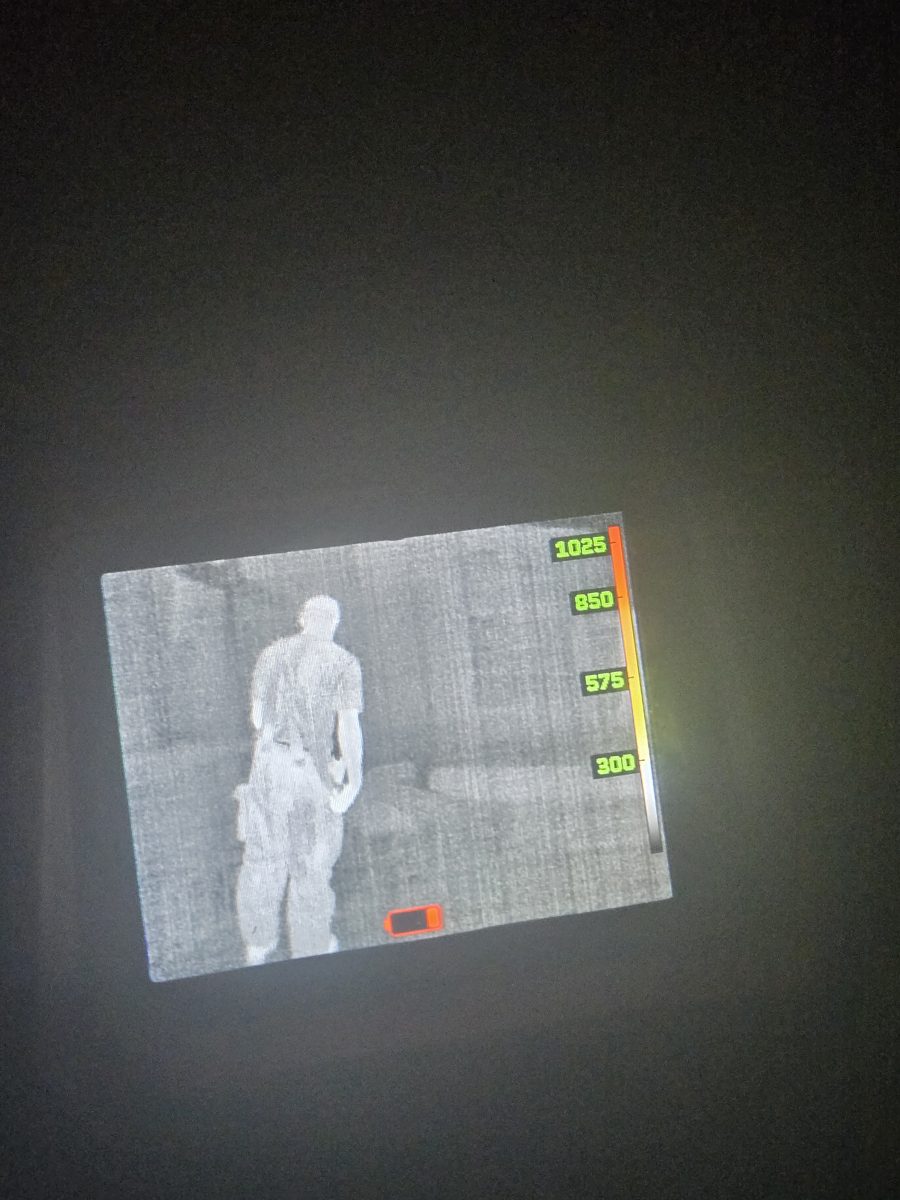
Glasgow Fire Department utilizes a thermal imaging camera to separate objects and people based on temperature. This photo was taken inside a simulated training session in a pitch dark house filled with artificial smoke on July 25. In a real-life scenario, the light and dark colors would be inverted. Photo by Allyson Dix
It was completely dark–pitch black to the naked eye inside the home that was being used as a training structure, just as it would be in a real life scenario. Firefighters moved blindly, oftentimes crawling, through the smoke-filled space, feeling their way along walls and furniture as they searched for potential victims in the simulation.
In the chaos of the simulation, a firefighter–staged as injured–lay motionless on a couch, his location unknown to the team navigating the scene. The air was filled words of the firefighters, pounding noises, crashing furniture, and the random beeping of an alarm–just a few of the sounds firefighters might encounter in a real emergency.
“Victim! Victim! Victim!” a firefighter yells once he discovers the person on the couch before proceeding to work together to rescue the victim, encouraging one another to stay calm.
The darkness, the loud sounds, the intense heat, the weight of the gear, and the mental strain–these are some of the conditions firefighters face regularly, whether during training or real-life emergencies.
Glasgow Fire Chief Lucas Tinsley said the department is always looking to improve with ongoing training to help them prepare for a variety of real-life situations.
“Our crew was tasked today with entering the structure and safely searching the structure in order to keep oriented for their own way out, to find and then remove the victim,” Chief Tinsley said.
Friday’s simulation is just one of many situations that can happen in larger scale scenarios.
“Our training can be very singularly-oriented or get into multiple subjects all in one scenario,” Tinsley explained. “Part of training throughout the year is we’re constantly trying to evaluate our needs and how we can do things better. We’re always trying to build upon that so we’re ultimately prepared for whatever the incident response may need.”
Training to stay calm under pressure, Glasgow Fire Department has spent the last ten weeks or so training five days a week in similar scenarios, Captain Buford said.
Running into burning homes, not knowing what they’ll face, firefighters risk everything to save lives–humans and their beloved pets alike. It’s an act of selflessness that places them among the most courageous servants of our communities. Yet, too often, their sacrifices go unnoticed. These men and women carry a quiet bravery, showing up day after day, not for applause, but because they want to. It’s their courage under pressure, their steady hands in chaos, and their hearts for service that make them true heroes–not just in the face of disaster, but every time they step into uniform.
Editor’s Note: A video of this training will be shared on our Facebook page of the Barren County Progress after our printed newspaper has been published and issued for circulation for educational and awareness purposes.
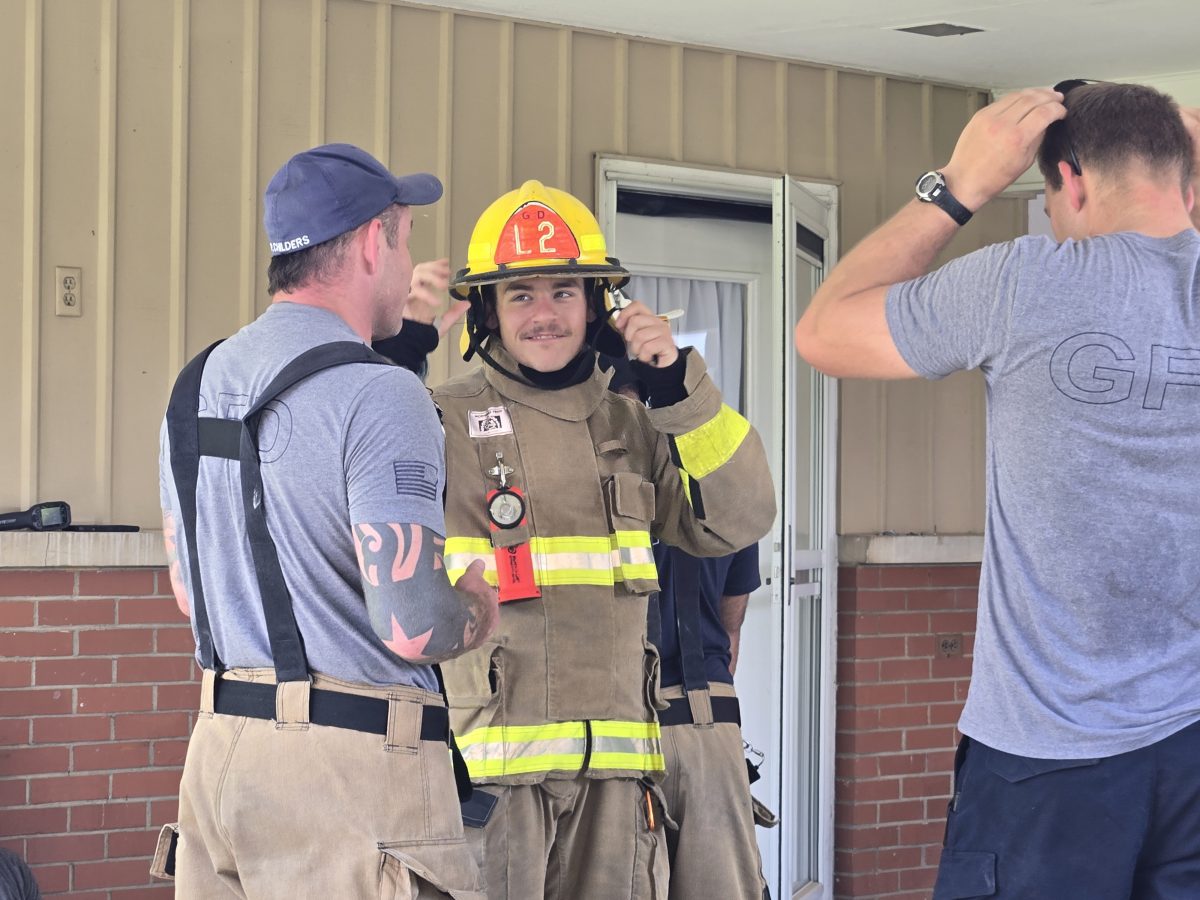
Ben Estes, a Glasgow firefighter, prepares for a training session in a simulated fire inside a residence. Photo by Allyson Dix