Saving the Bees

Honey bees are the most often seen bees, but they are not native to Kentucky. Photo |University of Kentucky Entomology
By PJ Martin
Editor
The Herald-News
There are many types of bees and they, for the most part, are the prime pollinators of our food and forage crops, flowers, and other plants. Wildlife Organizations are saying humans will become extinct unless we start saving the bee population. That statement is partially true and partially false and we will look at it more closely.
According to Scott Black, executive director of the Xerces Society for Invertebrate Conservation a non-profit that protects natural habitats, “Keeping honey bees to ‘save the bees’ is like raising chickens to save birds.”
The Honey bee is only one of approximately 20,000 bee species in the world. Similar to raising pigs, cattle, or chickens, honey bees are not native to North America and they are a domesticated animal (insect). The honey bee has been imported to every continent as a domestic product.
According to National Wildlife Federation naturalist David Mizejewski, “While vital to agriculture and the economy, keeping honey bees is not wildlife conservation.” He agrees with Black in that honey bees are a domesticated animal.
So how did these honey bees get to North America? They were transported by the Colonists from Europe in the 1620s, because they were a source of wax for candles and sugar for cooking in the colonies.
Somewhere along the way, humans found they could use boxes to move honey bees and use them to pollinate specific crops. Today’s beekeepers number around 212,000 according to the USDA and they make from $30,000 up to $70,000 for the large producers.
Bees feed on sugary nectar and protein-rich pollen from flowering plants and in doing so they perform a necessary service by pollinating our crops. According to the USDA, bees pollinate approximately 80% of all flowering plants and that includes 75% of the fruit, nuts, and vegetables grown in the United States.
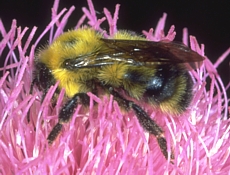
A native bee seen often in Kentucky is the bumble bee. They live in hives underground in abandoned burrows. Bumble bees are native to Kentucky. Photo | University of Kentucky Entomology
So yes, bees are necessary to keep the world fed and the human population alive!
Native Bees
Bees live on every continent except Antarctica and there are actually around 4,000 bee species in North America alone.
The misnomer about the original statement is that only honey bees pollinate plants. Many other bees pollinate plants as well. For example, the bumble bee, these bees are great commercial pollinators. A study by the International Union of Conservation of Nature (IUCN) shows that of the 47 bumble bee species in North America, 28% face some level of extinction risk.
There are specific reasons for the decline in bee populations. The main reasons are habitat loss, climate variances, disease, and pesticides.
According to federal biologists, honey bees carry diseases that can infect the native bees. They can also dominate the flowering and other plants in areas near groups of hives and that can literally starve out native bees.
Researchers found in a three-month study that a 40-hive honey bee apiary collected an equal amount of pollen and nectar as 4 million solitary wild bees. That is how honey bees manage to suppress native bees.
If you want to help bees, plant and grow as many native flowering plants as possible. Choose plants that bloom at varying times to supply a food source all through spring, summer, and fall. Plant native trees that bloom. Their hundreds of blooms give bees a great food source.
Another way to help native bees is to leave a spot of clean, bare soil in a sunny location in your garden. Some species need this to burrow underground and overwinter. Never use insecticides or pesticides near bees, their nests, or on flowering plants grown specifically for bees in your garden.
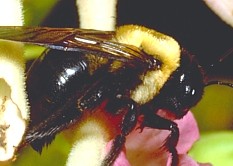
Kentucky has several species of Carpenter Bees (Wood Bees) which make holes in wood to lay eggs and leave nectar and pollen for the newly hatched bees. They do not live in hives. Photo | University of Kentucky Entomology
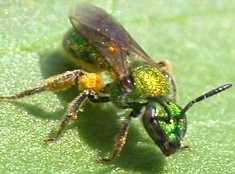
Most halictid bees are shiny black, metallic green, or metallic blue. Some members of this species are referred to as sweat bees. Most halictid bees are solitary and create underground nests for their offspring. Photo | University of Kentucky Entomology
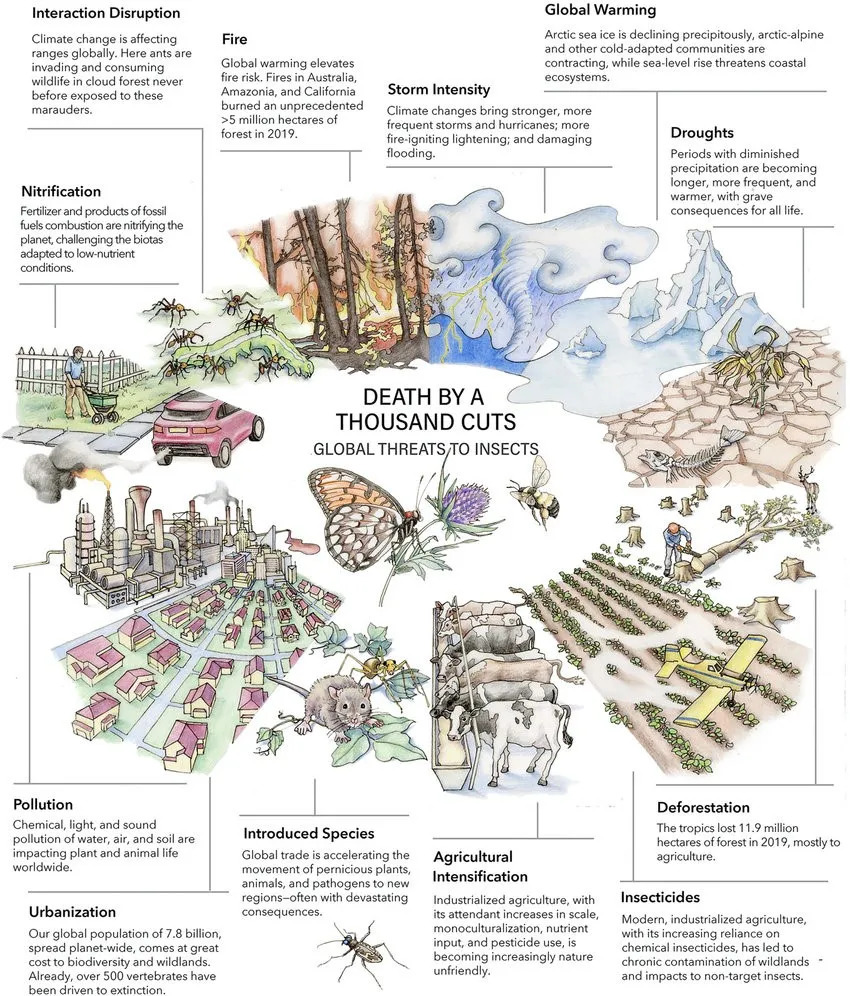
Bee threats graphic courtesy of www.knap.org Graphic credit Virginia R. Wagner