Drone Seeding in Barren County
By Allyson Dix, Managing Editor/Barren County Progress
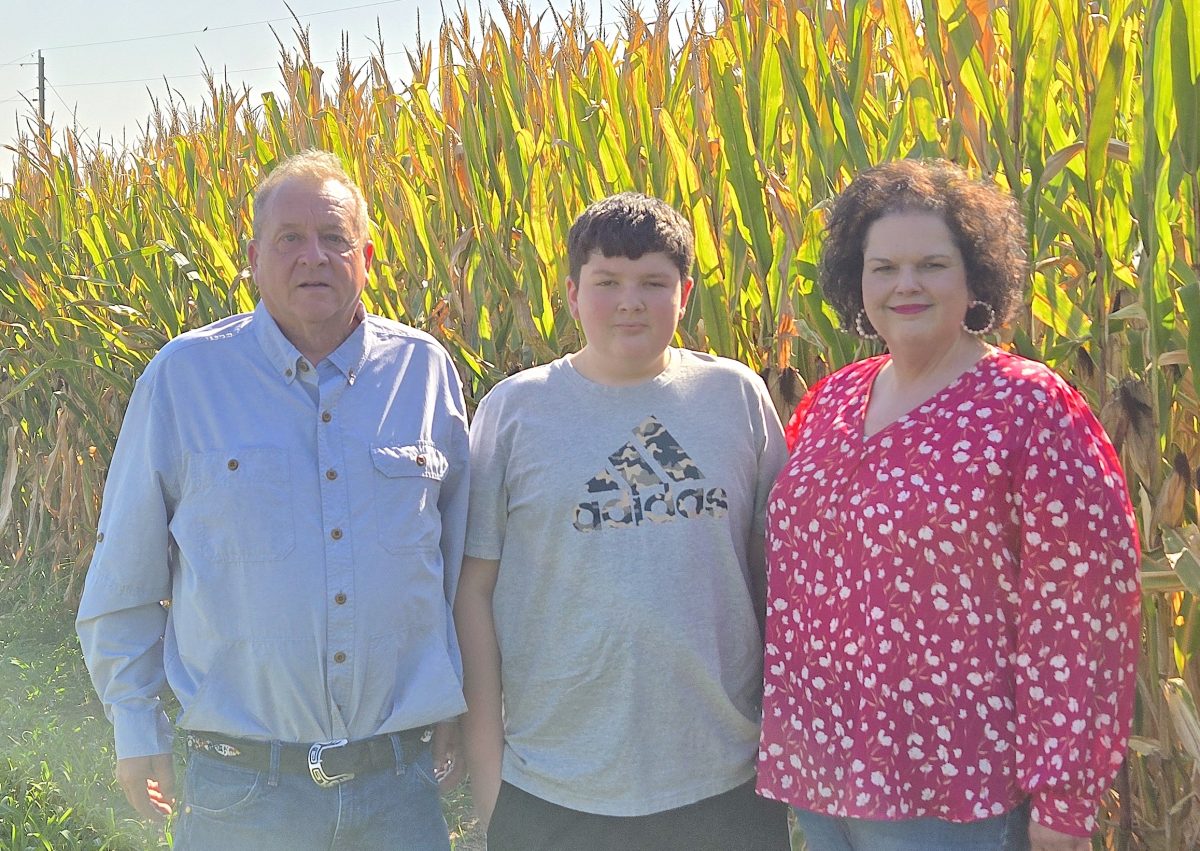
Tom Holmes, at left, stands with his wife, Janie, and their son, Jack in front of their corn fields. The fields were seeded utilizing the new technology of a drone powered by Skytech Solutions to plant cover crop in the standing corn, a first for Barren County. Photo by Allyson Dix, JPI
For the first time in Barren County’s history, Tom Holmes, a local farmer, recently opted to seed his crop cover in standing corn utilizing a drone, powered by a local company called Skytech Solutions.
Farms have utilized aerial seeding for upwards of four decades by way of airplanes and helicopters, but the emerging technologies of drones, also known as UAVs (Unmanned Aerial Vehicles), are gaining traction in many areas, including agriculture.
Cover crops are used by farmers to prevent soil erosion, replenish soil nutrients, weed prevention, food for wildlife animals, improve organic matter for better soil health, and better grazing for livestock leading to better cattle gain.
Farmers sometimes face challenges when seeding cover crop fields such as the timing and logistics like balancing the herbicide spraying, weather elements, and availability of equipment, especially for smaller acreage farmers as opposed to larger operations.
“I’ve been using cover crops for around 30 years, and I always have to wait until the corn is harvested,” Holmes said, factoring in those mid-October timeframes with shorter daylight hours and cooler temperatures.
Seeding cover crop in standing corn gives a cover for the seeds and holds in moisture leading to faster germination, Holmes explained; however, he said the corn leaves must be losing their color before seeding cover crop.
Skytech Solutions powered the drone used for seeding his cover crop, which is a DJI Agras T40 Drone, and it holds around 120 pounds of seed.
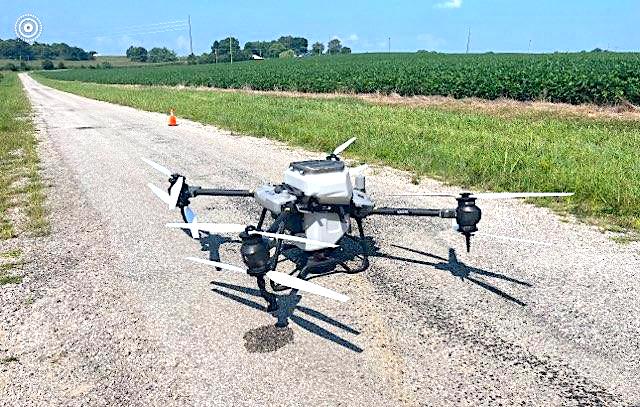
The DJI Agras T40 Drone operated by Skytech Solutions that seeding cover crop in standing corn on the Holmes Farm in Barren County. The top of the seed tank is seen at the top of the drone and propellers in the corners. Photo submitted.
Other drone seeding advantages include being able to apply when ground conditions are less than favorable like after rain, accessibility to reach challenging areas such as those with power lines or trees, precise seed placement, and they can be better for the environment since soil is often affected by heavy equipment like crop dusters.
Holmes seeded three separate fields that he rotates grazing cattle around. Farmers have the option of investing in aerial equipment and training, but Holmes opted to hire Skytech to help seed his fields.
While he could have chosen other cover crops, he planted both combine wheat and turnip seed in the standing corn. This route, Holmes said, has a cost savings for him as well.
Holmes purchased 100 pounds of wheat at 10-cents per pound (as opposed to the 24-cent local cost), costing $10 per acre. He also purchased 1 pound of turnips at $2.00 per pound. His total seed cost per acre is $12.00 with a savings of $14.00 per acre.
Overall, Holmes saved more than $1,600 to seed cover crop in 117 acres this year.
“The test in the turnips is going to be how well they come up in the way we’ve mixed them in,” Holmes said, adding that some of the hard turnip seeds may come up the second year after planting.
The turnips can grow in 25-degree weather conditions, helping keep the bare soil covered through winter.
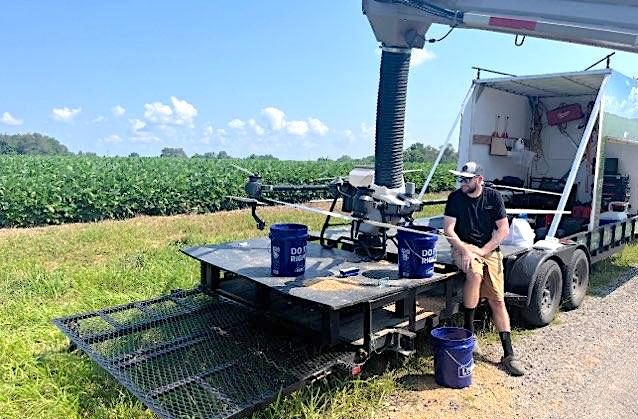
Owner of Skytech Solutions, Dakota Reed, awaits the results of the weight calibration before starting the mission of seeding cover crop in standing corn on a Barren County farm owned by Tom Holmes. Photo submitted.
Something Holmes says is important to remember is cover crops have to be cheap and easy to use because if the cost is too high, many will opt not to use them. He also suggests teaming up with people who may have cover crop seeds available for sale locally.
“If someone here in Barren County was raising seed for cover crop and could sell, they don’t have to truck it away, and it helps subsidize the farmer by cost share or having seed available at a reduced price,” Holmes said, adding it would cut out the need of having it imported from other areas.
Brian Boone, District Conservationist with Natural Resources Conservation Service (NRCS), said cover crops have had aerial applications through other means, but that “smaller farms at 500 acres or less, the drone really might fit a niche there,” Boone said.
While crop growers are not necessarily required to plant cover crops, they must be compliant to qualify for programs.
“To stay eligible for most programs through the NRCS or the Farm Service Agency, they do have to be compliant with highly erodable land conservation,” Megan Edwards with the Farm Service Agency said. “That means not having gullies and real erosion in your fields, which is prevented by applying cover crops.”
Boone said, that while it may be a lofty goal, the Soil Conservation office would like the water that runs off the fields to be clear, reducing or eliminating silt.
“In Eastern Kentucky where you have more slope, there is more runoff from water,” Boone said. “Something growing on the surface (in the bare winter months) is necessary.”
Even in the western parts of the state where the topography is more flat land, Boone said cover crops will still build soil health leading to better root structure. “You’re helping that water get down into that soil profile instead of leaving the ground,” he added.
Chris Schalk, Barren County Agricultural Extension Agent, also explained the differences in the topography of the land with a diversion line being around I-65, and cover crops are still important to use despite the land differences.
The drone technology for cover crop seeding, Schalk said, will be a tremendous benefit for the typical irregular-shaped fields east of I-65.
“We’re talking from I-65 to the West Virginia border–we’re talking smaller fields–this technology can really shine, and you know, it’s only going to get better,” Schalk said.
In hopes of inspiring the youth to pursue such technology for future careers, Schalk said with the uptick of video gaming, perhaps it might draw interest to learn more about it since controlling drones are similar to video game controllers.
“If it gets kids excited about learning about math and science, then that’s important, and they can get excited about this kind of stuff,” Schalk said. “It just takes a little seed sometimes.”
Barren County has around 14,000 unsprayed acres due to areas being so small crop dusters can’t get to the fields especially considering power lines and trees, Billy Celtruda with Skytech said.
“The drones have the ability to go under power lines and long tree edges that crop dusters can’t get to,” Celtruda said. “The farmer can expect better yield because they’re getting better coverage with a drone, providing much better precision mostly due to the amount of sensors.”
Pilot Brennan Morgan with Skytech Solutions, said the Federal Aviation Administration (FAA) requires a license for commercial use of UAVs.
Skytech Solutions is a multi-faceted company in that they can utilize their drones for many situations including thermo drones using heat to find animals or people, even in scenarios involving law enforcement such as hostage situations or fatality vehicle accidents.
“Right now, our main focus is agriculture,” Morgan said, adding that Skytech hopes to help other farmers where needed.
Morgan and Dakota Reed founded Skytech Solutions especially when they realized their operations could be a benefit to local farmers.
The company focuses heavily on agriculture this time of year and agrees along with Holmes that having local partnerships for smaller farms in the county is worth pursuing.
Visit SkyTechDroneSolutions.com or call 270-216-1601 for more information on the services offered.
For more information on planting cover crop, call the Barren County Extension Office at 270-651-3818.
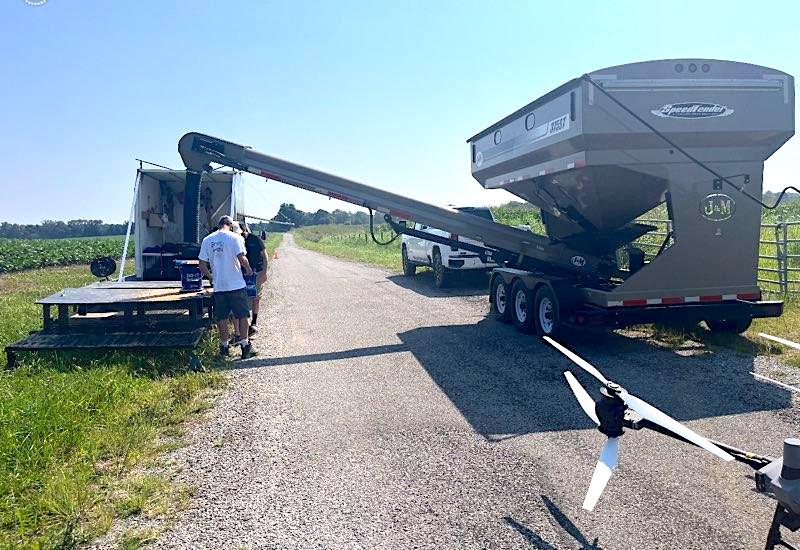
Skytech Solutions calibrating the weight sensors for the drone. The seeds are in the seed auger at right and travel up the boom into the bucket, which is used a couple of times in the weight calibration process. Photo submitted.