County Weighs Cannabis
By Allyson Dix, Managing Editor/Barren County Progress
Magistrates want to hear from constituents.
Last week, county magistrates weighed the consideration of medical cannabis businesses in the June 18 fiscal court meeting with some calling on constituents to contact them with comments.
The open discussion fell at the end of the meeting and no action was taken; however, the court is expected in July to consider an official position of opting in or opting out to allow medical cannabis businesses to operate in the county. Jurisdictions have until the end of the year to make a choice but business application deadlines for those interested are July 1 through August 31.
It is important to understand that with medical marijuana businesses is the realization of how an opted-in jurisdiction would potentially be chosen. The state has set regulations to allow a lottery system to choose which jurisdictions will be selected.
A total of 16 growers in the entire state will be chosen from an apparent luck of the draw. Forty-eight dispensaries will be allowed under the same lottery system; however, eight of those are reserved for Lexington and Louisville leaving a total of 40 retail dispensaries allowed to operate in the state. There are no promises for any jurisdictions to be selected even if they opt in to operate medical cannabis businesses.
Magistrate Tim Coomer said while he supports medical cannabis, he is hesitant to opt in because of the unknowns that surround the matter.
“I am 100% for medical cannabis,” Coomer said, initiating the discussion. “As far as our county being opted in or out, I think most of the public knows once you opt in, you cannot get out. You’re locked in.”
“With all the unknowns, it’s not like adopting alcohol,” Coomer said, adding that there was enough information from adjoining counties but not with this new law. He favored waiting to opt out until seeing how the first year goes.
Magistrate Tim Durham said he also supports medical cannabis especially if it helps individuals’ health and weighed both sides of the business aspect.
“If we opt out, we’re not going to be given the opportunity to that (helping others), but if we opt in, we do have some unknowns,” Durham said.
Regulations from the state level have changed week-to-week, according to Kevin Myatt, the joint city-county planning director, who has spearheaded the flow of information to local governments after attending training sessions.
But Durham proposed that the citizens of Barren County should decide with a vote.
“As a magistrate of Barren County, I don’t feel like I’m capable of making that decision by myself so what I propose – I don’t know what needs to be done – I would like to see it put on the ballot and let y’all vote for whether or not we have it,” Durham said, adding that comparing it to the wet/dry vote isn’t the same because this is a medical matter.
Coomer said he had no issues putting it to ballot but that voters aren’t prepared with enough information yet.
“I don’t think we’re prepared. I don’t think the voters have had enough information to make an honest vote at this time,” Coomer said. “Anytime you vote on something, you need to know as much about it as you can. I don’t think we’re ready as a county. I know I’m not ready to vote yes or no until I have more information.”
Magistrate Marty Kinslow supports all aspects of the medical cannabis especially if it brings jobs to the county standing by his initial campaign promise.
“When I ran for magistrate…my promise was this,” Kinslow said. “The main reason that I ran for magistrate is I want Barren County to be better. I want us to be progressive, not that I don’t like what we are, but we need to be better, we need more jobs, and that’s what I promised I was going to do everything I could to get jobs into Barren County.”
Kinslow said these jobs and growth are needed for the future.
“This is going to bring money in from other areas when we do this, they’re going to come here,” he added.
With Kentucky nearing the 40th state in the nation to take on legalizing medical marijuana, Kinslow said, “I’m not going to be the one that wants to drag my feet and make everybody wait for this.”
Magistrate Brad Groce said after attending a conference, “Kentucky, by far, will be the most regulated of any of them, at least what I’ve read into it.”
Groce recalled the negativity that swirled in the community when the alcohol vote hit the ballot. “There’s a lot of good things going on in the city and county right now. I really don’t want that negativity.”
Groce said he supported to “opt in as quick as possible” especially for those who will be investing in opening medical cannabis businesses.
Magistrate Jeff Botts proposed a town hall meeting to get the public’s opinion on it and Magistrate Derek Pedigo said he thinks the public needs to be more aware of it.
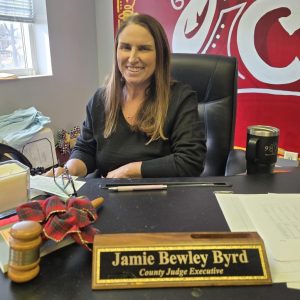
Barren County Judge/Executive Jamie Byrd spoke on the lottery system and said, “You could have multiple people apply within your county and not even be selected.”
Byrd also said, “If you do opt out, that might deter people in your area from applying because the license is non-refundable $5,000, so even if you don’t get selected, you lose $5,000 guaranteed.”
Myatt said those who are interested in growing marijuana will not fall under Kentucky’s Right to Farm law. It must be grown indoors only with strict regulations. He also wanted to ensure the court their vote would not effect medical marijuana patients. Those with legal cards will still be able to obtain it wherever it is sold in the state.
He told the court if the issue is put on a ballot, the county cannot even consider bringing it back up again for three years.
Durham said, “People have the choice.”
Myatt said people may have had the choice but the information changes daily. Just in one week, Myatt said the allowed amount was 3.75 grams, but now it is 37.5 grams, a litter over an ounce. He also shared if the county opts out and later opts in, an individual in another county can relocate to operate in Barren County.
“There are no regulatory fees like there are with ABC (Alcohol Beverage Control), you receive no taxes from this. You receive all the other requirements from law enforcement, but you receive no fees for this,” Myatt said. “You can’t even institute fees.”
He also pointed out if it’s put on a ballot for November, the application process will have already ended. This means the opportunity for businesses to apply locally may not happen given the uncertainty of a vote outcome.
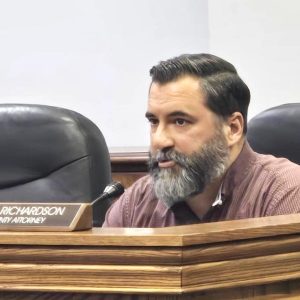
County Attorney Mike Richardson said while his role is not to sway the court with policies, he shared some of the ramifications other states have faced after such a passage and enforcement concerns.
“It’s correct many states have adopted medical marijuana, many of those states have also adopted recreational, and there are numerous studies done of the effects of these different areas that have kind of overlapped in other states,” Richardson said.
He said adopting medical marijuana has, in some areas, increased the black market and as for enforcement, Richardson said, “My concerns there are that without sufficient enforcement, you don’t know what effect it’s going to have in the community.”
“The cabinet in charge of making a lot of these regulations, and they shift with the winds – I don’t trust that,” he added. He also said a positive thing in the regulations is that having a medical marijuana card doesn’t exempt cardholders from being prosecuted if they drive under the influence.
Richardson said a misconception about medical cannabis is that it will decrease opioid use, which several magistrates mentioned in discussion.
“That is not true,” he said, explaining established studies have been done that chronic marijuana use can actually increase opioid dependency and even alcohol abuse. While he said marijuana is not as dangerous as drugs such as heroin and fentanyl, the federal government is debating transferring marijuana from a Schedule I drug to a Schedule III. Richardson also said the jury is still out on all the possible side effects of marijuana, including studies that link marijuana usage to the onset of psychosis and other mental health disorders.
Myatt, the planning director, also pointed out the lack of land use restrictions since there is no zoning in the county.
Most magistrates spoke in agreement about how if medical cannabis could help others including family members, they’d go to great lengths to legally obtain it. However, the opting in or out that local governments are facing isn’t about the benefits of medical cannabis, but business operations.
Botts urged constituents, “Help us magistrates make a decision.”
To contact your magistrate, the following information is provided from the Barren County website at barrencounty.ky.gov. To find out which district you live in, call the Barren County Judge/Executive’s office at 270-651-3338.
District 1 – Jeff Botts
(270) 834-0442
jbotts@barrencountyky.gov
District 2 – Derek Pedigo
dpedigo@barrencountyky.gov
(270) 453-3255
tcoomer@barrencountyky.gov
District 5 – Marty Kinslow
mkinslow@barrencountyky.gov
District 6 – Ronnie Stinson
rstinson@barrencountyky.gov
District 7 – Brad Groce
bgroce@barrencountyky.gov
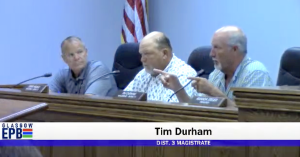
Magistrates Jeff Botts, left, and Derek Pedigo, center, listen as Magistrate Tim Durham states his opinion on whether or not to allow medical cannabis businesses in Barren County, adding that he prefers the citizens to weigh in. Photo | Screengrab | GEPB, YouTube