Mules: A Family Tradition
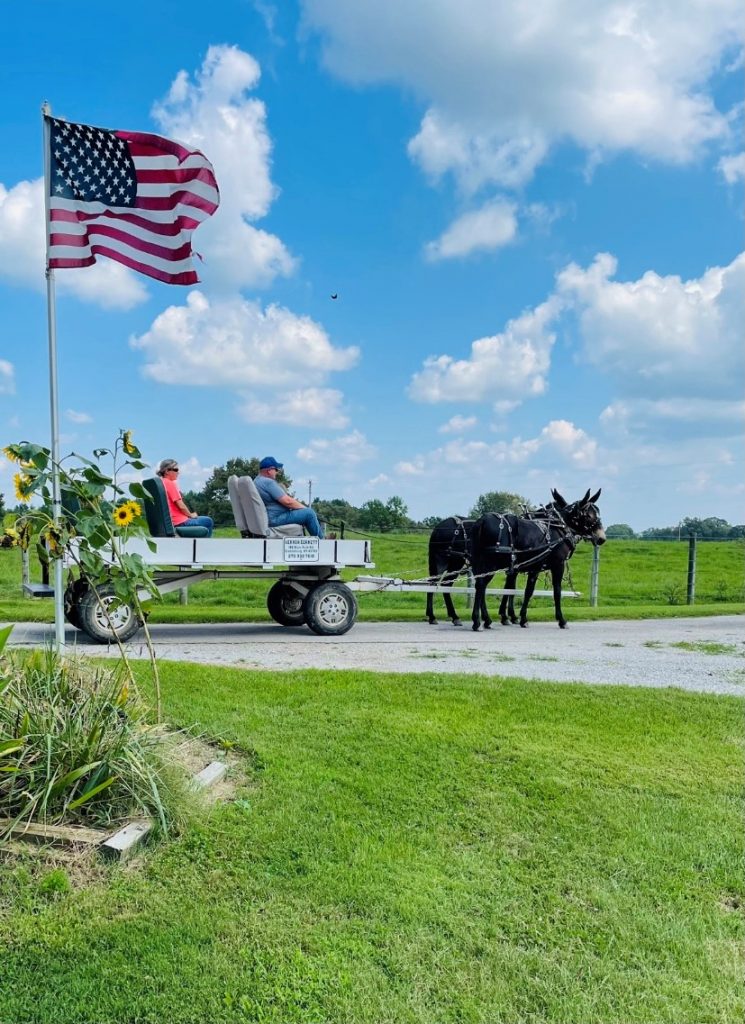
Jennifer and Josh Dobson of the Monroe Community, along with their son Grady, enjoy working with their mules. Photo submitted.
Mary Beth Sallee
Reporter, Hart County News-Herald
For Jennifer (Baker) Dobson of the Monroe community in Hart County, caring for and utilizing mules is a family tradition that has span decades.
“The first animal I ever remember sitting on was a mule,” Jennifer said. “Dad always had a team he was working around the farm. I remember being about the same age Grady (my son) is right now, he is nine, and walking behind those big mules and hooking them up to a sled for him (dad). Momma would fuss and say, ‘You’re gonna get hurt!’ But I was right there with them anyways.”
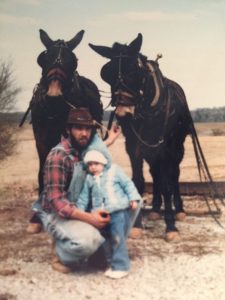
The first animal Jennifer Dobson remembers ever sitting on was a mule. Jennifer is pictured here as a child with her dad, Hessel Baker, and his mules. Photo submitted.
Jennifer’s dad, Hessel Baker, used to pull mules in competitions all over Kentucky and Tennessee. A mule pull is when concrete blocks are loaded onto a sled, and as soon as the team of two mules is hooked to the sled and called upon to pull, they have three tries to pull the weight a certain distance, which is either 15 or 20 feet, depending on lightweight or heavyweight class.
“If the team makes a full pull, then they advance on to the next round where more weight is added,” Jennifer said. “The team that can pull the most weight the farthest is the winner.”
As for Jennifer’s husband, Josh, he wasn’t as familiar with mules. Instead, he grew up around horses his whole life, trail riding with his father ever since he could remember.
“I was never around mules, always thought they were just work animals and dumb, but after buying our first team, I was hooked,” Josh said. “I won’t drive a horse. I’ve had a team of horses, and they weren’t like my mules. I just didn’t have that connection with them like I do with the mules. I’ll have mules until I die. I understand them, and I love working them.”
A mule is the oldest known man-made hybrid. Mules are the offspring of a male donkey (jack) and a female horse (mare). According to Jennifer, a mule has 63 chromosomes, thus making them infertile or not able to reproduce.
Josh and Jennifer purchased their first team of mules in the fall of 2009.
“We had shown walking and racking horses ever since we were in 4-H together growing up and had just returned from Alabama winning a World Championship title there,” Jennifer recalled. “Josh went on a trail ride with a friend and rode in a wagon pulled by a team of mules. He came in that evening and said, ‘We’ve got to get us a team. That was a blast!’ So, we sold our show horses and bought our first mules, Kate and Mag. They were very well broke (meaning you could hook them up to a wagon and go riding) but full of energy. We later learned that their previous owner had raced them in chuckwagon races, so that explained their eagerness to go. Josh built our first wagon, which we call a crash cart because of the short wheel base and ease of maneuvering in the woods. If you can drive a four wheeler through there, we can drive our mules, too.”
The Dobsons like to buy the mules when they are weanlings and train them.
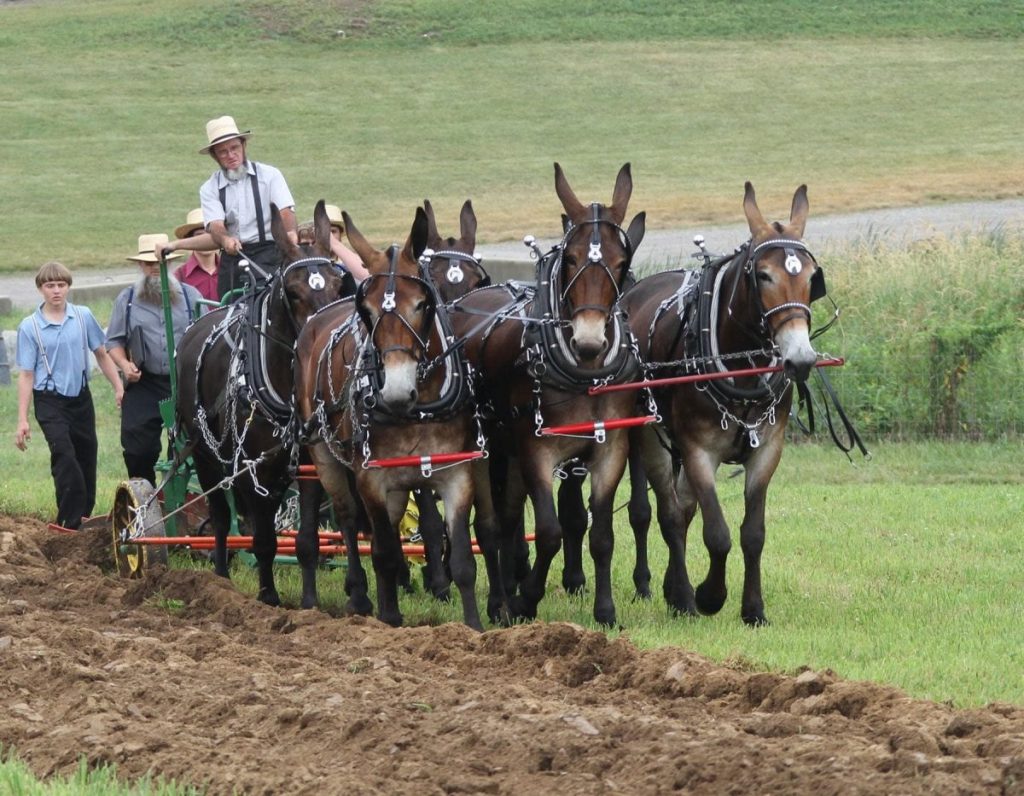
This is a six-mule hitch at the Horse Progress Days 2021 in Mt. Hope, Ohio. Three of the six mules had been trained by Josh and Jennifer Dobson. Photo submitted.
“I have found that if you buy an older mule then sometimes you are just getting someone else’s problem with that mule,” Josh said. “When they are young and learning, you want to give them a good start with a good foundation or else they will just be trouble. (It’s) kind of like a kid. Make them mind and behave. Then reward them when they’re good.”
The most difficult part of training mules, Josh stated, is the amount of physical and mental work required.
“We start them at six-months-old by getting them broke to lead and being harnessed,” Josh said. “Then we start line driving them in the barn, meaning putting them side by side and walking behind them with the lines to get them used to going, stopping, and turning. ‘Gee’ means turn right, and ‘Haw’ means turn left. It takes a lot of time and patience to get them to drive. Some days are good and everything works great, and then some days you have wrecks. We’ve had them lay down, fall over on one another, run off, jump gates, break the harness, and once Hessel and I even turned a wagon over. You just pick up the pieces, put them back together, and do it again. It’s like an addiction. Fooling with them gets in your blood. It gets in your mind.”
“Some mules can be rough, meaning they will kick, bite, and are mean,” Josh added. “You have to turn their attitude around by getting them to trust you and accepting the harness and work. Mentally you have to make sure you’re doing everything to help that mule perform to its best. You figure out what bit one mule likes (that) the other mule may not. She may work better in the lead than the off. She may walk a little faster than the other mule, so you need to either slow her up or figure out how to speed the other one.”
Both Josh and Jennifer also prefer training and driving draft mules, which means their mothers are draft horses, such as Belgians or Percherons, and their sires are Mammoth Jacks.
“The taller the jack and mare, the taller the mule will be,” Jennifer said. “Draft mules are typically more muscular and larger than mules out of riding-type horses, such as Tennessee Walkers or Quarter horses. They also tend to have a calmer, easier to get along with attitude and are able to withstand a heavier workload.”
“Draft mules are the ‘tractors’ for field work by the Amish in Pennsylvania and Ohio,” Jennifer continued. “Riding mules are becoming popular on the trails these days, mainly because of their sure footedness and stamina. I have had two really nice saddle mules, and they were both a lot of fun. You could go anywhere on them. They were like mountain goats. Due to increased interest in riding mules, prices were very high and I sold them both for a pretty penny. You could buy a really nice used vehicle for what I got out of each mule…Three of the six mules in a six mule hitch at the Horse Progress Days 2021 in Mt. Hope, Ohio had been trained by us. That made us very proud seeing them work like that and knowing we had trained them and given them their start.”
However, raising, training, and working with mules is not for everyone. As Josh explained, “Mules are like chainsaws.They’re not made for everyone to operate.”
“I think it takes a special kind of person to fool with mules,” Jennifer said. “You either love them or hate them.”
“A lot of people think that mules are dumb and stubborn, hence the saying stubborn as a mule, but that’s not the case,” Josh added. “Mules are very intelligent. What you teach that mule today, you won’t have to teach him again. He soaks it in and remembers.”
Josh stated that what additionally makes a mule unique is that it will not hurt itself. A mule is smart enough to not put itself in a situation where it could be hurt. However, a person should always be the leader for the mules.
“A horse gets scared and runs blind. A mule gets scared, and he will look around and most usually stop and try to figure out the problem,” Josh explained. “Mules are thinkers. To drive mules you must think ahead of them, not behind them. If you’re not thinking ahead of them, then they will take advantage of you. You must always be the leader.”
Josh and Grady Dobson with mules Kate and Mandy. Photo submitted.
Not only do Josh and Jennifer drive their mules to the wagon, but they also have a sled and a forecart.
“We can haul in wood or drag a log up with them,” Jennifer said. “We also pull big tractor tires with them to build up their muscles and give them a good workout…(Our mules) Kate and Mandy are young. They are 17- and 18-months-old right now. We don’t push them too hard right now with lots of miles and work. They’re still growing, so we take our time with them. You see progress in each team and think, ‘Wow. They came here young and didn’t know a thing, and now look at what we’re doing with them.’”
Most everywhere the Dobsons go, they are the youngest family driving mules. Although working mules is not very popular anymore, trail riding with their mules has allowed the Dobsons to become good friends with other mule enthusiasts.
“We ride a lot around home and have been to Wranglers Campground at Land Between the Lakes,” Josh said. “We meet lots of wonderful people from all over the United States. Mule people are like one big family. They’re always willing to help you out if need be. We’ve been blessed to have great friends like Vernon Cornett, who is a respected mule man from Green County, and the late Roger Gibson from Munfordville, who was well known for his show mules, that took the time to teach us things also. Hessel has helped us a lot, too, sharing his experiences and also being an extra hand when needed.”
But beyond the training and trail rides, the best part of raising mules for Josh and Jennifer Dobson is certainly the family time and passing along the tradition to their son, Grady.
“It’s something we can do together and enjoy and make lots of memories,” Jennifer said. “Teaching Grady responsibility and being able to pass along some of the things my dad taught me is very special. Some of my best childhood memories involve mules. I loved going to those mule pulls and watching them pull so hard. Hopefully one day Grady can pass the same knowledge on to his own children.”
“I like their long ears the best,” Grady said of the mules. “My mule is Kate. Daddy’s mule is Mandy. I help feed them and brush them off. Daddy has taught me all the parts of the harness and how to hook them up. I drive them to the wagon and the sled. They’re fun. I like going in the woods in the wagon and going up the hills.”
Next year, the Dobsons plan to raise a garden with their mules, as well as go on many more rides and maybe even a wagon train. Although Josh and Jennifer have not yet bred and raised any mules of their own, they hope to one day purchase draft mares and raise mule colts when they retire.
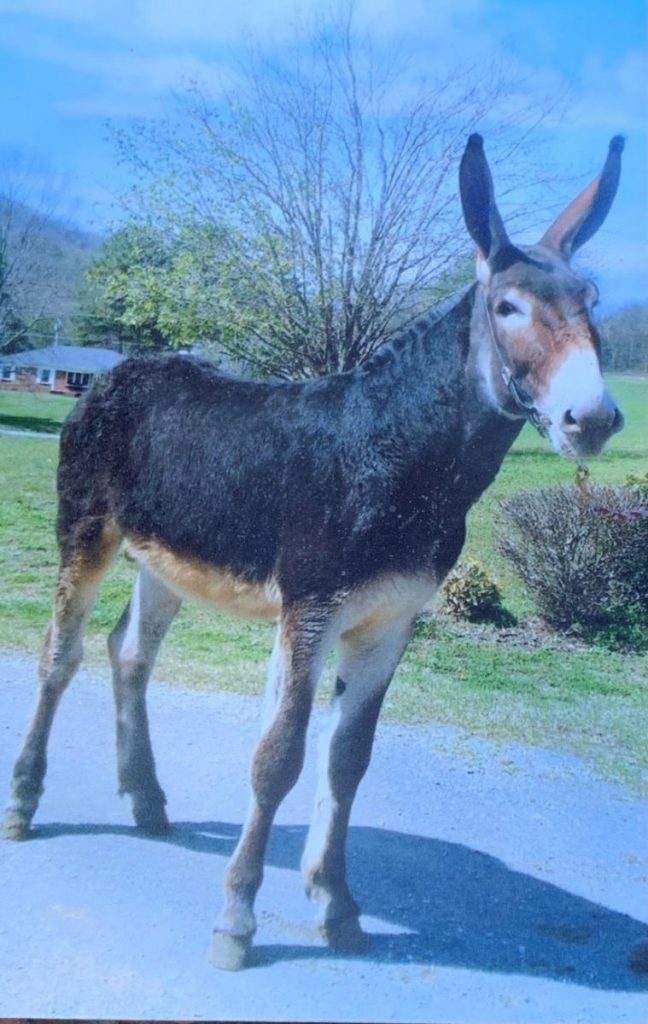
Jack the mule. Photo submitted.
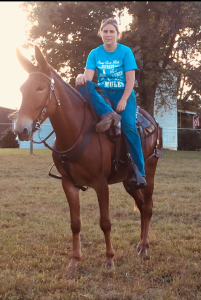
For Jennifer Dobson, raising mules has become a family tradition. Photo submitted.
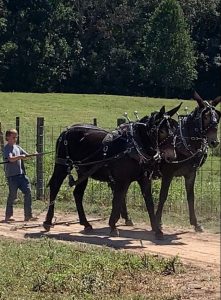
At only 9-years-old, Grady Dobson works with his family’s mules. Photo submitted.
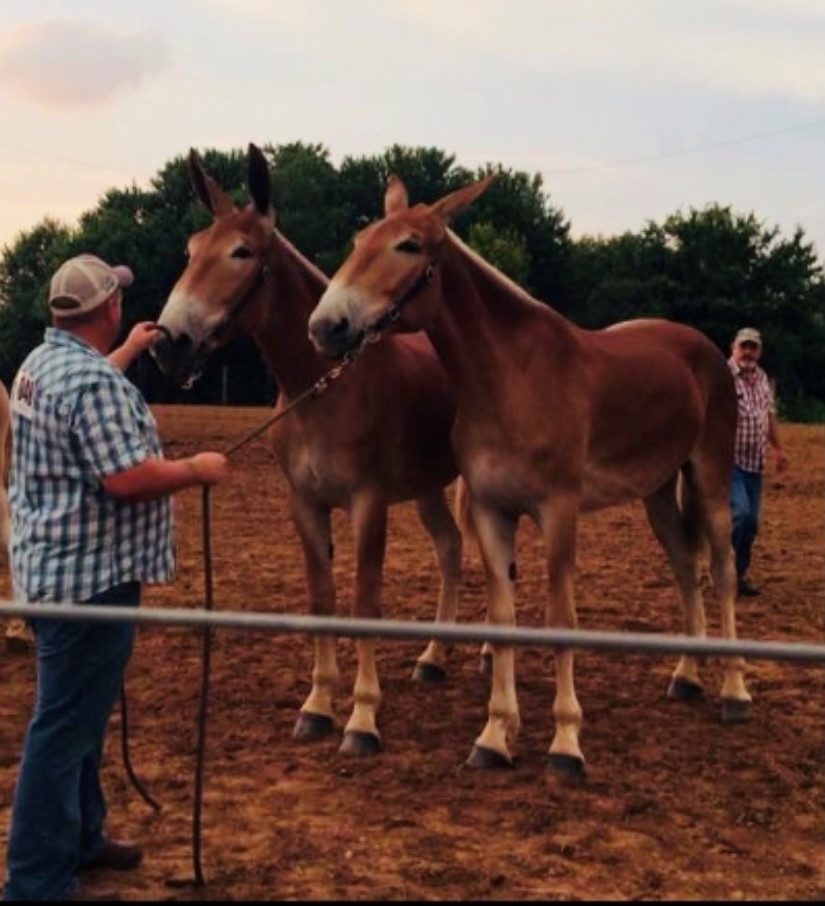
Mule show. Photo submitted.