The Fight Above And The Stakes Below
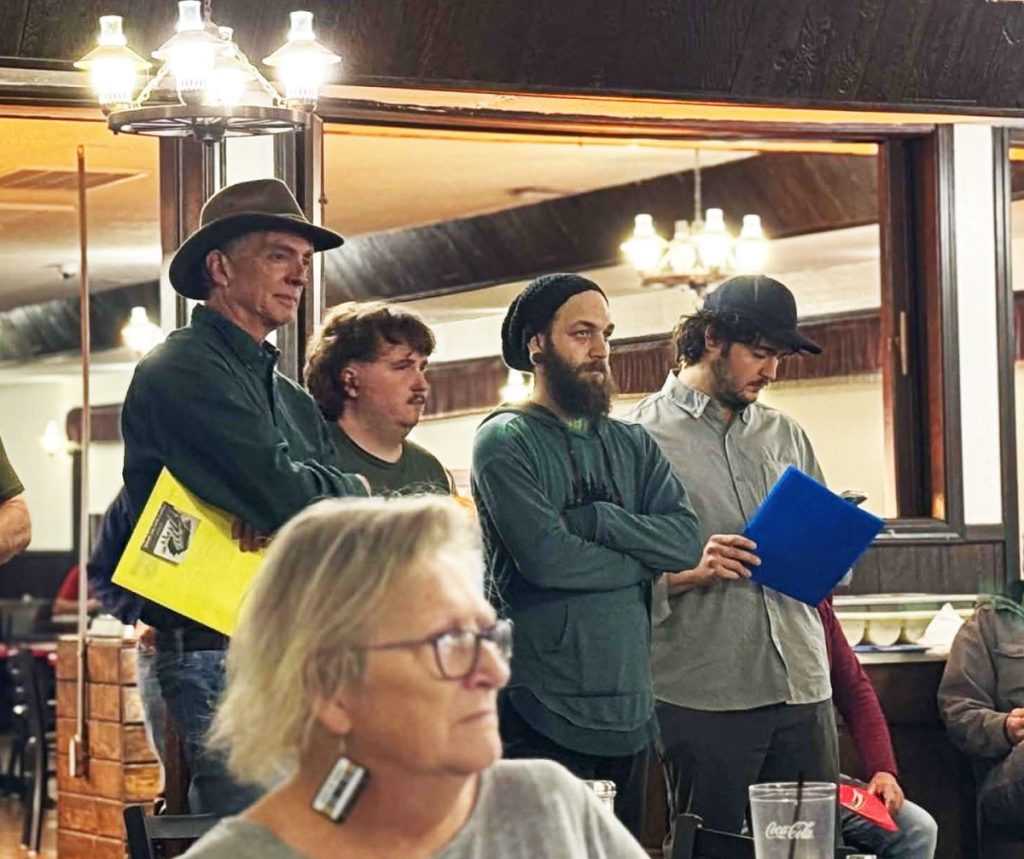
David Foster, left, and fellow Hidden River Cave representatives attended the November 10 meeting of the Sinkhole Data Center Coalition. Photo by Mary Beth Sallee.
A grassroots coalition and local citizens raise concerns over a proposed data center near Mammoth Cave.
Mary Beth Sallee
Managing Editor
Hart Co. News-Herald
A proposed multibillion-dollar data center just miles from Mammoth Cave National Park is raising concerns about the potential impact of large-scale development on the region’s underground cave systems, groundwater, and endangered wildlife.
Those concerns brought residents and environmental advocates together Tuesday, November 10, at the Watermill Restaurant in Cave City for the second meeting of the newly formed Sinkhole Data Center Coalition.
The grassroots organization is questioning the environmental and economic consequences of the proposed data center, particularly its proximity to Mammoth Cave National Park, surrounding farmland, and residential communities. Earlier plans outlined a project spanning approximately 600 acres in Cave City and unincorporated Barren County, on a site the coalition estimates contains at least 37 sinkholes.
Although the project would be located in Barren County, speakers at the meeting emphasized that the region’s interconnected underground water systems make the potential environmental implications a concern for neighboring communities, including those in Hart County.
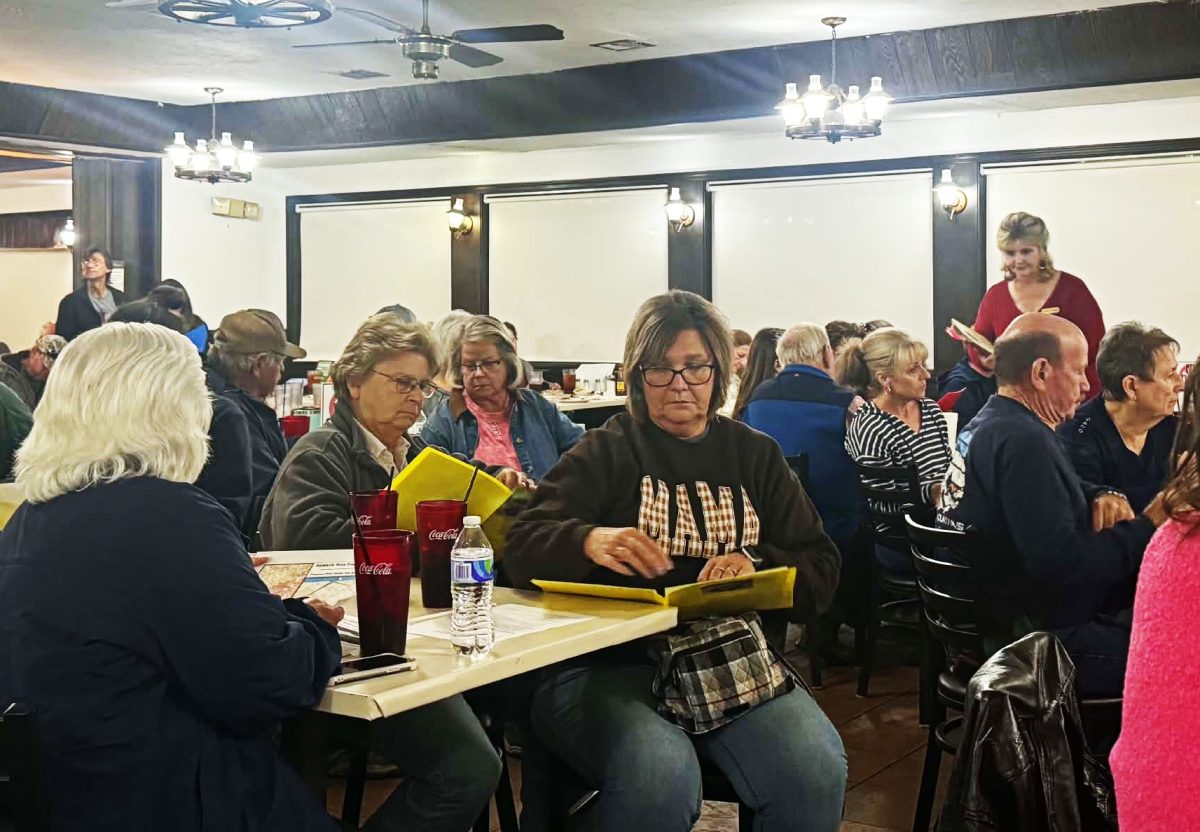
3. A large crowd gathered at the Watermill Restaurant in Cave City on November 10 to hear concerns about the proposed data center and its potential impact on Mammoth Cave National Park and surrounding areas. Photo by Mary Beth Sallee.
Lee Anne Bledsoe, a karst hydrologist with Western Kentucky University’s Crawford Hydrology Laboratory, was the first guest speaker at the meeting. Having studied the Mammoth Cave region’s groundwater systems for nearly two decades, Bledsoe discussed the relationship between the area’s natural resources, its communities, and its economy.
“Today, I was actually kayaking on the Green River, which is one of the most biologically diverse rivers in North America. We’re working on a project to better understand the Kentucky cave shrimp, the habitat, and conditions that are required for it, and I’m so lucky that that is my day job,” Bledsoe said. “But I am here tonight because I am a resident of the region.”
Bledsoe, who grew up in the community of Pig and still lives on her family’s farm, also serves as volunteer chair of the Mammoth Cave Biosphere Region Advisory Council.
The Mammoth Cave Biosphere Region received its international designation through UNESCO in the 1990s, recognizing both the area’s biological diversity and the commitment of surrounding communities to protecting their natural resources.
“We also acquired that designation because local community leaders at the time committed, and still do today, to coming together, working together to better manage and protect our groundwater resources to sustain the livelihoods of all of our residents,” Bledsoe explained. “And when I say residents, I’m talking about from cave shrimp to all of you sitting in this room. It’s what supports all of us.”
To demonstrate the importance of the region’s underground water systems, Bledsoe presented a short documentary highlighting the Mammoth Cave Biosphere Region and the efforts of local communities to protect groundwater resources.
The film explained how the region’s karst landscape develops as water gradually dissolves limestone, creating sinkholes, caves, and underground drainage channels that allow rainfall to enter the ground and flow through interconnected waterways.
“What this means is as precipitation falls upon that karst landscape, it can quickly enter the subsurface,” Bledsoe explained. “It is one of the reasons our water resources are vulnerable in karst areas to the activities that we do on the surface.”
The documentary also highlighted the environmental recovery of Hidden River Cave in Horse Cave, where decades of pollution once left the underground water system severely contaminated.
David Foster, the President and CEO of the American Cave Conservation Association in Horse Cave, described how the development of a regional sewage treatment system in 1989 helped end the discharge of waste into the cave’s groundwater system, allowing its ecosystem to recover.
“The odor went away first, and then we started to see the cave life come back,” Foster said in the film. “And to our amazement, we had gone from being one of the most polluted caves in America, and perhaps in the world, to one of the most biologically diverse caves.”
The recovery of Hidden River Cave also helped create opportunities for tourism and environmental education, demonstrating the economic benefits that can accompany successful conservation efforts.
For Bledsoe, those efforts illustrate why the protection of Mammoth Cave’s natural resources cannot be considered separately from the surrounding communities.
“While the national park is the heart, it is the core of our biosphere region, the boundaries of our biosphere region don’t stop there,” she said. “It includes all of us, it includes our gateway communities, right? And we are connected through all of this. Whether it is tourism and all the related services that bring billions of dollars to our local economy, whether it’s agriculture, whether it’s industry, water connects all of us.”
Bledsoe encouraged residents to recognize their responsibility in determining how the region’s natural resources are managed, emphasizing that those decisions affect both the environment and the livelihoods of the people who depend on it.
“It’s our responsibility to make the choices on how we best manage our natural resources,” she said.
Rick Olson, a retired Mammoth Cave National Park ecologist who spent 28 years working at the park, continued the discussion by explaining how the region’s sinkholes, underground drainage systems, and the Green River connect communities across county lines.
Olson, who first began exploring Mammoth Cave in 1973, told attendees that understanding those connections is essential when considering development on the sinkhole plain.
“We live in a karst landscape,” Olson said. “And, you know, from Brownsville to Park City to Cave City to Horse Cave to Munfordville, we’re all kind of in this together. It all drains to the same river.”
Olson explained that rainfall entering the region’s sinkholes carries organic material into underground streams, where it supports bacteria and other small organisms that form the foundation of the cave food chain. Those organisms, in turn, provide food for larger aquatic species, including cave crayfish, blind fish, and the endangered Kentucky cave shrimp.
“And out here on the sinkhole plain, this is the feedwaters for our cave systems,” Olson said.
The concern, he explained, is what happens when natural surfaces are replaced, changing how water enters the underground system.
“Whenever we harden a surface, whether it’s a highway, or homes, or roads, or big factories, something like that, we convert something that was actually feeding, we hope, clean water and nutrients into the cave systems into something that provides runoff,” Olson said.
Olson expressed particular concern about the proposed development’s apparent location near the boundary of two underground drainage basins, where water could flow toward different cave systems.
“Headwaters of drainage basins are the most sensitive place,” Olson said. “Unfortunately, where we’re talking about building this is apparently right on the boundary line between two drainage basins. Most of it is probably going to go to the Hidden River Basin. They’re going to get most of it, and then some of it is probably going to go to the Turnhole Basin and into the national park.”
If those drainage patterns are confirmed, changes in runoff or water quality associated with the development could have implications for groundwater systems connected to both Hidden River Cave in Horse Cave and Mammoth Cave National Park. Determining the precise drainage patterns and potential impacts would require site-specific scientific evaluation.
Olson also discussed the Green River, which receives water from the region’s underground cave systems and plays an important role in sustaining aquatic life beneath the surface. Although underground springs normally discharge water into the river, heavy rainfall upstream can raise river levels enough to force water back into the caves.
“That turns out to be a really, really important natural process,” Olson said.
He explained that the returning water carries small fish larvae and other organisms into the cave environment, providing food for species that have adapted to living entirely underground.
“The animals that are adapted, fully adapted to the cave, they cannot survive on the surface,” Olson said. “So now, if that water is contaminated when it back floods in, that’s very bad news.”
Olson pointed to historical pollution associated with oil production upstream of Mammoth Cave as an example of the consequences contamination can have on underground ecosystems. Saltwater brine discharged into the Green River decades ago, he said, may have contributed to a decline in the Kentucky cave shrimp, a federally endangered species found only in the Mammoth Cave region.
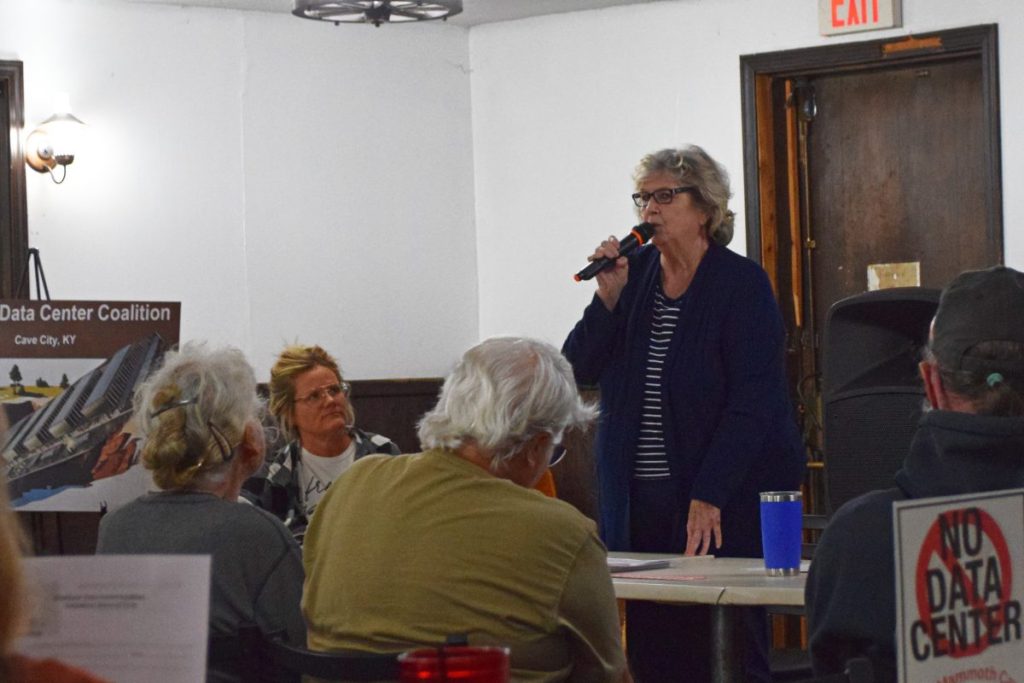
Coalition member Angie Herald, seated left, listened as coalition organizer Judy Jessie Crabtree addressed residents about the proposed data center near Mammoth Cave National Park. Photo by Mary Beth Sallee.
The Kentucky cave shrimp has also become a central concern for coalition organizer Judy Jessie Crabtree, who told attendees that protecting the species was among the reasons she became involved in opposing the proposed development.
Crabtree, who lived in Cave City for approximately two decades and raised her children there, said her concerns about the proposed development grew from research she had previously conducted on Barren County’s history.
“I didn’t even know what a data center was six months ago. I’m telling you, you learn a lot,” Crabtree said. “But the way I got involved is when I started hearing about it, I thought, ‘Well, they can’t put in a data center near Mammoth Cave.’ Because I had written a book three years ago about the 225-year history of Barren County, and I did two years of research on that. So, I knew that Mammoth Cave National Park had a little shrimp that the only place in the world it lives is in Mammoth Cave National Park.”
Referring to an image of the shrimp displayed during the meeting, Crabtree described the species as an important part of the coalition’s efforts.
“That’s going to be our David and Goliath story, I think,” she said. “We don’t want it to become extinct.”
According to National Park Service information distributed at the meeting, the Kentucky cave shrimp is a federally endangered freshwater crustacean that spends its entire life in the darkness of underground cave passages. The species’ habitat includes 10 groundwater basins, eight of which lie wholly or partially within Mammoth Cave National Park, while two are located immediately upstream. The Roaring River within Mammoth Cave is designated critical habitat for the species.
Because the shrimp depend on microorganisms and biological material carried into the cave environment by groundwater, changes in water quality can pose a serious threat to their survival.
The Kentucky cave shrimp was also recognized as the 2025 USA Cave Animal of the Year, a distinction Crabtree believes could help bring national attention to the coalition’s concerns.
Beyond the environmental concerns, residents also questioned how a development of the proposed size could affect local roads, traffic, and tourism.
Mike Frazee, a Barren County resident who said he spent approximately four years delivering materials through data center construction sites, shared his concerns about the amount of truck traffic that could accompany the proposed development and its potential impact on surrounding communities.
“These trucks run in 200 a day, 24 hours a day, seven days a week. Holidays, they still run. They’ll run all day long,” Frazee said, describing traffic volumes he had encountered during his work.
Frazee explained that delays in unloading deliveries can quickly create congestion, with tractor-trailers forced to wait along roadways or seek parking elsewhere. He warned that the same situation could affect businesses and residential areas around Cave City and Park City.
Frazee also questioned whether existing roads and local law enforcement could accommodate the additional traffic, while raising concerns about the availability of hotel rooms for tourists if construction workers occupy area accommodations.
“You’re going to cut your tourism out,” Frazee said, referring to the potential demand for hotel rooms during construction.
He urged residents to consider the combined effects of construction deliveries, workers traveling to and from the site, and tractor-trailers using local roads.
“Our infrastructure can’t take this,” Frazee said.
The meeting also provided an opportunity for coalition members to explain the organization’s position and encourage greater public involvement.
Crabtree said the coalition was formed approximately two weeks earlier after she became frustrated with what she considered a lack of opportunity for residents to express their concerns during a public meeting about zoning. She subsequently contacted friends and other concerned citizens, including Angie Herald and Sherry Williams, who helped organize the grassroots effort.
Crabtree emphasized that the coalition is not opposed to data centers in general, but believes the proposed location is inappropriate because of its proximity to homes, farmland, and Mammoth Cave National Park.
“We’re not against a data center. We all use them. I want to make that perfectly clear,” Crabtree said. “We just don’t want them near our homes. We don’t want them in the farmland. We certainly don’t want it by a national park.”
The coalition’s stated mission is to protect Cave City and Mammoth Cave National Park from potential adverse effects of data center development on cave systems, groundwater, wildlife habitats, and the tourism economy.
Crabtree also recognized Cave City Mayor-elect Clifton Parsley and newly elected Barren County District 6 Magistrate Steven Gibson, telling attendees that both had expressed opposition to the proposed data center development.
At the end of the meeting, coalition member Sherry Williams spoke about the importance of balancing economic growth with the preservation of natural resources, drawing from her own family’s history in Barren County.
Williams lives near Barren River Lake, where she said recent flooding and drought conditions have reinforced her appreciation for the environment and the need to protect it.
“You might wonder at 70 years old why I wanted to become an activist against the proposed AI data center,” Williams said. “I’ve seen firsthand just how fragile our natural environment can be.”
Her concerns, however, do not stem from opposition to industry. For Williams, the question is not whether economic development is beneficial, but whether its potential costs have been fully considered.
“So why am I speaking up at the age of 70? Because I’ve lived long enough to appreciate what industry contributes, but also to understand that some things, once damaged, cannot be repaired,” Williams said. “I’m not against progress. I’m against calling something progress when we haven’t fully considered what we might lose, and that’s why we’re all here tonight.”
Williams encouraged attendees to become involved in the coalition through various means, emphasizing that participation does not require extensive experience or a major time commitment.
“I don’t expect everyone in here to become an activist. Believe me, I never expected to be one either, but I do believe that everyone has something to contribute,” she said. “Some of you may have professional knowledge or experience that can help us. Others may be good at research, writing letters, organizing events, or simply spreading the word. We’re a young coalition, and we’re building this organization as we go. We don’t need everyone to do everything. We just need people willing to do something…The strength of this coalition won’t be measured by how many people attend our meetings, but by how many are willing to help us make a difference.”
Crabtree said the response to the newly formed organization has already exceeded expectations, with its Facebook page receiving approximately a quarter-million views in its first two weeks.
The Sinkhole Data Center Coalition’s next meeting is scheduled for Tuesday, December 1 at 5:30 p.m. at the Watermill Restaurant in Cave City. All are invited to attend.